

The Supreme Court on Monday dismissed a plea challenging the appointment of Padmesh Mishra, son of sitting Supreme Court Justice Prashant Kumar Mishra, as an Additional Advocate General (AAG) for Rajasthan.
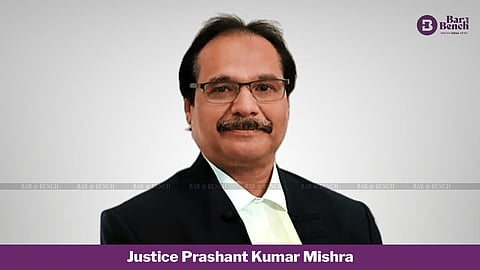
A Bench of Justices Aravind Kumar and Vipul M Pancholi dismissed the petition, which had challenged a Rajasthan High Court order upholding Mishra's appointment.
According to the plea, Mishra was enrolled as an advocate in August 2019. He was appointed as a panel lawyer at the Supreme Court on August 20, 2024, a post that required a minimum of five years’ practice.
Three days later, on August 23, 2024, the Rajasthan government amended its litigation policy of 2018 to insert a new clause allowing “the authority of the appropriate level” to appoint “any counsel to any post,” after considering the counsel’s expertise, regardless of the policy’s other eligibility conditions.
On that very same day, the government withdrew Mishra’s appointment as panel lawyer, and instead appointed him as AAG before the Supreme Court, a post that otherwise required ten years of practice under the same policy.
The petitioner contended that these events, all occurring within a single day, showed that the amendment had been introduced specifically to benefit Mishra.
The plea pointed out that 20 other AAGs appointed by the Rajasthan government held an average of over 25 years of practice, with the least experienced among them having 13 years, making Mishra’s appointment, at roughly a fifth of that experience, a marked departure from the norm.
The petition also argued that the appointment had been made without effective consultation with the Advocate General as required under the litigation policy, and without any objective criteria to assess Mishra’s claimed “expertise” under the newly inserted clause.
The Rajasthan High Court had earlier dismissed a writ petition challenging the appointment, holding that the litigation policy was not legally enforceable, and that consultation with the Advocate General was not a mandatory precondition.
A Division Bench of the High Court upheld this view in December 2025, additionally holding that the post of Additional Advocate General was not a “public office” and was therefore not amenable to judicial review. The High Court also observed that “the art of presentation of a case and art of advocacy is not bound by years of experience.”
The petitioner challenged this reasoning before the Supreme Court, arguing that the litigation policy was intended to be binding, since it had itself been framed pursuant to an earlier Supreme Court direction.
The petition also argued that the post of Additional Advocate General should be treated as a public office, given that its occupant is remunerated by the government and appointed under the Governor’s authority. It also pointed to the Supreme Court’s own precedent holding that such appointments carry a “public element” that cannot be reduced to a private professional engagement.
However, the top court today concurred with the Rajasthan High Court’s view that the office of an AAG is not a “public office” and dismissed the petition.