Supreme Court refuses to entertain PIL claiming minority educational institutions are brainwashing children

The plea said there should be no rights available under Article 30 to institutions imparting religious education and such institutions should be declared as falling under Article 26.
Supreme Court
Supreme Court
Published on
2 min read
Listen to this article

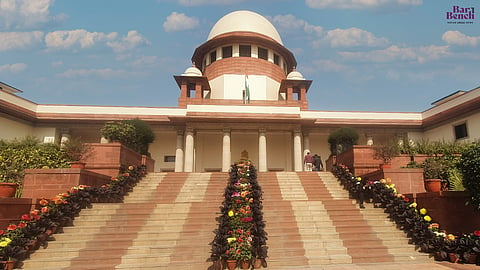
The Supreme Court on Monday refused to entertain a public interest litigation (PIL) petition seeking steps to register, recognise, supervise and monitor all institutions, imparting secular education and/or religious instructions to children up to the age of 14 years.
The petition filed by BJP leader and advocate Ashwini Kumar Upadhyay also alleged that semi-religious minority educational institutions, operating the under the garb of Article 30 (right of minorities to  establish and administer educational institutions), are radicalising gullible children.

"Presently, semi-religious minority educational institutions are being covered under Article 30, which is a wrong interpretation. Thousands of non-registered institutions are radicalising gullible young children under the garb of imparting religious instruction as they are not monitored by the State. It has serious implications not only for internal security but also fraternity, unity and national integration, as one can easily brainwash young children in the name of religion," the petition said.

A Bench of Justices Aravind Kumar and Vipul Pancholi declined to entertain the plea prompting Upadhyay to withdraw the petition.

"Imparting religious institution is indirectly promotion of religion," Upadhyay said.

"You cannot file successive writ petitions," the Bench replied.

Upadhyay then proceeded to withdraw the petition.

"Petitioner seeks to withdraw his petition and pursue his remedy in appropriate forum," the Court noted.

Upadhyay's plea sought a declaration that Article 30, which confers rights on minorities to establish and administer educational institutions, is specific reiteration of Article 19(1)(g) [freedom to carry on trade and profession] and doesn't confer any additional right, benefit and privilege than the right guaranteed to citizens under Article 19(1)(g).

The plea by Upadhyay said that the words 'educational institutions of their choice' in Article 30(a) mean 'secular/professional educational institutions of their choice' and not 'religious educational institutions of their choice'.

Hence, there should be no rights available under Article 30 to institutions imparting religious education, he said.

Institutions imparting religious education should be declared as falling under Article 26 (freedom to manage religious affairs) and not Article 30, the plea said.

"Imparting religious instruction amounts to 'promote' religion and shall be covered under Article 25. Any institution which imparts religious instruction falls squarely under the 'Institutions for Religious & Charitable Purposes' under Article 26. The magnitude of religious instruction being imparted or secular education is also imparted, would be no ground to exclude such institution from Article 26. All institutions imparting religious instruction are covered under Article 26. It's immaterial whether it imparts non-religious secular education alongside religious instructions," the petition said.

[Read Live Coverage]

Bar and Bench - Indian Legal news
www.barandbench.com