
Subscribe
Subscribe
- Latest Legal News
- News
- Law Firms
- Columns
- Interviews
- Law School
- Legal Jobs
- हिंदी
- ಕನ್ನಡ
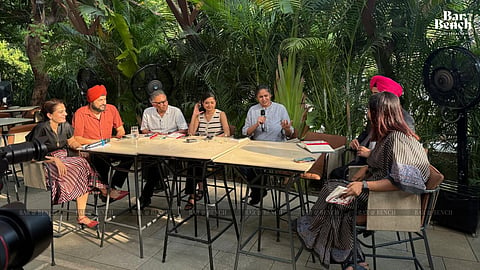
On a recent Friday evening, a stage full of busy practising lawyers in Delhi traded the courtroom for a book club, discussing The Figure in the Fog: Malti Jakhar Case Files by Manini Brar, a practicing lawyer.
The event turned into a candid conversation about why a full-time commercial lawyer spent 5 years writing a murder mystery on the side and what she actually wanted the book to say.

The panel was almost entirely drawn from the bar: Sherbir Panag, founder of white-collar crime and corporate law firm Panag, Babu & Sarangi; Mishika Singh, founder of charitable trust Neev which provides pro bono legal aid; Sumant Batra, an insolvency lawyer and author across several genres; Pragya Parijat, a Supreme Court advocate-on-record; Satyajit Sarna, a Delhi High Court advocate and published author in his own right; and Mumtaz Bhalla, Equity Partner at ELP, who anchored the audience Q&A. Also on the panel was Mansi Shetty, who is the head of marketing at the publishing house Juggernaut Books.
For the uninitiated, The Figure in the Fog follows Malti Jakhar, a struggling lawyer with 10 years of practice who runs a small, financially shaky practice. She practices before district courts in Delhi assisted by her clerk Chandan Pal and a sole junior Charu. The tale begins when Malti is approached by a young tribal man named Gola Pithaan who hails from a fictional tribal village whose inhabitants believe that djinns haunt their forest. Gola confesses to killing a man in the forest on a the night of a religious festival, believing he was striking a djinn.
Brar derived the basic premise of the tale from the 1958 case of State Of Orissa v. Ram Bahadur Thapa which asked the question: what happens when a legal system built on mens rea collides with an accused who sincerely believes in a supernatural threat?
But Brar takes it much further by asking pertinent questions regarding the role of socio-political and cultural conditioning in such events.
At the book reading, each of the panelists read out a passage they had personally chosen and found to be particularly interesting.
These included Chandan Pal's courtroom gossip network, Charu's overeager theatrics, the awkward etiquette of a young lawyer interacting with opposing senior counsel and Malti's closing arguments at Gola's trial.
Panag observed that the book is made all the better by not varnishing over Brar's voice, with which he is keenly familiar from reading Brar's column in Bar & Bench - The Obiter Truth.
Sarna even compared the courtroom chapter in the book to Dickens's Bleak House, for its mix of the comic and the serious in a single courtroom.
During the Q&A, Brar revealed that it was a conscious decision to base her story on something that happened over six decades ago.
"I think it's important to put layers between the happening of a story and your real circumstances, so that you can suspend your disbelief and actually listen to the story as a story and perhaps then receive the message that it conveys," Brar said.
[Watch Video]
Speaking of Chandan Pal, who is likely to be most readers' favourite character, Brar said that he is an amalgamation of the idiosyncracies of all the advocate clerks you see in courts across India.
"I see these equations all the time. Sometimes you have the best lawyer, walking out after an incredible hearing and I see the face of the clerk who's not amused! He's not impressed at all! He's already on to the next thing, thinking about somebody who's waiting outside or some bill that hasn't been cleared! The book has very light-hearted humour on various aspects of life of an independent lawyer, a girl struggling and waiting for that one big break," she said.
When Bhalla asked what she considered the book's real core, Brar pointed to its ending and to what she called a "shifting idea of justice". She said that in a way, she built the book towards the fictional judge's closing observations in the book, on how our system of justice doesn't adequately address the normalisation of hate in a society.
"This sort of shifting idea of justice is something that always fascinates me and boggles me. That sometimes you do all the right things, you take all the right positions and you're still stuck in a set of circumstances or in a set of social circumstances that don't add up," Brar said.
Asked when and how she'd actually written the book, Brar revealed that she started on it while pregnant with her elder son, who is now nearly 5. The first draft was ready within a few months but what took 5 years was the process that followed, she said.
Brar's first editor was her own father, who she said reworked the manuscript roughly 40 times over the following 2 years. In that time, she had her second child and returned to independent practice. Finding a publisher took roughly 2 more years until everything fell in place with Juggernaut.
Speaking on why she chose a criminal trial and tribal settings for her book, Brar explained,
"When we all first decided we wanted to lawyers, there would have been a human and social angle to it. You wanted to do something for someone, you wanted to be something and I think through this book, I'm living that fantasy of being a trailblazing human rights lawyer who can set the world right. And then my reality is, of course, the commercial law that I practice!"
Brar also said that she wouldn't have had any material to write about if not for her legal practice and that she will always be a lawyer first and writer after.
"I couldn't be a writer if I wasn't a lawyer. All my material comes from the fact that I'm a lawyer and I don't think I would have anything to write about if it wasn't for the law and for what I see. At my core, I will always be a lawyer!"
You can purchase the The Figure in The Fog on Amazon at here.