
Subscribe
Subscribe
- Latest Legal News
- News
- Law Firms
- Columns
- Interviews
- Law School
- Legal Jobs
- हिंदी
- ಕನ್ನಡ
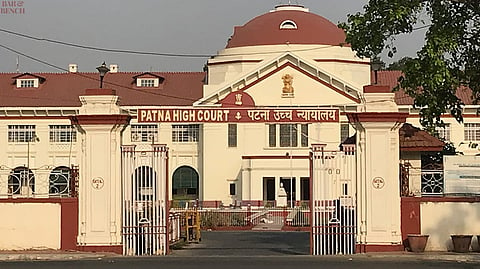
The Patna High Court recently held that entering a woman’s house late at night, extinguishing the oil lamp, lying upon her and smothering her mouth to stifle her cries does not amount to an attempt to commit rape [Md Ainul Haque v. State of Bihar].
Justice Sandeep Kumar held that in the absence of any overt act towards penetration, such acts fall short of Section 376/511 (rape/attempt to rape) of the Indian Penal Code (IPC).
Consequently, the High Court set aside the four-year rigorous imprisonment awarded to the accused, one Md Ainul Haque, under Sections 376/511 IPC, reducing his substantive sentence to the period of about two and a half months already spent in custody.
It, however, convicted him under Section 354 IPC (outraging modesty) and directed him to pay a fine of ₹25,000, ordering the entire amount to be handed over to the victim as compensation.

The order comes in the backdrop of a similar controversial ruling by the Patna High Court earlier this year, where the court held that pressing a woman's breasts or unfastening her salwar string did not constitute an attempt to rape. The ruling drew sharp scrutiny after the Supreme Court took suo motu cognisance of the matter.
The present case dates back to February 2010 in Begusarai district. According to the victim - a widowed laborer living with her children - Haque barged into her thatched house around 10:00 PM, put out the oil lamp (dibiya), lay on top of her and pressed her mouth when she tried to raise an alarm.
Hearing her shouts, neighboring villagers rushed to the scene, caught Haque and assaulted him. After local police refused to lodge her complaint, the victim moved the chief judicial magistrate's court. In July 2013, an additional sessions judge convicted Haque under Sections 376/511 and 448 (house-trespass) IPC.
Challenging the verdict, Haque argued that the prosecution relied solely on the victim's uncorroborated account. He pointed out that no medical test was conducted, the investigating officer was never examined and the woman suffered no physical injuries or torn clothes.
While the High Court accepted that Haque illegally entered the house and used criminal force, it held that the charge of attempted rape was legally unsustainable.
Relying on Supreme Court precedents, Justice Kumar observed that a conviction for attempted rape requires clear proof of a determination to achieve penetration despite all resistance, moving decisively beyond the stage of mere preparation.
"In the absence of any evidence that the appellant undressed himself or the prosecutrix, or did any act towards penetration, it cannot be held that he had gone beyond the stage of preparation and had done an act which, if not interrupted, would have resulted in the commission of rape," the High Court held.
Observing that "indecent assaults are often magnified into attempts at rape," the Court ruled that Haque's conduct squarely attracted Section 354 IPC instead. Invoking Section 222(2) CrPC, which permits conviction for a minor cognate offence, the Bench altered the finding while maintaining his conviction under Section 448 IPC for house-trespass.
Taking note of the 16-year delay since the incident and the fact that Haque had remained on bail for over 13 years without adverse reports, the High Court limited his sentence to time served, subject to depositing the ₹25,000 compensation within eight weeks.
Advocates Parithosh Parimal and Md Fahimuddin appeared for the appellant.
Additional public prosecutor Anita Kumari Singh represented the State.
[Read Judgment]