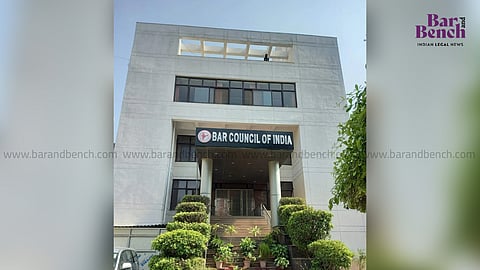

Ten elected members of the Uttarakhand Bar Council have moved the Supreme Court challenging a July 2026 resolution and circular issued by the Bar Council of India (BCI) which deal with how court-ordered representation of women in State Bar Councils is to be implemented [Kuldeep Kumar and Ors. Vs Union of India & Anr.].
The petitioners have contended that the BCI's approach amounts to illegally altering the composition of State Bar Councils.
The circular proposed increasing the strength of State Bar Councils where an insufficient number of women were elected, by adding additional seats to comply with the Supreme Court-mandated 30 per cent representation for women.
According to the petitioners, this amounts to unlawfully expanding the Council to secure women's representation despite there being no legal amendment or specific direction from the Supreme Court permitting such an increase.
A Bench of Chief Justice Surya Kant, Justice Joymalya Bagchi and Justice V Mohana on Tuesday sought a response from the Bar Council of India (BCI) and the Union Ministry of Law and Justice in the matter.
The elections to member positions of the Bar Council of Uttarakhand was held in February this year.
Meanwhile, the Supreme Court had passed an order in Yogamaya MG v. Union of India & Ors, directing that 30 percent of positions in State Bar Councils must be occupied by women.
To implement this directive, the BCI passed a resolution on July 19 and issued a circular consequently, proposing how women's representation could be implemented in State Bar Councils.
The BCI noted that the Advocates Act, 1961, presently fixes the elected strength of State Bar Councils at 15, 20 or 25 members, depending on the size of the electorate.
The BCI's July 19 resolution sought to ensure 30 per cent women representation by prescribing a target number of women members in the following manner:
- 7 women members when the strength of the council is 25;
- 6 women members when the strength is 20; and
- 4 women members when the statutory strength is 15.
If the required number of women were not elected within the existing statutory strength, the BCI proposed adding extra seats to accommodae more women.
For example, if no woman was elected among the first 25 candidates in a 25-member council, seven additional women members could be inducted, taking the council's total strength to 32.
If one or more women were already among the top 25, only the remaining shortfall would be filled through elections to additional seats, the BCI added.
Ten elected members of the Uttarakhand Bar Council have now challenged this move.
The petitioners termed the BCI's approach of creating additional elected seats an arbitrary departure from the Supreme Court's directions on how women representation should be implemented - namely, 20 per cent through election and 10 per cent through co-option.
“The Respondent No. 2 [BCI] has gravely misconstrued this limited liberty by unilaterally implementing seat enhancement through the Impugned Resolution, without submitting any proposal before this Court and without obtaining any specific enabling directions. This constitutes a direct and patent violation of the binding orders of this Hon'ble Court,” the petition stated.
The petitioners added that any alteration to the statutory composition of State Bar Councils requires a parliamentary amendment.
“The Respondent No. 2 [BCI] has neither obtained nor sought any such parliamentary amendment and has not placed any proposal before this Court for specific enabling directions. Thus, the BCI circular is an act of legislative usurpation," the plea said.
The petitioners have urged the top court to quash the BCI's circular. They have also sought directions to restrain the BCI from carrying out any move that amounts to revising the Uttarakhand Bar Council's election results.
The petitioners have further sought a declaration that no increase in the existing composition of the State Bar Council of Uttarakhand beyond 25 elected members should be permitted without an amendment to the law or a specific court order.
The petition was filed through advocate Dhruv Joshi.
Senior advocate Amit Anand Tiwari, advocate-on-record Dhruv Joshi with advocates Vardhman Kaushik, Vineet Negi and Arindam Sarin appeared for the petitioners.