Was Taj Mahal originally a Shiva temple? Allahabad HC asks Centre, ASI to respond on plea to inspect monument

The plea seeks the appointment of an Advocate Commissioner to inspect and photograph the Taj Mahal in a suit claiming it was originally the Tejo Mahalaya temple before being converted into a mausoleum.
Taj Mahal
Taj Mahal
Published on
2 min read
Listen to this article

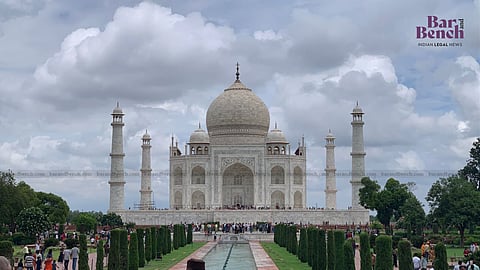
A plea has been filed before the Allahabad High Court seeking the appointment of an Advocate Commissioner to inspect and photograph the Taj Mahal, in connection with a pending civil suit claiming that the monument was originally the Tejo Mahalaya, a Hindu temple dedicated to Lord Shiva.
Justice Rohit Ranjan Agarwal on Monday sought responses in the matter from the Union government and the Archaeological Survey of India (ASI), and directed them to file their counter-affidavits.

Justice Rohit Ranjan Agarwal

The plea, filed by the deity Lord Sri Agreshwar Mahadev Nagnatheshwar Virajman Tejo Mahalaya Temple Palace through next friend Hari Shankar Jain and others, challenges the refusal of a trial court and a revisional court to appoint an Advocate Commissioner for the inspection of the Taj Mahal.

The dispute traces back to a civil suit instituted in Agra in 2015. In that suit, Hari Shankar Jain and other devotees claimed that the Taj Mahal was originally the Tejo Mahalaya, a Hindu temple dedicated to Lord Shiva, before it was converted into Mumtaz Mahal's mausoleum during the reign the Mughal emperor Shah Jahan.

They have sought a declaration to that effect as well as permission for Hindus to perform darshan, pooja and aarti within the monument.

According to the petitioners, an inspection of the Taj Mahal is necessary to document architectural and structural features which, they claim, support their case.

They argue that such evidence cannot effectively be proved through oral testimony alone. Since the Taj Mahal is a protected monument under the control of the ASI, they contend that they cannot independently access or photograph the portions they seek to rely upon before the trial court.

It was for this reason that the petitioners moved an application in 2017 seeking appointment of an Advocate Commissioner to inspect, photograph and videograph the Taj Mahal and submit a report before the trial court.

The trial court, however, rejected the application in July 2019, holding that there was no justification for appointing a commissioner. The Additional District Judge at Agra affirmed that decision on April 4, 2026.

Aggrieved by these orders, the petitioners have now approached the Allahabad High Court, contending that both courts failed to examine whether a local investigation was necessary to resolve the issues in dispute and instead rejected the application on grounds unrelated to its merits.

The petition argues that the physical features, architectural characteristics and other visible aspects of the monument cannot be effectively proved through oral evidence alone.

It relies on the Supreme Court’s judgment in the Ayodhya title dispute, which recognised the power of civil courts under Order XXVI Rule 9 of the Code of Civil Procedure to appoint commissioners for local investigation where such an exercise is necessary to elucidate matters in controversy.

The plea was argued by Advocate Vishnu Shankar Jain, assisted by Advocate Saumya Srivastava.

Bar and Bench - Indian Legal news
www.barandbench.com