
Subscribe
Subscribe
- Latest Legal News
- News
- Law Firms
- Columns
- Interviews
- Law School
- Legal Jobs
- हिंदी
- ಕನ್ನಡ
Replacing an arbitrator after years of hearings can wipe out substantial time, money and effort already spent in the proceedings, Bombay High Court judge Justice Bharati Dangre said while explaining why courts often grant extensions under Section 29A of the Arbitration and Conciliation Act.
"If I turn it down today and appoint a new arbitrator, what happens to all that effort, all that resources which have gone for all these years?" Justice Dangre said.
She added that courts may therefore grant a short extension if it ultimately serves the interests of justice.
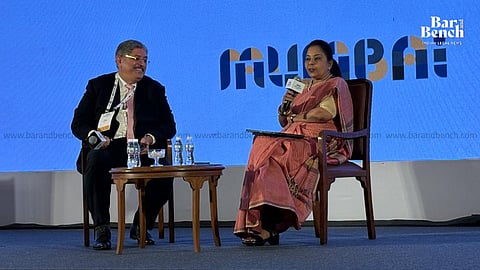
Justice Dangre was speaking during a fireside chat with Senior Advocate Vikram Nankani at India ADR Week 2026 in Mumbai, organised by the Mumbai Centre for International Arbitration (MCIA).
During the discussion, Nankani asked about her transition from Nagpur to Mumbai and her experience of handling commercial matters.
Justice Dangre said that her earlier practice, largely involving civil and criminal matters for the government, had given her little exposure to arbitration.
She said her shift to commercial matters after moving to Mumbai eventually proved beneficial and that she found considerable satisfaction in dealing with the wide body of arbitration law.
The discussion then turned to India's efforts to compete with international arbitration centres such as Singapore.
Justice Dangre said delay remained one of the biggest problems affecting arbitration in India.
"When I was given the arbitration assignment, I could see Section 11 applications pending for two years, three years. Then you find the disclosure made that is again subjected to challenge," she said.
She added that such delays could be one reason India has struggled to attract more international arbitrations.
"That is why I feel one of the reasons is probably why we have not been successful in attracting more and more international arbitrations. It is because the delay is plaguing the system," she said.
Justice Dangre suggested that arbitral institutions should be given a larger role in appointing arbitrators, instead of courts retaining control over the process.
"I think that will help a lot. I mean, why should we all feel that it is only our prerogative?" she said.
She also called for the development of a dedicated arbitration bar and said arbitration should not be treated merely as an evening or part-time practice.