Delhi, Mumbai lawyers condemn police crackdown on student protests

Bar bodies and around 750 lawyers from Delhi and Mumbai have termed lathi charges, tear gas and blanket prohibitory orders on student protesters, an assault on constitutional rights.
CJP Protest
CJP Protest
Published on
3 min read
Listen to this article

Lawyers’ bodies in Delhi and Mumbai have issued statements condemning police violence against students protesting in the two cities over exam paper leaks and seeking reforms.
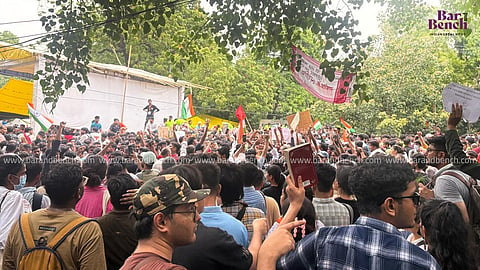
The lawyers have also questioned the sweeping restrictions imposed on peaceful assemblies, amid the recent wave of student protests.

They have called such actions an assault on constitutional rights and democratic dissent. 

Senior members of the Bar have demanded accountability for the alleged use of lathi charges, tear gas and prohibitory orders against youth, raising concerns over the future of education and public examinations.

Delhi lawyers’ condemnation

In Delhi, a group of 650 lawyers, including senior advocates Indira Jaising, Raju Ramachandran, Chander Uday Singh and Sanjay Hegde, have condemned the use of violence by Delhi Police against peaceful youth protestors at Jantar Mantar on July 20, 2026. The violence followed an attempt by the protesters to march to the Parliament on July 20.

“The sight of students being met with violence instead of dialogue is unacceptable. Police brutality against protesting students is an attack on the principles of free expression, human dignity, and the right to dissent. We stand in solidarity with everyone who has been harmed, intimidated and traumatized,” the statement reads.

The signatories also include former judges, senior advocates and lawyers such as Vrinda Grover, Prashant Bhushan and Shahrukh Alam. 

“The parliament of India is not an ivory tower that should be beyond the reach of its citizens. Those responsible for excessive use of force must be held accountable,” they have stressed. 

The lawyers have called upon the government and constitutional institutions to step in to ensure the safety of peaceful protesters and to protect the right to dissent.

Bar associations of the Supreme Court have also passed a resolution to strongly condemn lathi charges on students and members of the legal fraternity.

“The use of excessive and disproportionate force against peaceful students and members of the Bar is deeply disturbing and wholly unacceptable in a democratic society," the Supreme Court Bar Association (SCBA) has stated, praying for an impartial and time-bound inquiry into the incident. 

The Supreme Court Advocates-on-Record Association (SCAORA) have separately condemned the crackdown. 

It expressed deep concern over visuals showing Delhi Police using force against students and young protesters gathered peacefully for the integrity of public examinations.

“In a constitutional democracy, peaceful dissent is not an act of defiance but an exercise of the fundamental freedoms guaranteed under Articles 19(1)(a) and 19(1)(b) of the Constitution. The strength of our Republic lies not in suppressing dissent but in protecting it within the framework of the Constitution. The true measure of constitutional governance is not how the State responds to agreement, but how it responds to peaceful disagreement,” their statement reads. 

Mumbai Bar’s criticism of police action

The Bombay Bar Association expressed grave concerns over the reports and videos “which appear to depict students being subjected to lathi charges and the use of tear gas by the police.” 

The association underlined that peaceful protest is an essential feature of democratic governance.

“If these reports are accurate, the use of force against students exercising their constitutional rights is deeply disturbing and cannot be countenanced in a society governed by the rule of law,” their statement reads. 

They also deprecated adopting measures like using intimidation tactics of filing FIRs. 

The lawyers have also critiqued the action by the Mumbai police to detain protestors and issue blanket prohibitory orders. 

On July 21, a group of more than 120 lawyers, including senior advocates practising before the Bombay High Court, issued a statement deprecating the consecutive prohibitory orders passed by the Mumbai Police Commissioner’s office - one covering July 7 to 21 and another from July 23 to August 6

These orders under Section 37(3) of the Maharashtra Police Act ban assemblies of five or more persons and processions across Mumbai and have been used to detain over 300 citizens, including minors, near Shivaji Park.

“The ostensible reason for the arrests appears to be that no permission has been given for protesting at Chaityabhoomi,” the statement says. 

The lawyers have argued that no such prohibition can remain in force for more than 15 days without the State government's sanction. So, the consecutive prohibitory orders with only a respite of 24 hours imply they have been issued in a manner so as to circumvent the requirement of State government sanction.

They have urged the Commissioner of Mumbai police to withdraw these orders claiming the orders fail to comply with other requirements of law as well. 

“It ought not to fall on citizens to seek recourse to already overburdened courts, and spend scarce judicial time to assail orders that are quite plainly on shaky legal footing,” the statement reads. 

Bar and Bench - Indian Legal news
www.barandbench.com