
Subscribe
Subscribe
- Latest Legal News
- News
- Law Firms
- Columns
- Interviews
- Law School
- Legal Jobs
- हिंदी
- ಕನ್ನಡ
National Law School of India Review (NLSIR) has announced the theme for the inaugural edition of the Chief Justice ES Venkataramiah Memorial Best Essay Prize.
The theme for this inaugural edition has now been announced as Does the Constitution Choose an Economic Model? Directive Principles and the Question of Ideological Neutrality.
The theme draws on the Supreme Court's 2024 nine-judge Bench ruling in Property Owners' Association v. State of Maharashtra. The Bench had considered whether all privately owned property falls within the expression "material resources of the community" under Article 39(b) of the Constitution, a Directive Principle that asks the State to distribute the community's resources for the common good.
The majority, led by then Chief Justice DY Chandrachud, held that it does not, reasoning that the Constitution does not commit India to a single economic ideology, and that treating all private property as a material resource would require the Court to endorse one particular vision of the country's economic and social order. Justice BV Nagarathna sat on the Bench and wrote a separate opinion partially concurring with the majority while Justice Sudhanshu Dhulia had dissented.
Rather than a case comment, NLSIR has asked entrants to use Property Owners' Association as a starting point to explore whether, and to what extent, the Constitution embeds, permits, or rejects particular economic visions. Participants are invited to consider whether the Constitution - and specifically the Directive Principles dealing with ownership, distribution and the common good - can ever be neutral between competing economic models, or whether interpreting these provisions inevitably involves normative choices about property, markets, redistribution and the role of the State. NLSIR has said strong essays will engage with comparative constitutional perspectives, as well as political and economic theory.
The competition remains open to undergraduate law students, enrolled in either the five-year or three-year law programmes, at any law school recognised by the Bar Council of India (BCI). Each entry must be an original, unpublished, single-authored essay in English, and must clear anti-plagiarism checks. Entrants must also submit a bonafide certificate, signed by the Registrar, Vice-Chancellor, or other appropriate authority, confirming their enrolment as an undergraduate law student at the time of submission. NLSIR has clarified that abstracts or proposals will not be considered or reviewed separately.
Essays must be between 8,000 and 10,000 words, inclusive of footnotes, formatted in Times New Roman, size 12 font, with 1.5 spacing on an A4 sheet, and referenced using the OSCOLA citation guide. Entries must also comply with the NLSIR Style Guide and other policies notified on the NLSIR Repository.
Entries can be submitted through a Google form on the NLSIR website, which will begin accepting submissions from September 1. No prior registration or registration fee is required. The submission deadline is October 10, 2026. As previously announced, the winning entry will be published in NLSIR, and the winner will receive a cash prize of ₹25,000 and a citation plaque bearing their name. Queries can be addressed to nlsir.communications@nls.ac.in.
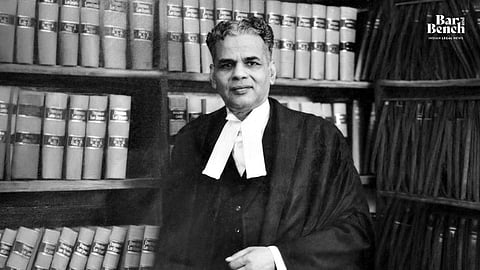
NLSIR, the law journal of the National Law School of India University (NLSIU), Bengaluru, instituted the Prize in June with the support of Justice BV Nagarathna of the Supreme Court of India, daughter of the late Chief Justice of India Venkataramiah, and her daughter, Advocate Nayana Tara BG.