
Subscribe
Subscribe
- Latest Legal News
- News
- Law Firms
- Columns
- Interviews
- Law School
- Legal Jobs
- हिंदी
- ಕನ್ನಡ
National Law School of India Review (NLSIR), the law journal of the National Law School of India University (NLSIU), Bengaluru, has announced the institution of the ‘Chief Justice ES Venkataramiah Memorial Best Essay Prize’.
The annual national essay competition, instituted with the support of Justice BV Nagarathna - daughter of Late Justice ES Venkataramiah and a sitting judge of the Supreme Court of India - and her daughter Advocate Nayana Tara, is open to undergraduate law students (enrolled in either the five-year or three-year law programmes) at any law school recognised by the Bar Council of India (BCI).
The competition will be conducted between June and September every year. Each year’s essay competition will be organised around a contemporary and significant theme in law. Shortlisted entries will be evaluated by a panel of eminent academics and practitioners with relevant subject-matter expertise. The winning entry will be published in NLSIR and the winner will receive a cash prize of ₹25,000 and a citation plaque bearing the winner’s name. This year’s competition theme will be announced in early July.
NLSIR is the flagship student-edited, bi-annual, double-anonymous peer-reviewed law journal of NLSIU. The journal is one of India’s oldest student-edited law reviews, now in its 38th year of publication. Over the years, the journal has been cited by the Supreme Court of India on multiple occasions.
NLSIR features pieces from both scholars and practitioners. It has featured contributions from former Chief Justice of India DY Chandrachud, Prof Michael Furmston (who was at the time Dean and Emeritus Professor of Law, Singapore Management University), Prof Cass Sunstein (Professor, Harvard Law School), Prof Chan Wing Cheong (Professor of Law, Singapore Management University), Prof Richard Whish (Emeritus Professor of Law, King’s College London), Prof Martin Hunter (who was at the time Barrister, Essex Court Chambers), Prof Rosalind Dixon and Prof Dev Gangjee (Professor of Law, University of Oxford), among other eminent scholars and practitioners.
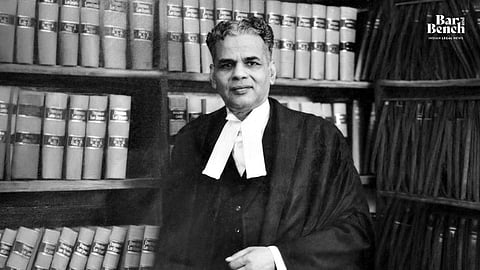
Justice Venkataramiah, who served as the 19th Chief Justice of India, was born to a schoolteacher in the village of Manikyanahalli in Karnataka. After serving as Advocate General of Mysore and as a judge of the Karnataka High Court, he was elevated to the Supreme Court, where he served for nearly a decade. After retirement, he returned to the classroom at NLSIU, where he held the MK Nambiar Chair in Constitutional Law and taught until his passing in 1997.
Nayana Tara BG described the prize as honouring Justice Venkataramiah's lifelong commitment to legal scholarship.
“Justice E.S. Venkataramiah was born to a schoolteacher in the village of Manikyanahalli and rose to become the 19th Chief Justice of India. He was also the Advocate General for the State of Mysore, and a Judge of the High Court of Karnataka prior to his elevation to the Supreme Court where he served for nearly a decade. Throughout his life, he sustained a commitment to scholarship in general and legal scholarship in particular, evident in his judgments, and other writings. He devoted time as an Advocate to teaching and writing, alongside a flourishing practice. Unusually for a former Chief Justice of India, he returned to the classroom at NLSIU where he also held the M.K. Nambiar Chair in Constitutional Law and taught till his passing in 1997.
This Prize instituted in his memory seeks to honour his legacy of commitment to legal scholarship. While the prize rewards excellence, its deeper purpose is to give students an opportunity to reflect on contemporary legal issues with intellectual rigour and discipline of persuasive writing. The Prize materialises Justice Venkataramiah’s conviction that scholarship paves the way for development of the law,” she said.
The NLSIR Editorial Board said, “Justice E.S. Venkataramiah, a former Chief Justice of India, was also a member of the faculty at the National Law School of India University, and his distinguished contributions to the legal profession, adjudication, legal education and cultural life continue to inspire us. At NLSIR, we hope this Prize will encourage rigorous academic writing among undergraduate students and serve as an aspirational benchmark for sustained scholarly engagement with legal theory and doctrine across law schools in India. We are very grateful to Hon’ble Mrs. Justice B.V. Nagarathna (Judge, Supreme Court of India) and Ms. Nayana Tara B.G. (Advocate and alumna of NLSIU) for their immense support in making this endeavour possible."
NLSIR also thanked the Vice-Chancellor, the Registrar, and the Dean Research’s Office of NLSIU for their support in instituting the Prize.