
Subscribe
Subscribe
- Latest Legal News
- News
- Law Firms
- Columns
- Interviews
- Law School
- Legal Jobs
- हिंदी
- ಕನ್ನಡ
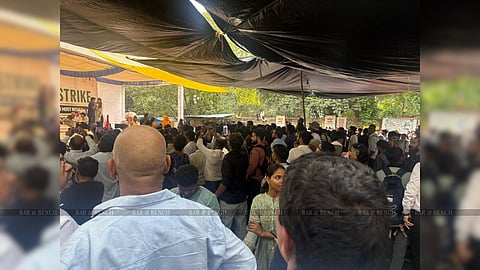
Here's what actually happened, stripped of the noise: thousands of students and young people, mobilised under the banner of the Cockroach Janta Party, tried to march to Parliament on July 20 demanding Education Minister Dharmendra Pradhan's resignation over the NEET-UG 2026 paper leak. The Delhi Police had invoked Section 163 BNSS across New Delhi, with Jantar Mantar carved out as the only sanctioned protest site, and said that no permission existed for a march to Parliament Street. The police reported that over 118 personnel, including senior officers, were injured in the clashes that followed and around 70 protesters were detained. CJP founder Abhijeet Dipke was among those detained, and the crackdown drew condemnation from opposition leaders over the forcible removal of Sonam Wangchuk from the protest site two days earlier.
That's the headline. The actual legal material is underneath it. Moreover, one precedent in particular does more work here than most commentary has noticed.
Section 163 BNSS is the reincarnation of Section 144 CrPC - the same preventive logic, restricting assembly on apprehension of danger to public order. The Supreme Court has never treated that power as a rubber stamp. Babulal Parate upheld its constitutionality, but Madhu Limaye v. Sub-Divisional Magistrate, Monghyr tied that validity to a condition: the order must record material facts showing genuine, specific apprehension, not a boilerplate recitation renewed on autopilot. Ramlila Maidan Incident, In Re v. Home Secretary, Union of India, the Supreme Court's own suo motu case on the 2011 midnight crackdown on Baba Ramdev's anti-corruption protesters, went further, holding that force under a Section 144 order must be proportionate to the actual threat, not the threat the state assumes exists. Notably, that judgment also found Ramdev and his organisers partly at fault for not cooperating with the evacuation order, so the precedent cuts in both directions; it's a balancing test, not a one-way ratchet against the State.
The sharpest authority, though, is one that gets cited far less than it should: Mazdoor Kisan Shakti Sangathan (MKSS) v. Union of India (2018). In that case, the Supreme Court didn't just review a single order. It examined Delhi Police's practice of renewing Section 144 notifications across Central Delhi every 60 days and called it what it was: a virtual blanket ban dressed up as a temporary, case-specific measure. The Court ordered Jantar Mantar reopened, restored protest rights at the Boat Club near India Gate after a decade-long ban and gave the Police Commissioner two months to frame written guidelines regulating how and where demonstrations could proceed.
That compliance question now has an unlikely companion. Since July 17, the Union Home Ministry has ordered mobile internet suspended around Jantar Mantar on several separate occasions, most recently on July 23, each time citing public emergency and public safety. The Software Freedom Law Centre challenged the pattern before the Delhi High Court on July 24, arguing the orders never disclose the specific material facts. Even the Anuradha Bhasin standard requires only recycled language each time. It is the same structural complaint this piece is making about Section 163, now being argued in real time about a different provision entirely.
That judgment is now 7 years old. The live question for Chalo Sansad isn't only whether the July 20 order recorded specific material facts, it's whether those MKSS-mandated guidelines still exist, were ever made public and were actually followed when this particular order went out.
Zoom out further and the geography tells its own story. Protesters had unrestricted access to the Boat Club lawns near India Gate until agitations in the 1980s got that site restricted. Jantar Mantar took over as the city's sanctioned protest ground from 1993. In 2017, the National Green Tribunal tried to shut that down too and ordered a shift to Ramlila Maidan. The 2018 MKSS judgment reversed that contraction, reopening both Jantar Mantar and the Boat Club, and insisting that any restriction be genuinely regulatory rather than exclusionary.
What that history suggests, cumulatively, is that the space available for protest in the capital doesn't move through one clean constitutional test; it moves through a series of separate legal levers (security orders, environmental tribunals, administrative renewal practice) that each look reasonable in isolation but add up, over decades, to a net contraction that no single case is designed to catch. Article 19(1)(b) jurisprudence in India has mostly been built incident by incident rather than asking whether the cumulative effect of successive, differently-justified restrictions has quietly narrowed the right itself. MKSS came closest to making that argument explicitly,and it's worth asking whether Chalo Sansad's transgression, walking past the edge of the sanctioned zone toward parliament, is best read as a one-off violation, or as the latest data point in a map that keeps needing court intervention to stay open.
Most coverage has folded Wangchuk's removal into the same "crackdown" narrative as the July 20 march. That flattens a more interesting question. Wangchuk was removed from Jantar Mantar 20 days into a hunger strike that began on June 28 and Delhi Police stated he was shifted to hospital for essential medical care on the High Court's own orders, following medical advice. That's not a unilateral police decision to break up a protest; it's a court-sanctioned medical intervention on a fasting man and it belongs to a different doctrinal family.
The nearest comparison is the long-running Irom Sharmila force-feeding controversy, although the two are analogous, not identical, since Sharmila's case arose in a custodial, AFSPA-adjacent context that Wangchuk's does not. What they share is the underlying tension: does a court have authority to override a fully conscious adult's refusal of treatment in the name of preserving life under Article 21, when that refusal is the form the protest takes? Wangchuk's family reportedly objected to any treatment being administered without their and his doctors' consent, which points toward bodily autonomy as the real fight here, not crowd control. Treating this as part of the same story as the baton charges two days later muddies both arguments; they deserve separate legal treatment.
Section 189 BNS (formerly Section 141 IPC) defines unlawful assembly. Section 190 (formerly Section 149) makes every member liable for an offence committed by any member in pursuit of the assembly's shared "common object," even without personal participation in that specific act. Courts have been careful to say mere presence isn't enough; a shared object has to be shown. But they've also held, as far back as Moti Das v. State of Bihar (1954), that an assembly lawful at its outset can turn unlawful through the later conduct of its members. This cuts against reading "common object" as fixed from the first moment people gathered at Jantar Mantar and complicates any argument that liability should attach to everyone equally regardless of when, in the day's events, the assembly's character actually changed.
The Delhi Police had registered ten FIRs across five police stations over incidents at Parliament Street, Connaught Place and elsewhere. Thousands attended; the violence police attribute to the crowd came from sections of it. Whether the FIRs hold up will turn on exactly this point - whether "common object" is established for each individual accused at the moment the offence occurred, or assumed backward across an entire day's assembly. That's the live doctrinal fight and it cuts both ways: too narrow a reading lets organised violence hide inside a peaceful crowd; too broad a reading turns ordinary attendance into criminal exposure.
The injury data here is asymmetric and largely uncontested on one side, disputed on the other. The National Human Rights Commission took up a complaint alleging that a 12-year-old girl suffered a head injury during the protest, issuing notices to Delhi's social welfare department, the IT ministry and the Delhi Police Commissioner, while Delhi Police publicly dismissed that claim, as well as reports of 40 to 50 other head injuries, as false information circulating online.
The detail worth sitting with: the same NHRC order also directed that if the circulating information proves false, action including an FIR should follow against whoever posted it. That means the single order meant to hold the State accountable for an alleged injury is also the order that raises the cost of publicising an unverified one. That's not a conspiracy, it's a structural design flaw: an accountability mechanism and a chilling mechanism riding in the same vehicle. And it deserves more attention than it's getting.
The PIL now before the Delhi High Court, filed by Advocate Anshul Kumar, actually names the sharpest gap in the whole episode: alongside seeking a court-monitored inquiry, preservation of electronic evidence and compensation, it asks for an investigation into unidentified individuals reportedly seen operating alongside uniformed police during the crackdown. India has no mandatory body camera regime for crowd control and no independent police complaints authority in Delhi. Without that infrastructure, any proportionality review under Ramlila Maidan is going to be fought over a contested factual record before it ever reaches the legal question of whether the force used was proportionate.
The brush-off didn't hold and it split down an unexpected line. On the morning of July 22, a Supreme Court bench led by Chief Justice of India Surya Kant declined urgent listing of a plea over the police action. Hours later that same day, the Delhi High Court took up a batch of PILs on the identical incident and reached the opposite conclusion, issuing notice to the Centre and the Delhi Police, directing preservation of CCTV footage, videography and all related records, and listing the matter for September 11. The Bench specifically observed that the allegations did not concern isolated incidents for which individual victims could be told to file separate complaints.
The hearing also revealed that the factual narrative itself is now contested. Opposing the PILs, Additional Solicitor General SV Raju, appearing for the Centre and the Delhi Police, argued that the petitions were founded on selective social media videos whose authenticity could not be readily accepted. He contended that the demonstrations had turned violent, referred to videos showing injuries to police personnel and damage to police vehicles, questioned the maintainability of the PILs and argued that individuals alleging assault should pursue ordinary legal remedies rather than invoke the Court's public interest jurisdiction.
The Bench was not persuaded that the matter could be reduced to a series of individual grievances. Observing that the allegations concerned the manner in which the police had dealt with an entire protest, it remarked that the case did not involve isolated incidents for which each victim could simply be asked to file a separate complaint.
The litigation has already answered some questions, at least procedurally. The Delhi High Court has directed preservation of CCTV footage, videography and other relevant electronic records, ensuring that the evidentiary foundation of the dispute is not lost while the case is pending. It has also issued notice on the challenge to the Section 163 order, placing the legality of the restrictions squarely before the Court.
Other questions remain unresolved. Whether the Section 163 order ultimately survives scrutiny under the principles laid down in Mazdoor Kisan Shakti Sangathan and Anuradha Bhasin will depend on the State's justification and the Court's application of proportionality. Whether the FIRs invoking common-object liability satisfy the requirement of individualised criminal culpability, particularly in light of Moti Das, also remains to be tested. Equally unanswered is the petitioners' allegation regarding unidentified individuals seen alongside police personnel and whether the proceedings will shed light on their identity or role.
The politics of NEET, and whether the protest itself was justified, are separate questions. The legal questions are now before a constitutional court. For the first time since July 20, the central issues are being determined through judicial process rather than competing public narratives.
Paras Sharma is a practicing advocate at the Punjab and Haryana High Court, Chandigarh.
Views are personal.