
Subscribe
Subscribe
- Latest Legal News
- News
- Law Firms
- Columns
- Interviews
- Law School
- Legal Jobs
- हिंदी
- ಕನ್ನಡ
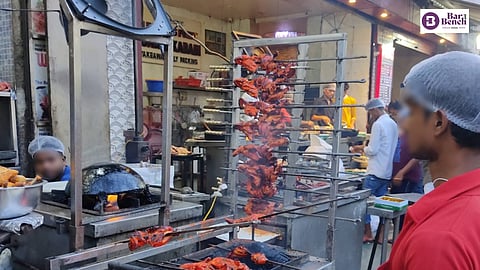
For nearly four decades, a cluster of licensed restaurants along the Veraval–Una state highway in Gujarat’s Gir Somnath district quietly cooked, plated and sold meat, fish and eggs to local fishermen, industrial workers, and passing travelers. Their kitchens were tucked behind closed doors, their municipal trade permits were in order and their food safety registrations were valid.
Then, on August 10, 2026, the district magistrate decided that the mere existence of these menus constituted an intolerable assault on the religious sensibilities of pilgrims visiting the Somnath Temple. By administrative fiat, he banned the preparation, storage and sale of all non-vegetarian food within 500 metres of the shrine and across six major arterial stretches, reaching restaurants located nearly two kilometers away from the shrine.
When Justice Nisha M Thakore of the Gujarat High Court struck down the prohibition on October 30 as an illegal overreach, the State government moved with a speed rarely seen when ordinary citizens seek bail or wage arrears. Within two-and-a-half hours of the pronouncement, before the 38-page judgment could even be uploaded to the Court’s website, a division bench of acting Chief Justice (ACJ) Manash Ranjan Pathak and Justice Nirzar S Desai assembled at 5:30 PM on an urgent oral mention. Without reading a single line of the verdict under challenge, the bench stayed the relief and restored the ban, citing the approaching Diwali and Gujarati New Year crowds.
A few days later, the Supreme Court bench of Justices MM Sundresh and PB Varale declined to disturb that freeze, offering the petitioning restaurateurs a breezy homily about maintaining balance and celebrating the festival with sweets instead.
"We need to maintain a balance. We don’t say anything..Celebrate the festival of lights (Diwali) by having sweets. Leave veg or non-veg aside," the bench remarked.
The episode lays bare a peculiar transformation in Indian governance. A pilgrim’s personal dietary preference has been elevated into a public order mandate, enforced by police statutes and rubber-stamped by courts reluctant to stand in the way of majoritarian comfort.
India has developed an increasingly supervisory relationship with what sits on its citizens’ plates. Choosing vegetarianism out of spiritual discipline, ethical conviction or habit is entirely unremarkable. The pathology begins when personal abstinence acquires a police escort and starts inspecting the neighbour’s kitchen.
We have watched this supervisory instinct migrate steadily from temple steps to residential doorsteps. Municipal corporations routinely shut down meat shops during Navratri and Paryushan. In July 2025, during the month of Sawan in Ghaziabad, Bajrang Dal workers intercepted a Blinkit delivery rider on the street, rummaged through his bag to discover raw chicken and telephoned the customer to interrogate her about her religion.
What makes this moral crusade so deeply dishonest is the selective calendar on which it operates. Within Hindu society itself, dietary habits are notoriously fluid and calendar-bound. Millions of devout Hindus abstain from meat on Mondays, Tuesdays, or Thursdays, observe strict vegetarianism through Sawan or Navratri, and happily return to mutton curry and fish fry the moment the auspicious window closes. Even within the same household, one family member’s religious fast coexists alongside another’s regular dinner.
Yet, under the new doctrine of bruised sensibilities, the devotee who eats chicken on Wednesday demands that the State sanitize his field of vision on Thursday so he is spared the trauma of seeing a restaurant sign on his way to darshan. Devotion, once an internal discipline of self-restraint, has been outsourced to the district magistrate. If the pilgrim cannot bear the sight of an omelet two kilometers away from a shrine, the law must shut down the kitchen.
Whenever these bans are challenged, the State inevitably summons Hindu scripture as though the ancient texts were municipal zoning codes waiting to be enforced. In her October 30 judgment, Justice Thakore dismantled this monolithic caricature by turning directly to the seventeenth chapter of the Bhagavad Gita.
Verses 7 through 10 of Chapter 17 classify food into three qualitative categories - Sattvic, Rajasic and Tamasic - based on how they affect the human temperament. While the text commends Sattvic foods for cultivating clarity and vitality, it issues no blanket scriptural decree outlawing meat for all Hindus. Across the subcontinent, from the fish-eating Shakta traditions of Bengal and Assam to the martial communities of Rajasthan and the coastal populations of Gujarat and the South, meat has always been an integral part of Hindu social and ritual life.
To pretend that Hinduism requires a two-kilometer cordon sanitaire around every major temple is an act of sectarian projection. It takes the dietary code of upper-caste Vaishnavism and imposes it through the coercive machinery of the State upon fishermen, Muslim residents, Dalits and meat-eating Hindus alike. A coastal town whose very economy rests on the Arabian Sea’s catch is suddenly told that selling fish along a State highway defiles the sacred geography.
Somnath is an ironic stage for this administrative zeal, given how fiercely the architects of the Republic debated the boundary between the State and this very temple.
When the shrine was reconstructed after Independence, Prime Minister Jawaharlal Nehru repeatedly cautioned President Rajendra Prasad and KM Munshi against associating official State machinery with the temple’s consecration in May 1951. Nehru argued that while individuals were completely free to worship and contribute, the government of a secular Republic had to maintain a clear institutional distance from religious observances.
75 years later, that institutional restraint has evaporated. The administration no longer merely attends the ceremony; it patrols the highways with a menu card.
Even the chronology of the Somnath restrictions exposes the arbitrary nature of the August 2026 ban. Back in March 2006, the local administration had drawn a tight, sensible 500-meter exclusion zone immediately around the temple compound and the bus stand approach. For two decades, this balance kept the immediate sanctum intact without extinguishing established businesses along the state highway.
While a 2018 municipal resolution - still under challenge before the High Court - and a 2019 police notification extended restrictions to select local stretches, restaurants along the wider Veraval-Una highway toward Bhalka Tirth continued operating undisturbed.
The fresh itch to expand the cordon to six major roads - swallowing establishments up to two kilometers away - was triggered between May and August 2026 by a batch of representations from local socio-religious outfits. As per the submissions noted by Justice Thakore in her order, these complaints were mechanical duplicates, typed in the exact same font with identical cut-and-paste phrasing. Rather than recognising an organized pressure campaign for what it was, the collector treated those photocopied demands as a binding command to extinguish 40-year-old businesses.
Stripped of its religious rhetoric, the August 10 notification collapses under basic statutory scrutiny. When an executive officer wants to enforce a cultural taboo without legislative backing, he has to torture the statute book until it confesses to powers it does not possess.
The district magistrate issued the ban under Section 33(1)(w)(ii) of the Gujarat Police Act, 1951, a clause meant to regulate places of public amusement or entertainment in order to prevent traffic obstruction, stampedes, or physical disorder. There is just one fatal flaw in relying on that provision. In April 2018, the Gujarat Legislature enacted the Gujarat Police (Amendment) Act, which explicitly deleted "eating houses" from the statutory definition of "public entertainment" and stripped the police's licensing jurisdiction over restaurants under Section 33. The legislature had consciously stripped the police and the magistrate of this exact regulatory power eight years earlier.
Furthermore, central regulations framed under the Food Safety and Standards Act of 2006 already lay down specific sanitary and visibility safeguards for retail meat shops near places of worship. Those national rules prescribe a precise statutory buffer between licensed meat shops and places of worship - 50 meters, extending to 100 meters if the shop sits directly opposite a temple’s entrance gate. By inflating a 100-meter national standard into a 2,000-meter highway ban using an inapplicable police clause, the district magistrate simply invented executive power out of thin air.
To defend this statutory sleight of hand, the State relied heavily on the Supreme Court’s 2004 ruling in Om Prakash v. State of UP, which upheld municipal bye-laws banning the sale of meat, fish and eggs in Rishikesh. Yet, the comparison is deeply flawed. In Rishikesh, an elected municipal board passed formal bye-laws under an express statutory power governing food markets within a small, riverine pilgrim town. In Somnath, an unelected district officer bypassed municipal law altogether to shut down restaurants along multi-kilometer state highways serving industrial workers and local residents.
The State’s reliance on two High Court orders is even more disingenuous. It cited the Allahabad High Court’s 2022 dismissal in Shahida v. State of UP as proof that sweeping ward-level meat bans in Mathura and Vrindavan pass constitutional muster. In reality, the Allahabad bench never ruled on the meat ban at all. Because the PIL petitioner had failed to formally challenge the government’s prohibition order in her pleadings, the Court expressly declined to comment on its validity. Passing off a procedural dismissal as a constitutional endorsement is a courtroom parlour trick.
The Punjab and Haryana High Court’s April 2026 ruling in Rajinder Kumar v. State of Punjab also does not rescue Gujarat’s case. That dispute concerned a formal prohibitory order issued by Punjab’s Department of Animal Husbandry restricting meat sales strictly within the historic walled city of Amritsar housing Sri Darbar Sahib, leaving the rest of the city completely open for trade. The Chandigarh bench upheld that localised restriction only after the State produced a valid prohibitory order from the competent department, directing authorities to temporarily unseal the petitioners' shops so they could clear out perishable fish stock.
Somnath already had its localised precinct in the 500-meter temple cordon established back in 2006. Stretching a repealed police clause across two kilometers of commercial state highways bears no resemblance to a walled-city heritage restriction backed by a competent State department.
Even more absurd was the government pleader’s attempt before the single judge to invoke the seven-judge bench Supreme Court ruling in State of Gujarat v. Mirzapur Moti Kureshi Kasab Jamat (2005). That judgment upheld a ban on slaughtering bulls and bullocks based on Directive Principles under Article 48, citing the agrarian utility of cattle for dung, organic manure and biogas. Stretching a constitutional ruling on agricultural livestock economics to shut down coastal eateries serving fish and omelettes is legal desperation masquerading as precedent.
Even in cases where the Supreme Court has permitted religious-sensitivity closures - such as the nine-day Paryushan slaughterhouse ban upheld in Hinsa Virodhak Sangh (2008) - the Court’s approval hinged entirely on the brief, temporary window, noting that traders remained free to operate for the remaining 356 days of the year.
"What one eats is one’s personal affair and it is a part of his right to privacy which is included in Article 21," the Court famously noted.
The Somnath order is permanent. Telling a 40-year-old non-vegetarian restaurant that it is free to survive by switching its menu to paneer and dal is like telling a bookseller he is free to stay open provided he only sells stationery.
Before the single-judge, the petitioning restaurant owners offered every conceivable compromise to spare passing devotees from visual or olfactory discomfort. They undertook to keep their doors self-closed, cover their glass facades with opaque dark film, eliminate all external displays and transport supplies in sealed refrigerated vans. A pilgrim walking down the highway would never have seen, smelled, or encountered a trace of meat.
Under the Supreme Court’s own proportionality doctrine reaffirmed in Puttaswamy (2017), any restriction on a fundamental right under Article 19(1)(g) must adopt the least intrusive measure available to achieve its objective. Where opaque glass and closed doors solve the problem entirely, wiping out a 40-year-old livelihood fails the constitutional test at the threshold.
Had the State genuinely cared about balancing devotee comfort with the right to trade, those safeguards would have settled the matter immediately. Instead, the division bench stayed an unread judgment at dusk and the Supreme Court told citizens facing financial ruin to go eat Diwali sweets.
There is an unmistakable echo of 18th century Versailles in that judicial shrug. In his Confessions, Jean-Jacques Rousseau recorded the infamous anecdote of a sheltered princess who, upon being told that the peasants had no bread, cheerfully suggested they eat brioche. The line forever etched into popular memory through Marie Antoinette as "Let them eat cake." Whether the French queen ever uttered those precise words matters far less than what the phrase came to symbolise on the eve of the French Revolution: an insulated ruling class so comfortably removed from the mechanics of survival that it treats a livelihood crisis as a trivial menu adjustment. Telling working restaurateurs, fishermen and daily-wage kitchen staff in Veraval to put aside their ruined businesses and enjoy Diwali sweets carries that same aristocratic air of detachment.
The Constitution was drafted for a sprawling, argumentative republic where citizens would inevitably disagree over gods, rituals and dinner menus. Its promise lies in ensuring that one citizen’s sacred fast never affects another citizen’s right to livelihood. The State has every right to protect access to a temple and enforce hygiene on its streets. Once it begins using police notifications to sanitise the highway of foods that offend a passing pilgrim’s sensibilities, it ceases to be a constitutional republic and becomes a municipal canteen run by the loudest lobby in town.