
Subscribe
Subscribe
- Latest Legal News
- News
- Law Firms
- Columns
- Interviews
- Law School
- Legal Jobs
- हिंदी
- ಕನ್ನಡ
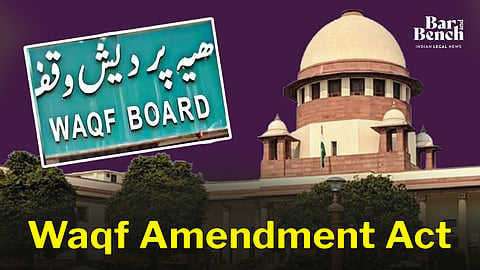
On December 8, 2025, the Union Minority Affairs Ministry announced that a nationwide deadline for registering waqf properties on the government's new UMEED portal had expired. The result was sobering: only 27% of India's roughly 8.8 lakh waqf properties had been registered - approximately 2.16 lakh properties out of a universe that the government's own WAMSI portal puts at 8,72,328 immovable assets spread across more than 38 lakh acres.
The State-wise breakdown reveals the gap between legislative ambition and administrative reality. Karnataka managed to register 81% of its 65,242 properties. Jammu and Kashmir hit 77%. Punjab reached 90%. Gujarat registered 61%. And then there is West Bengal. A State with 80,480 Waqf properties - the second-largest portfolio in India after Uttar Pradesh -managed to register 716 properties. Less than 1% compliance. Uttar Pradesh, which holds roughly 2.4 lakh properties across its separate Sunni and Shia boards, registered only 11% of Sunni properties and 5% of Shia properties. Maharashtra, with 36,700 properties, uploaded 48%.
Over 2.13 lakh applications submitted by mutawallis remain pending. Nearly 11,000 have been rejected during verification. The All India Muslim Personal Law Board (AIMPLB) has sought an urgent meeting with the Ministry. The portal, by all accounts, keeps crashing. Older properties lack documentation. And the government has responded by announcing a 3-month penalty-free window for those who missed the deadline.
This is not the implementation of a modernising law; it is an administrative train wreck. And it is happening 8 months after the Waqf (Amendment) Act, 2025 came into force on April 8, 2025.
To understand why the registration crisis matters, one must understand the scale of what is at stake. India has 8,72,328 registered Waqf properties across 30 States and Union Territories, managed through 32 State Waqf Boards. Uttar Pradesh alone accounts for 2,32,547 properties - roughly 27% of the national total. West Bengal follows with 80,480; Punjab with 75,965; Tamil Nadu with 66,092; and Karnataka with 62,830.
Of these, 4.02 lakh are 'waqf by user' - properties that have functioned as waqfs for generations without a registered deed. Graveyards constitute 17.3% of all properties. Agricultural land accounts for 16%. Mosques for 14%. Shops for 13%.
Now here is the figure that should worry the government more than any protest: according to data presented by the Ministry to parliament, 5,973 government properties across 25 States and Union Territories have been declared as waqf properties. The government argues this is evidence of encroachment. The communities argue it is evidence of historical use. Either way, it is a ticking time bomb.
The Sachar Committee, in its 2006 report, estimated the market value of waqf properties at ₹1.2 lakh crore and projected potential annual income of ₹12,000 crore if managed efficiently. The actual income at the time of the Sachar report? A meagre ₹163 crore annually. The government has spent ₹23.87 crore under the Quami Waqf Board Taraqqiati Scheme and ₹7.16 crore under the Shahari Waqf Sampatti Vikas Yojana between 2019-20 and 2023-24 to digitise and develop these properties. That is ₹31 crore over 5 years to manage assets worth over a lakh crore.
And the litigation is exploding. According to the Ministry's own data, waqf-related pending cases increased from 10,381 in 2013 to 21,618 in 2025; it more than doubled in 12 years. The Act was supposed to reduce this. Instead, it has added fuel to the fire.
The constitutional challenge to the Waqf (Amendment) Act, 2025 reached the Supreme Court with remarkable speed. 65 petitions were filed by MPs, state governments, religious organisations and civil rights groups. 6 BJP-ruled states intervened to defend the Act. Kerala opposed it.
On September 15, 2025, a bench of Chief Justice BR Gavai and Justice AG Masih delivered a 128-page interim judgment that refused to stay the Act in its entirety but stayed the provisions it found 'prima facie arbitrary'.
The Court stayed Section 3(r), which requires a person creating a waqf to demonstrate they have been 'practising Islam for at least five years.' The Court accepted the government's argument that the legislature had legitimate concerns about fraud, but stayed the provision because there was no mechanism to determine who is a 'practising Muslim' for five years, and the Central government had not yet framed rules.
The Court also stayed Section 3C, which allows a state government to designate an officer above the rank of Collector to inquire whether a waqf property is actually government property. The Court found that this violated the separation of powers. As the judgment put it, an executive officer cannot be given 'sweeping authority which would affect the rights of citizens' to determine property titles.
On the inclusion of non-Muslim members in Waqf Boards, the Court did not stay the provision, but imposed structural safeguards. Solicitor General Tushar Mehta assured the Court that non-Muslim members would not exceed 4 in the Central Waqf Council and 3 in State Waqf Boards. The Court recorded this assurance and directed that the CEO of Waqf Boards should 'strive to ensure' they are from the Muslim community.
This is not the wholesale constitutional demolition that the petitioners sought. But it is not the blank cheque the government wanted either.
In its submissions to the Supreme Court, the Union government revealed that waqf lands increased by 116% between 2013 and 2024 - meaning over 20 lakh acres were added in 11 years. The government presents this as proof of rampant encroachment. The Andhra Pradesh case is their Exhibit A: the Waqf Board declared 1,654 acres of government land as Waqf property, which the Supreme Court eventually quashed.
But here is what the government does not say. Of the 4.02 lakh 'waqf by user' properties, the vast majority are not disputed government land. They are graveyards. They are small mosques. They are community properties whose documentation was never completed because the state never invested in surveying them. The Standing Committee on Social Justice and Empowerment noted as far back as 2014 that most states had not completed the survey of waqf properties. You cannot retrospectively punish communities for the state's own administrative failure.
And the 116% figure is misleading if read without context. Much of that increase came from the 2013 Amendment, which mandated comprehensive surveys. When you actually survey land that was always being used as waqf but never formally recorded, the numbers will spike. That is not encroachment; it is documentation.
The Act did not pass quietly. On April 14, 2025, protests in Murshidabad, West Bengal, turned violent. At least three people died,and the Border Security Force deployed 300 personnel to the district. The AIMPLB organised a massive 'Save Waqf, Save Constitution' protest in Hyderabad on April 19, attended by thousands.
The Act abolishes 'waqf by user' prospectively. For communities that have maintained graveyards and mosques through oral tradition and continuous use for generations, this is not an administrative reform. It is an existential threat. When the state has registered only 1,083 deeds on its own portal - out of 8.72 lakh properties - and now demands that communities prove their properties are not government land, the asymmetry of power is stark.
Chief Justice Gavai's Bench made two critical contributions. First, it reaffirmed that parliamentary legislation carries a presumption of constitutionality. Second, it recognised that certain provisions crossed the line from administrative reform into arbitrary executive power.
But the Court left two major questions unresolved. What happens to the 4.02 lakh 'waqf by user' properties that are now prospectively derecognized? And what happens when the UMEED portal - the very mechanism supposed to bring transparency - crashes, rejects applications and achieves only 27% compliance?
The Supreme Court cannot build a working portal. It cannot fund surveys. It cannot fill the gap between legislative ambition and administrative capacity. That is the work of the executive. And on that front, the evidence is damning.
If the government is genuinely concerned about waqf property mismanagement - and there is evidence to support that concern, from Karnataka's alleged scams to Maharashtra's land deals - then the answer is not to change the law in ways that frighten minority communities. The answer is to fund the survey, fix the portal and empower the Waqf Boards.
The government has had the WAMSI portal since 2014. It has had the 1995 Act, amended in 2013, with provisions for digitisation and transparency. It has spent ₹31 crore in 5 years on modernisation schemes. And yet, after a decade, only 1,083 deeds were uploaded as of March 2025. By December 2025, despite the UMEED portal push, 73% of properties remain unregistered.
That is not a problem of law. That is a problem of political will. And the Waqf (Amendment) Act, 2025, for all its rhetorical packaging as 'UMEED' (hope), does not address that foundational failure. Instead, it introduces provisions that shift power from religious communities to executive officers, that create new categories of exclusion and that generate exactly the kind of communal anxiety that a secular republic should be working to dissolve.
The UMEED portal deadline has passed. The 3-month extension window is open. The Supreme Court's interim order is holding the constitutional line. But the political damage, in many ways, is already done. The Act has been weaponised in state elections, protested on the streets and defended as a nationalist necessity. The actual administration of waqf properties - the cleaning of graveyards, the repair of mosques, the development of commercial assets for community benefit - remains where it has always been: neglected.
We cannot be mute spectators of a republic testing its own secular commitments against the hard arithmetic of land and power. And the arithmetic, I am afraid, does not look encouraging.
8.72 lakh properties. 38 lakh acres. 4.02 lakh without deeds. 1,083 deeds uploaded. 27% registered on UMEED. 21,618 pending cases. 116% land increase. Rs.31 crore spent on digitization. Rs.1.2 lakh crore in potential value.
These are not Muslim numbers. They are Indian numbers. And how we treat them - whether with the heavy hand of executive power or the careful scalpel of administrative reform - will tell us, more than any constitutional text, what kind of republic we are becoming.
Dr. Vikalp Shrivastava is Asst. Professor at Christ University.
The views expressed in this article are personal.