
Subscribe
Subscribe
- Latest Legal News
- News
- Law Firms
- Columns
- Interviews
- Law School
- Legal Jobs
- हिंदी
- ಕನ್ನಡ
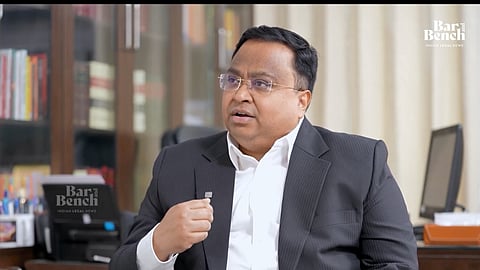
Dr Sasmit Patra is a Rajya Sabha Member of Parliament and lawyer. On the occasion of ten years of the Insolvency and Bankruptcy Code (IBC), Patra questions the inclusion of homebuyers in committees of creditors (CoCs), arguing that their interests and decisions could sometimes conflict with the commercial wisdom of institutional financial creditors.
In this interview with Bar & Bench's SN Thyagarajan, he also says that recognising homebuyers as financial creditors had diminished the relevance of the Real Estate (Regulation and Development) Act (RERA), with different groups of homebuyers frequently taking opposing positions on resolution plans.
Patra also discussed unrealistic insolvency resolution timelines, vacancies and inadequate infrastructure at tribunals, large haircuts and the need to address collusion within the insolvency ecosystem.
[Watch Interview]
Edited excerpts follow.
SN Thyagarajan (SNT): The IBC completes ten years in 2026. Has it achieved its objectives?
Sasmit Patra (SP): I think it has achieved its objectives to a large extent. Initially, the idea of the IBC was to ensure that a going concern is sustained. Compared to Securitisation and Reconstruction of Financial Assets and Enforcement of Security Interest (SARFAESI) Act, the debts recovery tribunals and other mechanisms, it has achieved that objective.
Yes, there has been criticism about the haircuts. There have been challenges. But overall, the National Company Law Tribunal (NCLT) has done well despite the limited infrastructure support it has received.
The amendments brought in by Parliament and judicial pronouncements have provided a tremendous value multiplier to the Indian economy, not only through liquidation but also through successful resolutions that preserve businesses and employment.

SNT: Would increasing the minimum default threshold from ₹1 crore to ₹5 crore help prevent misuse of the IBC as a recovery mechanism?
SP: The threshold has to be increased because ₹1 crore is quite limited. When you keep it at ₹1 crore, it basically becomes a recovery mechanism for small change. For a large organisation, ₹1 crore or ₹50 lakh is a very small amount compared to an organisation worth ₹500 crore or ₹700 crore. I would say there should be a threshold of at least ₹5 crore or even ₹10 crore.
The Delhi High Court's pecuniary jurisdiction has been increased to ₹10 crore. Why not the NCLT? Increasing the threshold will remove a large number of smaller default claims from the IBC ecosystem.
SNT: What is your assessment of the amendments proposed to the IBC in 2026? Do they sufficiently address its shortcomings?
SP: I think it is a band-aid. There are some good changes, such as cross-border insolvency and group insolvency. The proposal to make resolution professionals more like custodians, rather than persons actually running the company, is also significant. But I have serious concerns about timelines, particularly the requirement to admit or reject a petition within 14 days. You cannot expect the NCLT, which is examining evidence for the first time, to complete that exercise within 14 days.
SNT: Would prescribing shorter timelines improve efficiency?
SP: On the first day, an NCLT Bench may have to issue notice. The minimum notice period itself is two weeks. The respondent then needs two or three weeks to file a reply, followed by another two weeks for a rejoinder. Even without additional documents, completing the basic pleadings takes at least one-and-a-half to two months.
The NCLT must determine whether there is a debt and whether there is a default. That requires time. Sometimes, a bench has more than 120 matters when connected applications are counted. If you rush proceedings, orders may be challenged before the NCLAT and Supreme Court and eventually remanded. It is not about timelines. They look very nice and glossy, but does the due process of law in our country allow for those timelines?
SNT: Do you believe homebuyers should continue to enjoy the status of financial creditors under the IBC?
SP: If homebuyers were supposed to be part of the IBC, they would have been there on day one in 2016. The idea of the IBC was to protect financial creditors and not homebuyers. Homebuyers were never originally envisaged as financial creditors. Once homebuyers came in, Parliament did not reverse that position because it is not politically correct.
As a politician and parliamentarian, I understand where the government stands. If tomorrow, it says homebuyers should not be financial creditors, it will look bad politically. But the commercial wisdom of the CoC is today, in many cases, largely in the hands of homebuyers.
You have made RERA irrelevant. Why do you have RERA? What is its role?Today, RERA has almost become a certification agency. If I have a problem concerning possession or refunds, I come before the NCLT under Section 7 along with other homebuyers. You will find one group of homebuyers asking for possession and approval of a resolution plan, while another group opposes it. If the plan is good for all homebuyers, why are some petitioners and others respondents?
Politically, nobody will remove homebuyers from the IBC framework. But are homebuyers getting the best value for their money through insolvency, or would another platform serve them better?
SNT: You have questioned whether homebuyers possess the commercial wisdom required to decide the future of distressed companies. Could you elaborate?
SP: Suppose 70% of the CoC comprises homebuyers and 30% comprises financial institutions. The homebuyers may say they want possession. But financial prudence might suggest that taking a refund is better. A building may have been sitting unfinished for years. Its materials may have deteriorated. Even then, homebuyers may insist on possession.
I understand that if somebody has ₹80 lakh or ₹1 crore stuck in a property, they will be emotionally charged. But many times, possession may not be the right solution. Maybe the right solution is a refund. Financial institutions may have a better understanding of that question.
Even where institutional financial creditors have the necessary voting majority, a smaller group of homebuyers may approach the Supreme Court and explain their personal circumstances. The Supreme Court takes a strong view of homebuyers' interests on humanitarian grounds. I am not discounting homebuyers' decision-making. The question is whether they are getting the best value through this ecosystem.
SNT: Has project-wise insolvency in real estate matters worked better than placing an entire company under CIRP?
SP: I think it is a very realistic decision made by the courts. Suppose a real estate company has ten projects. Nine are running well and one has failed. If you initiate CIRP only against that particular project, the entire company does not go insolvent. Its other projects remain unaffected. Otherwise, instead of affecting 100 homebuyers, you may end up affecting 1,000 homebuyers. Project-wise insolvency protects ongoing projects and allows the successful resolution applicant to focus on the distressed project. The courts have taken the right approach.
SNT: You have repeatedly raised concerns about the infrastructure of the NCLT and NCLAT. How serious is the problem?
SP: Both require better infrastructure. I have spoken about this in Parliament and written to the government. A few months ago, I was appearing virtually before NCLT Delhi Court II when the virtual link stopped working. There was a power outage. The inverter did not work. Even after half an hour, the generator was not working. If this happens in Delhi, imagine what happens elsewhere.
In Delhi, Courts II and V have had to share a courtroom in shifts because rainwater entered courtrooms during the monsoon. Judicial and technical members operate in spaces separated by aluminium partitions. There is also a shortage of stenographers and trained staff.
I have written to Finance Minister Nirmala Sitharaman suggesting that, just as we have Kartavya Bhawan for the bureaucracy, we should have a Nyay Bhawan for tribunals. Why can't we have one building housing the NCLT, NCLAT, TDSAT, electricity appellate tribunal and GST appellate tribunal? It could have proper courtrooms, libraries and chambers. Lawyers would not have to run from one tribunal to another.
SNT: Vacancies have also become a persistent problem. What needs to change in the appointment process?
SP: Vacancies are not limited to the NCLT. You see the same problem across the judiciary. Appointments are delayed because we do not have a system that continuously identifies and recruits suitable candidates. We need a secretariat headed by a senior judge to monitor vacancies and identify talent in real time.
The Chief Justice of India already has several responsibilities. How much can one person take? There should be a committee of senior judges supporting the Chief Justice in identifying suitable candidates. If somebody is retiring in December 2026, do not start looking for a replacement in November. The process should have started six months earlier.
Vacancies also mean that members are required to sit on multiple benches. A bench may suddenly stop hearing matters because one member has to connect virtually with another bench. The remaining matters are adjourned by four or six weeks. During that period, the corporate debtor's assets continue to depreciate.
SNT: The Supreme Court has repeatedly upheld the commercial wisdom of the CoC. Should tribunals interfere with resolution plans approved by creditors?
SP: If the commercial wisdom of the CoC is supreme, why should a resolution plan approved by it remain pending before the NCLT for six months or a year?
I am appearing in a matter where the CoC has approved a plan and identified the successful resolution applicant. The Bench keeps saying it is not satisfied and wants something more. The resolution applicant says it will not increase its offer. The CoC says it has done its best. You cannot have it both ways. On one hand, you say the commercial wisdom of the CoC is supreme. On the other, the tribunal keeps asking for improvements.
If there is collusion or something suspicious about the valuation, the tribunal should intervene. But where financial creditors are satisfied, repeated compliance affidavits and remands only delay resolution. A resolution applicant willing to pay ₹10 crore today may offer only ₹7 crore after six months.
SNT: Should the law prescribe a maximum permissible haircut, given instances where creditors have lost more than 90% of their claims?
SP: Suppose you say that a haircut cannot exceed 50%. You may then end up without a successful resolution applicant. The company goes into liquidation, where creditors may recover even less. If you impose a threshold on haircuts, you are restricting the commercial wisdom of the CoC. On one hand, you say the CoC is supreme. On the other, you say it cannot accept a haircut of 90% or 97%. Both cannot work together.
The objective of the IBC is to preserve the business as a going concern and protect employment. A rigid haircut ceiling could defeat that objective.
SNT: Have operational creditors, particularly MSMEs and employees, been treated unfairly under the IBC?
SP: The waterfall mechanism under Section 53 determines the priority of distribution. Financial creditors generally enjoy a stronger position than operational creditors.
In one matter I am handling, two banks are fighting over who has the first charge and who has the second charge. There is no money left for operational creditors. One can argue that operational creditors should receive greater protection. But the IBC was fundamentally designed to protect investments and investors. If you want everybody to be treated equally, you could amend the law and provide for pari passu distribution. But that would fundamentally change the structure of insolvency resolution.
I am in favour of everybody sitting across a table and discussing the matter. Unfortunately, this is not a democracy. It is a business decision. A bank taking an 80% or 90% haircut is unlikely to voluntarily surrender part of its recovery for employees or vendors. Unless you provide for that in law, it will not happen.
SNT: As Parliament considers further IBC reforms, what should be the priorities for the next decade?
SP: I would identify three areas. First, improve infrastructure, fill vacancies and appoint permanent, properly trained staff.
Second, prescribe realistic timelines. Consult practitioners, judges and the IBBI to understand how much time is actually necessary. Do not prescribe 14 days and expect the NCLT to deliver results in that period. You are being unfair to the benches.
Third, and most crucially, identify the bad actors. There are instances of collusion, conflicts of interest and attempts to manipulate the resolution process. The IBBI periodically suspends resolution professionals and takes disciplinary action. That is good housekeeping, but the problems run deeper. We must ensure that resolution professionals do not operate under conflicts of interest, that resolution applicants are not proxies for corporate debtors and that CoCs are not improperly influenced by external stakeholders.
We may not talk about these realities, but keeping quiet will not make them disappear.
The periodic suspensions and expulsions by the IBBI are good housekeeping, but deeper chemotherapy is needed in this ecosystem. Otherwise, we are only putting a band-aid on a cancerous wound and hoping it will go away.