Parties don't trust institutions yet: Mihir Thakore on why ad-hoc arbitration still wins in India

The senior advocate speaks on the state of Indian arbitration, the persistent trust deficit around institutional arbitration and why Ahmedabad's arbitration ambitions may struggle to move beyond the domestic market.
Mihir Thakore
Mihir Thakore
Published on
6 min read
Listen to this article

The Gujarat High Court Arbitration Centre (GHAC) recently conducted a 3-day Arbitration Week 2026 at GIFT City Club, Gandhinagar The event brought together the judiciary, lawyers and arbitration practitioners to chart the future of institutional arbitration in India.
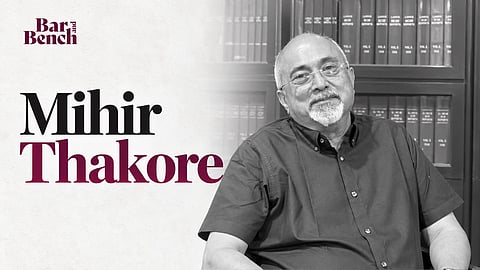
On the sidelines of the event, Bar & Bench's Pallavi Saluja spoke with Senior Advocate Mihir Thakore on the state of Indian arbitration a decade after the 2015 amendments, the persistent trust deficit around institutional arbitration and why Ahmedabad's arbitration ambitions may struggle to move beyond the domestic market.

Edited excerpts follow.

[Watch Video]

Pallavi Saluja (PS): Indian arbitration has undergone a significant change over the past decade. From your perspective, what has genuinely improved since the 2015 amendments and what reforms do we still need to make?

For arbitrations commenced after 2015, it still takes at least 3 years to conclude once pleadings are over, which is not a good sign.
Senior Advocate Mihir Thakore

Mihir Thakore (MT): To some extent, there is an improvement in the timelines by which arbitration is getting over. I can’t say it's a huge improvement, but there is a marginal improvement. There is pressure from the arbitrator to finish the arbitration. Even so, for arbitrations commenced after 2015, it still takes at least 3 years to conclude once pleadings are over, which is not a good sign.

I had a very good experience once. The arbitrator persuaded both parties that the matter turned purely on documents and that no evidence needed to be led, and both parties agreed. The matter was fixed for final hearing and the award came within 8 months.

I completely agree with Mr (former Justice) Nariman on his last suggestion that there should be a regular appeal. There cannot be these half-hearted Section 34 applications. You’re wasting time; the district judge often doesn’t know how to deal with them. Instead, there should be a full-fledged appeal directly to a division bench of the High Court, nominated specifically for this purpose. That way, awards that are questionable on grounds of integrity can be tested before a division bench, which would serve the process better.

PS: Do you agree that there should be specialised benches for hearing arbitration matters?

MT: Specialised benches come with their own problem. A single bench handling only arbitration matters can become autocratic over time. What's needed instead is a bench that takes up arbitration matters regularly, with some rotation built in. Perhaps one judge with arbitration experience sits alongside another who gains that experience over time. It shouldn't be one specialised bench holding onto the same matters for 3 years; that can be counterproductive.

PS: The Supreme Court has repeatedly emphasised the narrow scope of review under Section 34. In practice, do you think Indian courts have truly internalised that limited intervention philosophy?

MT: Substantially, yes. Courts generally don't interfere with arbitral awards but that's also the negative part of it. If an award isn't honest, courts still won't interfere, because under the patent illegality standard, they won't go into the evidence. So how do you even catch that?

PS: How do you characterise the Gujarat High Court’s approach to arbitration in recent years? Has the Court succeeded in striking the right balance between correcting arbitral awards and respecting party autonomy?

MT: Arbitral errors do get corrected, but the real limitation is that hearings often don't take place; matters simply get rotated. For instance, I have an international arbitral award in my client's favour and its execution lies with the High Court under Section 45. The other side has lost at every stage, all the way up to the Supreme Court. Yet, I remain stuck at the execution stage for more than 3 years now. No court is taking it up.

What do I tell my clients, who keep joining calls with me from Chennai? That's the real problem. Recently, (Supreme Court) Justice Pardiwala held that execution should be completed within 6 months. That may bring some progress.

PS: The conversation around arbitrator independence has become much more sophisticated clearly with the updated IBA Guidelines on Conflicts. What kind of conflicts or disclosure issues do you think Indian practitioners still underestimate? 

MT: Arbitrators are not disclosing everything. They must disclose upfront and at every stage of the hearing, how many times they've previously been appointed by a party. That disclosure simply isn't happening.

PS: There has been considerable debate about repeat appointments by the same party. Do they affect the perception of independence?

MT: They don’t affect the perception. They are not independent.

PS: India has invested heavily in developing its arbitration institutions. Why do you think parties still continue to prefer ad-hoc arbitration over institutional arbitration and how can we change that?

The real shift needed is in mindset: arbitration isn't about having someone who favours you. Once it’s institutional arbitration, the institution appoints. 
Senior Advocate Mihir Thakore

MT: Parties haven't fully realised these institutions exist, or they simply don't trust them. In my experience, parties want to retain control over appointing their own arbitrator. The first instinct is almost always to appoint someone who will favour them. That mindset doesn't sit well with institutional arbitration. Because it means losing your right to appoint. 

Changing that requires persuading both drafting lawyers and clients, even large industrial houses want to control the arbitral panel. Advertising institutional arbitration is one way to attract clients, but the real shift needed is in mindset: arbitration isn't about having someone who favours you. Once it’s institutional arbitration, the institution appoints. 

Not all institutions necessarily appoint. For example, I am doing an arbitration in Bombay, where two arbitrators are appointed by the parties and the presiding arbitrator is appointed by the Mumbai Centre for International Arbitration (MCIA). Maybe the clause is drafted like that. It should be that all arbitrators, whether single or three, should be appointed by the institution and this should be part of the agreement. 

Party autonomy lies in choosing to confer that appointment power on the institution.

PS: Do you think Ahmedabad can realistically emerge as a serious arbitration hub competing with Mumbai and Delhi and even international markets like Singapore and London?

I don’t think being in the GIFT City is of any advantage. Clients are coming into GIFT City; that might result in arbitrations coming here. I really don’t know if GIFT City has serious offices.
Senior Advocate Mihir Thakore

MT: International, very difficult. Domestic, perhaps. The issue is that even the drafting lawyers invariably put Bombay and Delhi jurisdictions because the major drafting firms are based there. So unless the party insists on Ahmedabad jurisdiction, matters will go to Bombay and Delhi. Frankly, I don’t think being in the GIFT City is of any advantage. Clients are coming into GIFT City; that might result in arbitrations coming here. I really don’t know if GIFT City has serious offices.

PS: GHAC is linked to the High Court, with the Chief Justice being its patron-in-chief and the judges being on the governing board. Does it get credibility because it's attached to the Court, or should there be some kind of separation between the two? Should outsiders be brought on the board? 

MT: For now, it's tied to the High Court, but I'm sure outsiders will eventually be brought in. That's necessary if the Centre wants to grow. Even today, the Court doesn't exercise direct control. It only controls rule-making and even those rules aren't framed by the judges; they're only reviewed and approved by them.

PS: One change that you would want to see immediately in the arbitration space?

Arbitrators shouldn't take on more than they can properly handle. 
Senior Advocate Mihir Thakore

MT: Several changes are needed. Timelines already fixed under Section 29A should be strictly implemented. Arbitrators need to exercise more discipline. I've personally stopped taking on new arbitrations because I felt overcommitted and arbitrators shouldn't take on more than they can properly handle. 

Execution needs to be enforced far more strictly and Section 11 orders should be passed within a month. If Section 11 isn't decided promptly, parties keep running to court under Section 9. If Section 11 were decided within a month, Section 9 applications would largely disappear. Everything would move to Section 17, which itself should be decided within a stipulated time. Time limits need to exist and, more importantly, they need to be enforced.

Bar and Bench - Indian Legal news
www.barandbench.com