
Subscribe
Subscribe
- Latest Legal News
- News
- Law Firms
- Columns
- Interviews
- Law School
- Legal Jobs
- हिंदी
- ಕನ್ನಡ
From a 60-partner start to a nearly 1,000-lawyer institution, Shardul Amarchand Mangaldas (SAM) has grown leaps and bounds 11 years since the split that created the firm.
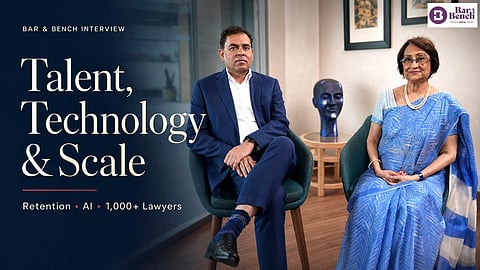
Co-managing partners Pallavi Shroff and Akshay Chudasama speak to Bar & Bench's Pallavi Saluja on the firm's journey. They discuss talent retention, AI adoption, the Management Board, succession planning and the competitive threat posed by foreign law firms entering India.
[Watch Interview]
Edited excerpts follow.
Pallavi Saluja: The firm you envisioned in 2015 and the firm you're running today - how would you compare them? What surprised you the most with the way things actually unfolded?
Pallavi Shroff: When Shardul and I realised we were going to separate and SAM would come into existence, the first question was strategy - how we'd handle Bombay, such an important commercial center. I knew Akshay and once we started talking, I realised we shared the same vision, approach and values for what we wanted in a firm. That's what clinched it for me.
The second big piece is communication. We run the firm knowing exactly what the other is doing, seeking each other's guidance, sharing thoughts. We departed from the original model of a single managing partner; we have two. How we work together as a team matters enormously and having a partner who thinks like you is critical to that. Bombay's growth has been so important to the firm and I want to attribute that entirely to Akshay. I've supported him there, but he's led it.
Akshay Chudasama: I don't actually agree with that last bit - it's been a team effort, not just mine or Pallavi's or Shardul's, but our partners' too. We've been fortunate in the group that came together.
At the start, I was quite sceptical. There were various perceptions that one had of Amarchand Mangaldas as a firm. I would say there were sort of misconceptions at that stage. 11 years on, we're both sitting here and the firm has done relatively well, but I had real apprehensions going in. It took 3 or 4 meetings before I decided to join. I was clear with myself: this was a great opportunity, but starting from scratch in Mumbai notwithstanding the firm's brand equity and legacy was going to be difficult. That we're now close to 400 lawyers in Mumbai is testimony to what we've achieved.
One thing we've been fortunate to have: Pallavi and I talk every day. We're on the same page. We'll have different views on a given situation, but there's never been a time we couldn't resolve something.
Shroff: Different views on the same issue matter - they bring out different perspectives. But we've never had something go unresolved.
Chudasama: One more thing. In one of our first conversations, Shardul told me: 'Think of this as a blank canvas. You're starting from scratch - you're the artist. I'm here to help and support you in achieving whatever it is you want.' And that's exactly what happened. There was real flexibility in how we set up the office, who we hired and how we grew it.
Saluja: The firm has grown. When you split, you were about 60 partners and you are now roughly 186. How big is the firm now?
Shroff: 925 lawyers. By July end, once the new joinees are in, we'll be at about a thousand. With staff included, we're looking at roughly 1,400–1,500 people.
Saluja: You've run the firm together for a decade now. How do responsibilities get divided between the two of you and has that division changed over the years?
Chudasama: Administratively, I look after Mumbai and Pallavi looks after Delhi - that happened naturally. What we pride ourselves on is being one firm: one P&L, one partnership. Everything we do is for the firm as a whole, regardless of geography or which office you're based in.
Shroff: If something's happening in the south, whether I go or Akshay goes just depends on who has the bandwidth at that point and what's needed.
Saluja: SAM has grown from 60 partners to 186 — three times over in a decade. Does that put a strain on the culture? How do you guard against it?
Shroff: Every growth puts some strain on culture - it's on us as senior leaders to make sure the basic values don't change. That means reiterating those values constantly, in action as much as in words. Part of it is how Akshay and I deal with each other. People see that we're a team, not individuals, and that itself speaks to the culture. Maintaining this "one firm" culture is something we've both been committed to and we've worked hard to keep it going over eleven years.
Chudasama: It hasn't been as difficult as it might sound, because there was already a legacy firm and a legacy culture to build on. We've grown from 300 to 1,000. But starting Mumbai in May 2015, then Bangalore and other offices, meant bringing in a lot of lateral hires and managing culture through that has been a real challenge. I think we've done a reasonably good job marrying the legacy culture with what the laterals brought in.
Shroff: With laterals, getting in people who share the same values and approach to the profession and to growth matters enormously. We've been lucky there. 3 times growth over 10 years is calibrated growth and that only works if the people coming in share the value system.
Chudasama: That's one of the first things we screen for - cultural fit. There have been star candidates we didn't go ahead with because we weren't confident they'd fit our culture.
Saluja: I've covered partner moves for about 15 years now — people move between firms, some come back. How do you see talent in 2026 and for the coming decade?
Chudasama: One thing we pride ourselves on is talent retention. There were a few departures in 2023–24, but by and large we lose south of 3-4 per cent of our people a year, which is normal for this market. Some leave because they don't fit; some pursue non-legal opportunities; some get poached. Our internal partner promotions have far outnumbered our lateral hires. So barring maybe a year or two with a larger exodus - particularly when a whole team leaves - I think we've done okay on retention.
Shroff: I'd agree. Losing partners to poaching is routine now. The market wasn't very mobile before 2015 - the split was actually the first time I saw real mobility in the Indian legal market. It's been mobile since and that's a good thing; it just means firms have to stay on their toes on retention. We invest heavily in that - giving people opportunity, empowerment, the right atmosphere to grow and the resources to nurture that growth.
Chudasama: This trend is going to continue. There are partners we've lost that we feel bad about, but we've also gained some stars. You have to accept this is the market we operate in; the legal industry isn't any different from any other.
Saluja: When a partner leaves, what honest internal conversation happens within the firm?
Shroff: We analyse it. Akshay and I talk about what happened, why it happened and whether we could have done anything differently for that partner or for that practice. We definitely will do an internal analysis.
Chudasama: Often the answer isn't obvious. It could be overcrowding in a particular practice, or a better opportunity elsewhere. We do exit interviews for nearly everyone who leaves and that feedback comes to us. We look at it, try to understand what went wrong and correct it where we can.
Saluja: How has your retention strategy evolved over the last decade?
Shroff: It's about giving people the right opportunities and a culture where they're valued and can grow. The firm can't grow if the partners don't; individuals and teams both need room to develop. We showcase our bench strength to clients and build systems around growth so no one feels overlooked, so people can represent the firm, represent themselves and get recognised. Those systems matter, but creating that right atmosphere is very important for everybody.
Chudasama: Compensation matters too. We have to stay competitive. That's a conversation we have regularly with HR, keeping pace with the market.
Saluja: 15 years ago, when we had interviewed Shardul Shroff, this is what he had said and that stayed with me:
“We see ourselves as trustees for the future generation. We believe in the Tata Sons and the Reader's Digest model that each one of us is here for a limited time. We contribute money, we act as trustees for the future and we exit at our historical course.”
Has this remained the same or has something changed since then?
Shroff: It is still the same. We are ultimately trustees. We are not permanent in life. None of us want to be permanent fixtures in a firm. You lose your own value; you have to go. As I said, we as a firm have adopted a dual model where there may be one person from the firm, one from non-family. That will continue. I see great value in having that. Ultimately, when you talk of the next generation, it's the next generation from the Shroff family and the next generation from the rest of our partnership. We have a very robust partnership and very good people. So at the end of the day, I am confident that we will do what is good for the firm. Whatever else happens, the firm is first.
Saluja: What does the next generation of leadership at SAM need to look like?
Shroff: I am very committed. You need to have a leader who is committed, who is willing to make sacrifices, who has a vision and thinks of others first. ‘Firm first’ is the first thing.
Saluja: You talk about the next generation of family that has come into the management board. How do you ensure that the family's continued presence in the leadership doesn't become a ceiling for a non-family member to reach at the top?
Shroff: The non-family will always be in the majority. So the family’s presence never becomes a ceiling. The family will always remain in the minority.
Chudasama: We talk about family and non-family, but the key is that it has to be on merit. It's the larger interest of the firm that must prevail over anything else.
Saluja: When you talk about succession, is there a plan on what the transition going to be?
Chudasama: Look, it's not that people are ignoring succession issues and shoving them under the carpet. We do discuss them all the time, but as you can appreciate, these are not easy decisions. This has nothing to do with family, non-family. It's just got to do with the firm. In every single firm, succession is an issue. As one generation passes the mantle to the next, it's something that we discuss. I wouldn't be surprised if after this interview, the two of us and Shardul are sitting and discussing succession. It takes time and there are no easy answers to certain things.
Shroff: Our approach is very clear. On merits and “firm first”. Two things.
Saluja: Do you see the entry of foreign law firms as competition?
Chudasama: Quite frankly, I don't perceive it as being a huge problem. Of course, if they do come in, we would want to ensure that it is a level playing field in that sense. And I don't think that there's a second view. There is no level playing field. There will be a certain amount of impact on the market, but I think it'll be for a temporary period. If you were to look at various geographies across the world, not only in Asia, the number one law firms in those countries are domestic independent law firms who are not affiliated to large international firms. So I don't really think that it's a problem. There could be some initial tremors, but I can't see this being an earthquake.
Shroff: I think this should be a challenge that we Indian law firms take on board and see how we change ourselves, improve ourselves into being more and more professional, at a certain level where we compete with those firms. I think it's a huge challenge which we have to accept.
Chudasama: There are a lot of positives. It will force Indian firms to update their systems, professionalise more, etc. If I go back to 20 years ago and look at the quality of output of Indian law firms, and you look at where it is today, that gap has actually shortened. There are various instances where clients actually appreciate the work that we are doing more than they do some international firms.
Shroff: When private equity firms came into India, they always came with their foreign law firms, but now they don't need their foreign law firm. They're very happy with everything that the Indian law firms have. So I think firms have also accepted the challenge and grown. Do we have to have more systems, processes and use of technology? Of course. We have to invest in the firm.
Saluja: Do you have plans to go international?
Chudasama: I don't think so. It's not that we haven't discussed and thought about it, but not at the moment for sure. We have enough on our plates here. My own personal view is that it might be a little bit of a distraction with limited benefits.
Shroff: I think there's just so much growth opportunity here in India. This is my home turf. We are so familiar with it. We have talent, we have everything. Why would I want to go and spend myself outside? I would rather use my energies to grow here.
Chudasama: Of course, if a great opportunity falls into our lap, we will certainly look at it.
Saluja: Coming to AI and technology, where is the firm in terms of AI? Is it still in the pilot stage or is it in the workflow system? Are all practices using AI?
Chudasama: I'll give you two statistics. 95% of our lawyers are using AI regularly. More than 50% of them use AI every single day. So that should give you a good idea. We were the first large firm to bring Harvey on board. We're using AI quite a lot. Obviously, with all of the checks and balances that one needs in terms of sort of security, in terms of making sure that the data is not compromised in any way, all of those checks and balances are in place.
Shroff: For us, investment in technology has been a priority for quite a while now. I'm so happy that we did invest in technology, because when COVID happened and we had to shift to work from home one fine morning, Akshay and I spoke and we told our firm to just go home. We could do that instantly because our system is already in place. That afternoon, we went home and started working, logging on and working on Teams. So we've invested a lot in technology. We have very robust platforms. We have our intranet system called SAM Atlas. We have SAM Wise, which is our knowledge portal. We use Harvey on all of this. Clementine - all our training programs are on that. We also have recorded training programs that people can access at any time from anywhere. So we have very heavily invested in technology.
Pallavi Saluja: In terms of deciding on Harvey or any other AI product, does the management take a call or do you have a CTO?
Chudasama: Prior to our decision to go with Harvey, we went through a pretty robust check in terms of what was available, what the advantages and disadvantages of different platforms were. We discussed it. We had a pilot going on for a while. Then we discussed it on the management level and then finally decided to go with Harvey.
Shroff: Naval (Chopra) and a team of lawyers work with our CTO to evaluate several products that are in the market and we ran pilots for 3-4 months. About 150 users were involved across our offices in the pilot. Then they made a recommendation and we went with it.
Saluja: This was big news that Kirkland & Ellis is investing a lot in AI and investing, building their own AI. Is the firm thinking in that direction?
Shroff: We don't need to. There are enough products in the market which we can use to our benefit.
Saluja: When we talk about AI, we also talk about billing. Are you seeing any pressure from your clients to move away from the hourly billing system?
Chudasama: There are billing pressures all the time, but not as a result of AI. Also, I think that we're still in a very early phase in the usage of AI. So it's not like we're blindly trusting it. There's still a lot of physical manual checking that we do in terms of the product that comes about. We find that Harvey has actually really helped us in legal reasoning. As far as legal research is concerned, I think there's still some work that has to be done. One of the things that we are looking at is specific customised workflows, which will be very unique to us. So that is really where the focus of the AI team is at the moment.
Saluja: Are there any specific practice areas where AI is being used a lot more than other practice areas?
Chudasama: Litigation probably uses it less than other practice areas also because you have to be very careful about things like hallucinations. We've seen that in the Supreme Court. I think it's also not so much about practice areas as it is about work streams. It's good to generate a first draft, for example, which will help you with drafting, but then you cannot just rely on that draft blindly and send that across to a client. There is a certain amount of manual checks that have to go through.
Saluja: Has AI affected your fresher hiring - up, down, or the same?
Shroff: We may see an impact going forward. As of this year, I don't see a change. We have to wait and see the impact of AI tools and how much people are using it. I guess over a couple of years we will see an impact.
Saluja: With AI taking over the grunt work juniors used to do, is junior training changing?
Chudasama: Yes, AI training will be part of it. Things are changing, no doubt about that. We need to adapt to the new world and we already are.
Shroff: For those of us trained the old way, on drafting from scratch, accepting that the new generation doesn't want that because they can use AI is a challenge. We have to change and find newer ways to train them. If the first draft now comes from Harvey, we need to spend time teaching them how to read that draft: what to look for, where the law is. That means spending more time with juniors, not less.
Saluja: What's next for the firm - any developments coming in the next couple of years?
Chudasama: Calibrated growth. I think we've always been very clear that it's not about numbers. It’s not about being the largest firm out there. I think the focus has to be on the bottom line more than it has to be on the top line. That's kind of been our philosophy, obviously at a particular scale.
Shroff: Working closely with different professional services is very important for us also. Therefore, the kind of knowledge that lawyers have to have is also changing. Lawyers typically run away from numbers and balance sheets and all, but if you want to do an M&A deal, you can't run away from balance sheets.
Chudasama: It's the first thing I tell juniors on any M&A transaction - look at the numbers, read the companies' annual reports, understand the underlying business. If you don't understand the business, you can't advise the client properly.
Saluja: What's one challenge that keeps you up at night?
Chudasama: I think for me - and I don't want to sound as if I'm contradicting myself - but I think talent retention is always a challenge. We've been fortunate so far, but that is always the challenge. Ultimately, any law firm is only as good as the people that make it up.
Shroff: I would add data security. With the volume of cyberattacks we're seeing - every major company in India has faced one, whether they admit it or not. We have to stay on our toes. How secure we are at the end of the day is important for us today.
But talent comes first and what more can we do for talent growth. Talent stays where there's growth.