
Subscribe
Subscribe
- Latest Legal News
- News
- Law Firms
- Columns
- Interviews
- Law School
- Legal Jobs
- हिंदी
- ಕನ್ನಡ
On 17 September 2026, the Tata Sons Board voted to reappoint N Chandrasekaran as Executive Chairman for five years, despite Noel Tata, the seniormost surviving Tata, and Chairman of the Tata Trusts, opposing the appointment. The legal controversy concerns the interpretation of article 118 of the Tata Sons’ articles of association which says “… the Board may appoint the person so recommended as the Chairman of the Board of Directors, subject to Article 121 which requires the affirmative vote of [the directors on Tata Sons that have been appointed by the Tata Trusts (Tata Trusts nominee directors)]”.
Article 121 says “Matters… shall require the affirmative vote of a majority of [Tata Trusts nominee directors]… and in the case of an equality of votes the Chairman shall have a casting vote”.
The jury is out on whether the last line means that the casting vote can break a deadlock if it has been caused by (a) equality at the overall Board level, which is the N Chandrasekaran and Harish Salve position or (b) if there is an equality amongst the Tata Trusts nominee directors, which is the Noel Tata and retd CJI DY Chandrachud position.
With the two Tata Trusts nominee directors, Noel Tata and Venu Srinivasan opposing and supporting the resolution, the question is whether N Chandrasekaran’s appointment actually received the ‘affirmative vote’. Noel Tata contends that since one of the two Tata Trusts nominee directors has not voted in favour of the resolution, the requirement that a majority of Trust nominated directors supporting the resolution has not been satisfied.
The reappointment dispute coincides with the larger disagreement over whether Tata Sons should be listed. Mr Noel Tata has expressed his desire to allow Tata Sons to remain unlisted on grounds that that “permitted Tata Sons to act repeatedly in ways that a purely commercial calculus would not have supported”.
While I support philanthropic activities and understand that sometimes nation building requires investments into loss making enterprises, the question is whether listing Tata Sons could promote transparency and introduce checks and balances through accountability, which would assist in mitigating losses such as the present day situation.
It would appear that Noel Tata is, understandably, alarmed both by Air India’s heavy losses, and whether their continued escalation can wipe out the entire group. Although investing in the airline was not N Chandrasekaran’s decision, managing it has been a responsibility he has shouldered. The various management decisions (and sufferings from the crash, operation Sindoor etc) have been overseen by him.
In my view, Tata Sons may benefit from the transparency and accountability of listing, which could steer future investments in profitable enterprises and mitigate losses sustained by older ones. In the end, a profitable Tata Sons would translate into more in the coffers for Tata Trusts to spend on their philanthropic activities. Tata Sons does not, of itself, need to carry the burden of philanthropy.
International experience suggests that listing and philanthropy need not be mutually exclusive. At Hershey’s, the chocolate making company, the publicly listed company has a charitable controlling stockholder - the Milton Hershey School Trust which holds approximately 79%, while a school is the Trust's sole beneficiary. The Trust receives a substantial portion of the dividends paid by the company. Wipro provides an Indian example where Azim Premji irrevocably transferred 66% of Wipro to the Azim Premji Foundation, while Wipro remains a commercial, listed company. Another example would be Novo Nordisk, which offers perhaps the clearest structural example. It is a publicly listed company under the controlling voting interest of the Novo Nordisk Foundation, whose purpose includes providing a stable basis for the companies’ commercial activities as well as funding scientific, humanitarian and social purposes.
The comparative lesson, therefore, is not that listing necessarily destroys a company’s philanthropic character. Governance architecture can be chosen to preserve that character after listing. Shapoorji Pallonji Mistry’s position captures this alternative possibility well where he said,
“I have repeatedly said that the public listing of Tata Sons is not merely a financial or regulatory matter. It is a social and moral imperative. It is about strengthening transparency and public accountability in one of India’s most consequential business institutions, while preserving and advancing the extraordinary philanthropic purpose that lies at the heart of the Tata legacy.”
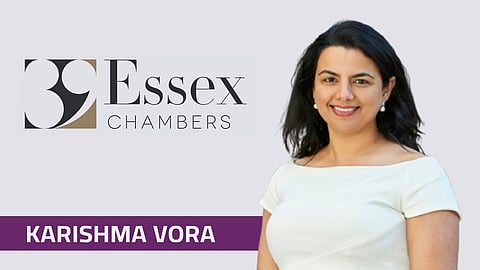
About the author: Karishma Vora is a Barrister at 39 Essex Chamber.
Disclaimer: The opinions expressed in this article are those of the author(s). The opinions presented do not necessarily reflect the views of Bar & Bench.
If you would like your Deals, Columns, Press Releases to be published on Bar & Bench, please fill in the form available here.