

Fourteen special courts to deal with terror, drug trafficking, paper leak and organised crime cases were inaugurated on Monday in Delhi’s Rouse Avenue Courts complex.
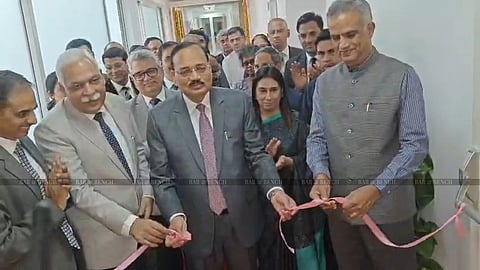
These special courts have been established by the Delhi High Court following the directions issued by the Supreme Court of India in a suo motu case.
“At present there would be 6 Courts dealing with matters under NIA Act and UAPA, 3 Courts for MCOC Act cases and 4 Courts dealing with NDPS Act matters. One Specially Designated Fast Track Court has also been set up to try offences under Public Examinations (Prevention of Unfair Means) Act, 2024 and connected offences at Rouse Avenue Court Complex,” a communication issued by the Delhi High Court said.
The courts were inaugurated by Chief Justice of India (CJI) Surya Kant. Delhi High Court Chief Justice Devendra Kumar Upadhyaya, Justice Jyoti Singh, who is the chairperson of Rouse Avenue court's Portfolio Judges’ Committee, and several other judges attended the inauguration ceremony.
Speaking at the event, CJI Surya Kant said that the prosecutions under the NIA Act, UAPA and the NDPS Act demand sustained judicial attention and specialised expertise.
“Dedicated Courts seek to address these challenges in a structured and lasting manner. They enable Judges to develop subject- matter expertise, ensure uninterrupted hearings, and encourage more effective case management. Over time, this accumulated experience translates into greater judicial efficiency and consistency, allowing complex prosecutions to progress more smoothly while preserving every safeguard of fairness and due process,” he said.
He added that the success of the special courts will ultimately depend on the shared commitment of every institution and individuals forming part of the criminal justice system.
“Judges must continue to ensure fairness with firmness. Investigating agencies must conduct professional and timely investigations. Prosecutors must present their cases with diligence and objectivity. Members of the bar must assist the court with the highest standards of professional responsibility. Court staff must continue to provide the indispensable administrative support that keeps the wheels of justice moving. When each stakeholder embraces this shared responsibility, timely justice ceases to be an aspiration, rather, it becomes a lived reality,” the CJI said.
High Court Chief Justice Upadhyaya underscored that infrastructural requirements in the national capital are immense and while they are interacting with authorities to meet this demand, a lot more needs to be done.
He said that the judicial officers, prosecutors, investigators and members of the bar must work in tandem to realise the goal of providing speedy access to justice.
“Unless we come together and discharge our functions in tandem with each other, the infrastructure itself is not enough. If we are to realise speedy justice, all stakeholders need to work together,” he said.