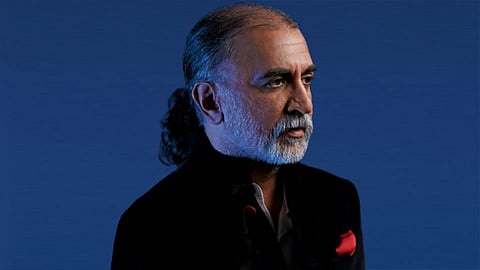

The Bombay High Court on Thursday reserved is verdict in the appeal filed by State of Goa against the acquittal of former Tehelka editor Tarun Tejpal in the 2013 sexual assault case [State of Goa v. Tarunjit Tejpal & Anr].
A division bench of Justices Neela Gokhale and Amit Jamsandekar completed the hearing in the appeal in seven sessions before reserving the plea.
During the hearings, the State alleged that the trial court’s judgment was perverse and coloured by prejudice. Tejpal maintained that the acquittal was based on a careful reading of the record, including CCTV footage, messages and expert evidence.
Solicitor General Tushar Mehta, appearing for State of Goa, told the High Court that the trial court had effectively put the complainant on trial, instead of assessing the accused’s conduct. He argued that the trial judge had relied on her personal life, post-incident messages and perceived normative behaviour. He argued that the judgment was a classic case of perversity, with findings unsupported by law or evidence and a selective reading of the complainant’s testimony.
He further argued that:
Complainant was asked intrusive and irrelevant questions about consensual sex, drinking and smoking, which violated settled protections in sexual offence trials. The judge should have intervened to stop improper cross-examination, because courts are not post offices and must enforce statutory safeguards for victims.
Reliance on WhatsApp chats, alleged sexual overtones and personal conduct amounted to barred character evidence and could not be used to infer consent. He argued a woman’s openness about consensual sex or her lifestyle choices cannot be equated with consent to the acts alleged in the case.
Trauma has no single template, so the trial court erred in treating the complainant’s conduct after the incident as proof that she was not distressed.
The complainant has been “sterling” witness whose core account remained steady despite aggressive cross-examination.
On the defence claim that nothing happened, the State pointed to the apology email and said it made little sense to apologise if no incident had occurred.
Senior advocate Aabad Ponda argued that the acquittal was justified because the complainant’s version was contradicted by CCTV footage, panchanama material and expert evidence on the hotel lift’s functioning. He claimed the complaint was tied to personal and professional dissatisfaction. He also alleged that the criminal case was driven by media and institutional pressure rather than the complainant’s own initiative.
He further argued that:
The lift doors opened twice during the relevant time undermining the claim of a continuous assault in a sealed lift. He stressed that the complainant’s account shifted on key details such as the floor where the lift stopped, the buttons pressed and who exited first.
CCTV footage showed the complainant waiting for Tejpal, walking with him and later exiting in a manner inconsistent with a person who was repulsed or terrified.
WhatsApp messages, SMSes and other communications relied on by them showed that the complainant appeared socially normal after the episode and was not acting like a traumatised victim.
The complainant deleted messages, refused to log into her phone in court and edited her narrative before sharing it with others, showing deliberate concealment and coaching.
The defence was one of complete denial, not a consent defence, and said the prosecution had to prove that any sexual act occurred at all.
Mehta was assisted by Advocate General Devidas Pangam and public prosecutors Shailendra Bhobe and Pravin Faldessai.
Ponda was assisted by advocates Subhash Jadhav and Raunaq Rao.