Bombay High Court to examine whether major liquor companies can resume sale after FSSAI prohibition

Companies including United Spirits and Mohan Meakin, which own liquor brands like McDowell’s No. 1 and Old Monk, approached the High Court after FSSAI effectively halted the sale of their Indian-Made Foreign Liquor.
McDowells, Old Monk
McDowells, Old Monk
Published on
3 min read
Listen to this article

The Bombay High Court will examine on August 10 a plea by various liquor manufacturers challenging prohibitory orders passed against them by the Food Safety and Standards Authority of India (FSSAI). [United Spirits and Anr v. FSSAI & ORs.]
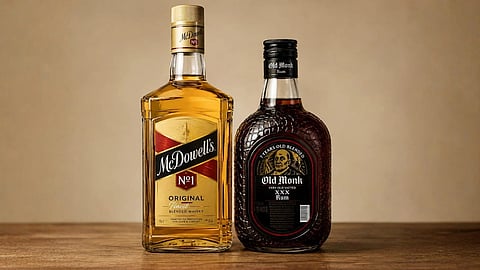
Companies including United Spirits and Mohan Meakin, which own liquor brands like McDowell’s No.1 and Old Monk respectively, approached the High Court after FSSAI took regulatory action which effectively halted the sale of their Indian-Made Foreign Liquor (IMFL) since June.

The FSSAI took the action citing misleading labelling and unauthorised flavour additions. The manufacturers then approached the High Court.

When the matter came up for hearing on Friday, a Bench of Acting Chief Justice Ravindra Ghuge and Justice Gautam Ankhad acknowledged that industry-wide shutdown overnight posed significant challenges.

However, since any decision by the Bench would have wide-reaching impact on manufacturers, distributors, and consumers, the bench deemed it fit to let the Additional Solicitor General (ASG) Anil Singh appear with instructions from FSSAI.

“We agree that everything can't be shut down overnight. However, we are not the experts or in the position to tell as to how we should analyse this product or its composition, and what we should call it if it is to be marketed. It is an old problem, to balance everything out. But since it is an industry wide issue, it is important that the ASG remain present." 

Acting Chief Justice Ravindra Ghuge and Justice Gautam Ankhad

The dispute stemmed from an FSSAI directive prohibiting sales of popular liquor products that add external rum or whisky flavours to spirits sold under standard product names.

FSSAI claimed that incorporating artificial or nature-identical rum or whisky flavoring masks a spirit's natural compositions. It makes it sub-standard and misleading to consumers unless labeled as a flavoured product or spirit with rum flavour.

Senior Advocate Birendra Saraf, representing United Spirits, argued that the regulator’s abrupt prohibition orders threatened to bring a significant portion of the domestic spirits industry to a complete standstill.

"The action taken by FSSAI has effectively shut down 30% of the Indian-Made Foreign Liquor (IMFL) industry. These products have been manufactured for over five decades. Suddenly, they come for inspection one day and give us notice," he said. 

Senior advocate Birendra Saraf

Saraf highlighted that the traditional process for IMFL rum involves blending a matured rum concentrate with neutral spirit, where additional flavour is added to round out the taste profile. He emphasised that this manufacturing practice has been used for around 50 years by McDowells. 

"Suddenly, they come and tell us that you can add orange flavor, you can add lime flavor, but in rum, you cannot add rum flavor because the only taste should be of the natural thing. They say you can't even add rum flavor. And if you want to sell this product, then don't call it rum at all. You call it 'Rum Flavored Spirit'...Essentially, there is an absolute prohibition saying you should not sell any rum with rum flavour in it,” Saraf submitted.

According to the manufacturer, the regulator also flagged labelling descriptions such as ‘matured in cask’ on bottles where neutral unmatured spirit forms the primary component and matured rum constitutes a minor portion. 

The FSSAI maintained that under existing regulations, age claims must accurately represent the youngest spirit in the blend.

During proceedings, the Court questioned the feasibility of adopting modified labelling to address the regulator's concerns.

Saraf responded that relabelling could not be executed overnight due to state-level regulatory approvals.

"Today, changing of a label is also not that tomorrow morning I can change my label by adding a sticker. Every label that I put has to be approved by the state excise department,” he said. 

In response, FSSAI counsel maintained that the action was aimed at enforcing proper labelling standards and preventing consumer deception.

“We have no objection but use the labels correctly. That is our [concern]. If they correct the labels, we have no problem," the counsel said. 

FSSAI also reiterated its position that there is no recognised international practice where external rum flavour is added to standard rum or whisky flavour to whisky to mimic ageing. Such a practice is misleading, it was contended.

Bar and Bench - Indian Legal news
www.barandbench.com