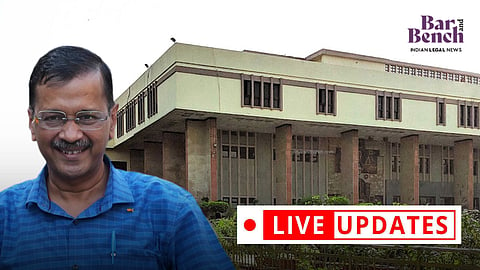
Delhi HC hears Arvind Kejriwal plea for recusal of Justice Swarana Kanta Sharma in excise case: LIVE UPDATES

Kejriwal has filed an application requesting Justice Sharma to recuse from hearing CBI's challenge to a trial court discharging all the accused in the Delhi excise policy case.
Arvind Kejriwal, DelhiHC, live updates

Kejriwal concludes.

Bench: I will take a two minute break.

Kejriwal: Ek old tradition thi ki judges ke near or dear ones agar kisi party se related hote the to wo judges us case se recuse kar jaate the (Translation: There used to be an old tradition that if a judge’s near or dear ones were connected to a party, the judge would recuse themselves from that case).

Bench records the submission.

Kejriwal: Abhi kuchh dino se social media pe ek mudda chal raha hai ki ek old tradition hai ki judges ke near and dear ones (For the past few days, an issue has been circulating on social media—that there is an old tradition concerning judges’ near and dear ones).

SG: Statements are being made that are not part of the pleadings.

Kejriwal: Abhi thode din pehle Home Minister Amit Shah ne ek statement diya ki HC se jo judgement aaega uske baad Kejriwal ko SC jaana padega.

(Translation: A few days ago, Home Minister Amit Shah made a statement that after the High Court’s judgment, Kejriwal would have to go to the Supreme Court.)

SG objects: There is no pleading to that effect.

Bench: Mr Mehta, I will deal with it.

Bench: What control I have over what someone says?

Bench records that there was no pleading to that effect but Kejriwal made the statement at bar.

Bench: There was one question. Aapne apne application m programme ka link nhi diya hai. I had a question that when i went to that programme had i made an ideological statement or a political statement or was it a legal programme.

(Translation: There is one question. In your application, you have not provided a link to the programme. I wanted to ask—when I attended that programme, did I make any ideological statement or political statement, or was it a legal programme?)

Kejriwal: The mere fact you attended the programme gives rise to an apprehension

Court records the submissions.

Kejriwal: If your honour is attending the programme of a particular ideology, then ek mere mind me apprehension paida hota hai

(Translation: If Your Honour is attending programs of a particular ideology, then an apprehension arises in my mind.)

Bench: Ki main us ideology ko follow karti hu?

(Translation: That I follow that ideology?)

Kejriwal: Aapke 4 baar jaane se mere mind m apprehension paida hota hai ki will I get justice.

(Translation: Your attending four times creates an apprehension in my mind—whether I will get justice.)

Kejriwal: Ek sangathan hain Akhil Bharatiya Adhivakta Parisdha. Unke event ko your honour (the judge presiding) 4 baar attend kar ke aai thi. Unki jo ideology hain ham uske sakht khilaaf hain aur khul ke khilaaf hain. Ye case political hai.

(Translation: There is an organization, the Akhil Bharatiya Adhivakta Parishad. Your Honour (the presiding judge) has attended its events four times. The ideology they follow is something we strongly oppose, and we oppose it openly. This case is political.)

Kejriwal: Last week meri pehli apperance this is court ke saamne. Us din kaafi log chilla raha the ki hame reply ka time dijiye.

Bench: Chilla nhi rahe the, plead kar rahe the. Chillaega kyu koi?

Kejriwal: SG TUshar Mehta ji ne bola ki ek week ka time aur de dijiye aur ek week ka time de diya gaya.

Court records the submission.

Kejriwal: Ma'am shouting ko pleading kar dijiye. M to pehli baar aaya hu is court me, main nervous hu.

(Translation -

Kejriwal: Last week was my first appearance before this court. That day, many people were saying loudly that we should be given time to file a reply.

Bench: They were not shouting, they were pleading. Why would anyone shout?

Kejriwal: SG Tushar Mehta requested that one more week be given, and one week’s time was granted.

(The court records the submission.)

Kejriwal: Ma’am, you may call it pleading instead of shouting. I am appearing in this court for the first time—I am nervous.)

He refers to the March 9 order.

Kejriwal: 27 Feb ko trial court ka order aaya. 4 ghante me CBI ne is court m appeal file kar di this. 500 page se zyada ki judgment hain. Court ne ek ek charge ko examine kiya hai aur fir detailed finding di hai. CBI ki appeal m kisi bhi finding ko le ke koi finding nhi hai. Is appeal ko pehle din hi dismiss kar dena chahiye tha. Wo defective hai. Us defective petition pe ek sweeping order paas kiya gaya.

(Translation: On 27 February, the trial court’s order was delivered. Within four hours, the CBI filed an appeal before this court. It is a judgment of more than 500 pages. The court examined each and every charge and then gave detailed findings. In the CBI’s appeal, there is no finding addressing any of those findings. This appeal should have been dismissed on the very first day. It is defective. Yet, on that defective petition, a sweeping order was passed.)

Kejriwal: CBI aur ED ne bola ye sab corrupt hain to court ne bola ye corrupt hain (The CBI and ED said that 'all of them are corrupt', and the court said 'they are corrupt').

Kejriwal: Reason 8: Ek trend observe karne ko mil raha hai ki every single averment of CBI and ED has been endorsed (A trend can be observed that every single averment of the CBI and ED has been endorsed).

Bench: Endorsed nahi upheld (Not endorsed—upheld).

Kejriwal: Every prayer has been turned into a judgment.

Bench: This argument i don't understand.

Kejriwal: Jab bhi wo argu karte hai to usko accept kar liya jaata hai aur order unke favour me pass hota hai (Whenever they argue, it is accepted, and orders are passed in their favour).

Justice Sharma objections to disturbance in Court.

Justice Sharma: I will write that you are vitiating these proceedings... Don't stare at me.

The Bench records Kejriwal's submissions.

Kejriwal refers to one case where he says the Court gave three months time.

Kejriwal: Our right to reply was closed.

Bench: Abhi kaha koi right close hui hai? (Where has any right been closed yet?)

Kejriwal: Madam 10 april ka time diya tha (Madam, time had been given till April 10).

Bench: Haan to nhi file karoge to close to hoga hi (Yes, so if you don’t file it, it will be closed).

Kejriwal: Reason no 6. We have analysed the way criminal revision petitions have been dealt with by this case. The speed at which this case is going and another case is going is speed se koi aur case nhi chal raha. ye dono case sabse prominent opposition political parties ke hain.

(Translation: Reason no. 6 — We have analyzed the manner in which criminal revision petitions have been dealt with in this court. The speed at which this case is proceeding, and another case as well—no other case is moving at this pace. Both these cases involve prominent opposition political parties.)

Justice Sharma: To aap political bias bhi bol rahe hain?

(Translation: So are you also alleging political bias?)

Kejriwal: Aapne apne order [March 9 order] me ye bhi likha that there was advance service hui thi, but we did not appear. In March 16, you have written we chose not to appear. Madam isse takleef hui. ye case 4 saal se chal raha hai aur hum aapke saamne hain. The language used by this court also indicated a bias.

(Translation: In your order [the March 9 order], you also wrote that there had been advance service, but we did not appear. On March 16, you wrote that we chose not to appear. Madam, that caused distress. This case has been going on for four years, and we have been appearing before you. The language used by this court also indicated a bias.)

Kejriwal: There is an order of SC that says that no order of discharge should be stayed except in exceptional circumstances. Hame bina sune the order was partly stayed. In my view this is violation of the SC order. So it appears that most of the trial court order is mostly neutralised by the march 9 order.

(Translation: There is an order of the Supreme Court which says that a discharge order should not be stayed except in exceptional circumstances. Without hearing us, the order was partly stayed. In my view, this is a violation of the Supreme Court’s order. So it appears that most of the trial court’s order has been largely neutralized by the March 9 order.)

Kejriwal: Trial court ke remarks were not against CBI. They were against the CBI Investigating Officer. He is not a party. He has not petitioned the court. CBI has come. CBI ke kehne pe IO ki proceedings ko rok dena bohot gehri shanka paida karta hai.

(Translation: The trial court’s remarks were not against the CBI; they were against the CBI’s Investigating Officer. He is not a party and has not approached the court. The CBI has come, and on its request, staying the proceedings against the Investigating Officer creates a deep apprehension.)

Kejriwal: Iske bohot heavy consequences hain ki aaj bhi main ED case me accused hu. Ek message ye gaya janta me ki ED ki proceedings ko pending rakho ki hum is discharge order ko set aside kar ke waapas bhej rahe hain. ye message gaya logo me.

(Translation: This has very serious consequences—even today I am an accused in the ED case. A message went out to the public that the ED proceedings should be kept pending, as we are setting aside the discharge order and sending it back. That is the message that went to people.)

Bench: Log kaun hain? Aap accused hi to ho.

(Translation: Who are these ‘people’? You are, after all, an accused.)

Kejriwal: In the March 9 ko ED ke favour m order pass kar diya. The Court was very generous to ED. The order was passed without following the principles of natural justice.

(Translation: On March 9, an order was passed in favour of the ED. The court was very generous to the ED. The order was passed without following the principles of natural justice.)

Kejriwal: Us din [March 9] aapke saamne trial court ka record bhi nhi tha. What was the need or urgency [for this order]? Uski wajah se ek shanka paida hui (Translation: On that day [March 9], even the trial court record was not before you. What was the need or urgency for this order? Because of it, an apprehension arose.)

Bench: Ye toh aap question nai kar skte ki kya need thi. Ye aap mujhe mat batao maine order kaise likha ye aap Supreme Court ko bataoge (Translation: You cannot question what the need was. Don’t tell me how I wrote the order—you can tell that to the Supreme Court.)

Kejriwal: 5-10 minute ki hearing m trial court order jo 3 maheene ki hearing ke baad aaya tha... Aapki jo finding approvers ke baare me, jab mera case aapke saamne aaya tha, aapne bola tha ki approver ke statements addmissible hain. Yha 5 minute ki sunwai ke baad aapne bola ki trial court ki findings approvers statements erroneous hain. That was the most concerning thing for me. It shows that the court still strongly sticks to its earlier findings.

(Translation: In a 5–10 minute hearing, the trial court’s order—which had come after three months of hearings… Your finding about the approvers—when my case came before you earlier, you had said that approver statements are admissible. Here, after just a five-minute hearing, you said that the trial court’s findings on the approver statements are erroneous. That was the most concerning thing for me. It shows that the court still strongly sticks to its earlier findings.)

Kejriwal: CBI ka pura case sirf approver statements pe hai. 9 March ke order me aapne agar un statements pe question khada kar diya to practically you have rejected the entire trial court order.

(Translation: The CBI’s entire case is based only on approver statements. In the 9 March order, if you have raised doubts about those statements, then practically you have rejected the entire trial court order.)

Kejriwal: Trial court ne Manish Sisodia ko puri tarah nirdosh paya. This shows that this court is totally committed to facts. To ab question ye hai ki kya is stage pe aa ke ye court badal paaega?

(Translation: The trial court found Manish Sisodia completely innocent. This shows that the trial court is fully committed to the facts. So now the question is whether, at this stage, this court will be able to change its stance?)

Court records Kejriwal's submissions.

Kejriwal: is case me bas 3 hearing hui thi and a conclusion was drawn that Manish (Sisodia) is a very corrupt person (In this case, there were only three hearings, and a conclusion was drawn that Manish Sisodia is a very corrupt person). This case was set aside by the SC.

SG: It was not set aside.

Bench: Mr Jain aap unko (Kejriwal) ko assist kar rahe ho. Aap seedha mujhe hi assist kar do na... Wo bina aapke bohot accha argue kar rahe hain... Your litigant is arguing very well.

(Translation: Mr. Jain (lawyer present in court), you are assisting him (Kejriwal). Why don’t you assist me directly instead? … He is arguing very well without you… Your litigant is arguing very well.)

Kejriwal: He (Sisodia) was declared guilty which was not necessary. There was one paragraph jaha pe kaha gaya ki ye saare log corrupt hai. Aesa laga ki hame sirf corrupt hi nahi maha corrupt declare kiya gaya.

(Translation: There was one paragraph where it was said that all these people are corrupt. It felt as if we were not just declared corrupt, but extremely corrupt.)

Kejriwal: I will now come to Manish Sisodia's case (decided by Justice Sharma).

Kejriwal: Trial court ne bola jis tarah CBI ne approvers banaye unka conduct was to prove a premeditated outcome. Finally the trial court discharged me completely with completely contrary findings to this court to isliye man me ek shanka hai.

(Translation: The trial court said that the way the CBI made approvers, their conduct was aimed at proving a premeditated outcome. Ultimately, the trial court completely discharged me, with findings that were entirely contrary to those of this court. Therefore, there is an apprehension in my mind.)

Justice Sharma records another submission by Kejriwal.

Kejriwal refers to the trial court judgement.

Justice Sharma: Aapki submission kya hai? Kyunki trial court ne maine bola hai usko galat declare kiya hai...Jis waqt maine faisla kiya us time is court (trial court) ka to faisla tha nahi. Uspe (trial court) ke order p ham tab jaaega jab wo decide karenge. Aaj ham sirf aapko recusal pe sun rahe hain.

(Translation: What is your submission? Because you have said that the trial court has been wrongly declared… At the time when I made the decision, there was no order of this court (trial court). We will go into the trial court’s order when they decide it. Today, we are only hearing you on the issue of recusal)

Kejriwal: The trial court has said there was no corruption, kickbacks, bribery. Koi Goa me paisa nhi le jaaya gaya. Jo recovery pe aapki finding hai uspe court ne likha hai...

(Translation: No money was taken to Goa. On the issue of recovery, the finding you gave—on that, the court has written…)

Justice Sharma records Kejriwal's submissions again.

After judge finishes recording the submissions, Kejriwal continues arguing.

Kejriwal: Ek issue utha tha approver ka. Iske upar aapki finding hai... Ispe bhi ek final finding de di gayi thi. I was almost declared corrupt. I was almost declared guilty. Bas saza sunani reh gayi thi.

(Translation: One issue that was raised concerned the approver. On this too, you gave a finding… A final finding was given on this as well. I was almost declared corrupt. I was almost declared guilty. Only the sentence remained to be pronounced).

Bench: I don't want to comment. That's what you think.

He also refers to Justice Sharma's judgement where she upheld his arrest in excise policy case.

Kejriwal: It was decided and a judgment given that the amount was used by AAP in Goa elections.

He refers to another paragraph of the same judgment.

Kejriwal refers to the present recusal application.

Kejriwal: The Court was not required to give a final verdict on the reasons. It appears the court gave a final judgement on many of those points in just two hearing. Do hearings m final judgement kar diya gaya (It was decided as a final judgment in two hearings).

Kejriwal: Is court ke saamne 5 pehle cases aa chuke hain. Mera case aaya tha arrest ko. Sanjay Singh, K Kavitha and Aman Dhall ke bail applications aaye the. Unme is court n jo observations diye the, they amount to judgements.

(Translatation: Five earlier cases have already come before this court. My case came regarding arrest. Bail applications of Sanjay Singh, K. Kavitha, and Aman Dhall were also heard. The observations made by this court in those matters amount to judgments.)

Kejriwal refers to another judgement.

Kejriwal: So the law is simple. It is not whether the judge is actually biased but whether litigant has an apprehension. M aapke saamne 10 reasons rakhunga ki mujhe apprehension kyu hain (I will present 10 reasons before you explaining why I have this apprehension). Reason 1: What is reasonable apprehension?

Court records Kejriwal's submissions.

Justice Sharma: Main aapki submissions saath saath likha deti hu (I will note down your submissions as you make them).

Kejriwal: All that I am demanding is same parity as ED. Especially when my apprehension is on much stronger ground.

Kejriwal: I want to rely on Satyendar Jain v ED judgement of this court. Is case m bail ki sunwai chal rahi thi. 6 din ki sunwai ho chuki thi. Aakhri taarekh thi. Suddenly ED has an apprehension. District Judge allows it. The matter comes to this court and the HC allows it. us case aur mere case m kaafi similiarities hain. Us case me court n kaha tha question is not about uprightness of the judge but apprehension in the mind of the litigant. Mere case bhi same hi hai. Here also question is not about the uprightness of the judge.

(Translation: In this case, the bail hearing was going on. Six days of hearing had already taken place. It was the last date. Suddenly, the ED raised an apprehension. The District Judge allowed it. The matter came to this court, and the High Court also allowed it. There are many similarities between that case and mine. In that case, the court had said that the question is not about the uprightness of the judge, but about the apprehension in the mind of the litigant. My case is the same. Here also, the question is not about the uprightness of the judge.)

Kejriwal refers to a Supreme Court judgement on recusal of judges.

Kejriwal: This is Ranjith Thakur v Union of India... Unhone saaf saaf kaha hai ki judge ko ye nhi dekhna hai ki wo biased nhi but agar party ke man m shanka hai bias ki to there is a case for recusal. That is why i am here before you personally. Ek meri chhoti si baat hai ki mere mind m jo apprehension hai that is between me and the court. CBI should not be made a party in this case.

(Translation: They have clearly said that a judge does not have to determine whether they are actually biased; rather, if there is an apprehension of bias in the mind of a party, then there is a case for recusal. That is why I am here before you personally. I have a small submission—that the apprehension in my mind is a matter between me and the court. The CBI should not be made a party in this case.)

Kejriwal: Jab 9 March ka order aaya to mera dil baith gaya. I had serious apprehensions about bias. Isliye maine Chief Justice ko letter likha. Chief Justice sahab ne reject kar diya. after receiving the Chief Justice's letter maine ye application file kari.

(Translation: When the order of 9 March came, my heart sank. I had serious apprehensions about bias. Therefore, I wrote a letter to the Chief Justice. The Chief Justice rejected it. After receiving the Chief Justice’s letter, I filed this application.)

Kejriwal: 9 March ko jab is case ki sunwai hui to CBI ke alawa koi maujud nahi tha. Ex parte, bina kisi ki sunwai kiye, pina kisi ka reply liye is court ne order pass kiya ki prima facie the order is erroneous. Jo order tiral court n pura pura din sunwai kar ke order paas kiya tha 40,000 pages ke documents padh ke us order ko is court ne 5 minute ki sunwai ke baad erroneous declare kar diya.

(Translation: On 9 March, when this case was heard, no one was present except the CBI. Ex parte—without hearing anyone, without taking anyone’s reply—this court passed an order stating that, prima facie, the order is erroneous. The order that the trial court had passed after a full day of hearing, after reading 40,000 pages of documents, was declared erroneous by this court after just a five-minute hearing.)

Bench notes that a counsel is assisting Kejriwal.

Justice Sharma: Mr Jain (counsel). He says he has not authorised anyone. Proxy nahi karenge yaha aap. Dekhiye, Mr Kejriwal aaj hum recusal sun rahe hain to aap seedha us par aa jaae (You won’t argue by proxy here. Look, Mr. Kejriwal, today we are hearing the recusal matter, so please come straight to that.)

Kejriwal: Madam mujhe 2 minute sun lijiye (Madam, please hear me out for two minutes).

Bench: Sunaiye (Go ahead, speak).

Kejriwal: Main aaj ek accused ki tarah nhi khada hu. Mera discharge ho chuka hai (I am not standing here today as an accused. I have already been discharged).

Justice Sharma: Aap recusal pe argue kare (You argue on your recusal application). Let's concentrate on that.

Kejriwal: M niji taur par aapki bohot izzat karta hu. Nyayalaya ki izzat karta hu (I personally have great respect for you. I respect the court)

Bench: The respect is mutual. We will just concentrate on this application. Nothing personal. I am here to cooperate with you. You can start your arguments.

Kejriwal is addressing the court in Hindi.

Kejriwal: M aapka dhanyawad karna chahta hu (I want to thank you).

Bench: Hum to aapki sewa ke liye hi hain (we are here only for your service).

Court: He (Kejriwal) will argue on his own, he states he has not authorised any counsel. This court allows him to argue his case (recusal application).

SG Tushar Mehta: We filed our reply.

Court: Mr Kejriwal you moved an application which you wanted to argue.

Justice Sharma presides.

Solicitor General Tushar Mehta, Additional Solicitors General SV Raju and DP Singh are present in Court. They will appear for the CBI.

Arvind Kejriwal was reached court.

The Delhi High Court is hearing the CBI's plea challenging the discharge of Aam Aadmi Party (AAP) leader and former Chief Minister Arvind Kejriwal and other accused from the Delhi excise policy case. 

Notably, Kejriwal has filed an application calling for the recusal of Justice Swarana Kanta Sharma from the case. Kejriwal has requested her not to hear the matter.

He is also arguing personally in the matter. The recusal application was first heard on April 6, when the Court sought the CBI's response to Kejriwal's recusal plea.

During the April 6 hearing, Solicitor General (SG) Tushar Mehta, appearing for CBI, strongly objected to the recusal plea. He argued that Kejriwal's application is founded on baseless allegations. The CBI has also filed its formal response opposing the recusal application.

Track this page for live updates from today's hearing.

Related Stories

No stories found.
Bar and Bench - Indian Legal news
www.barandbench.com