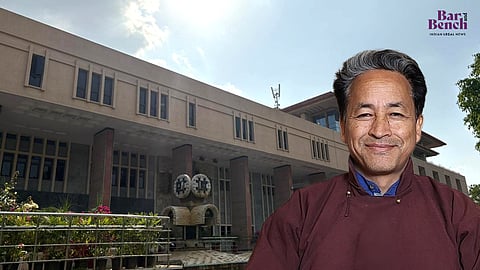
Delhi HC seeks comprehensive medical report on Sonam Wangchuk after wife claims he is forcibly kept at Safdarjung Hospital

Pertinently, the Central government contended that the State has an interest in ensuring that Wangchuk's health or life is not compromised because it could have an impact on law and order situation.
Sonam Wanghcuk
Sonam Wanghcukx.com
Published on
6 min read
Listen to this article

The Delhi High Court on Monday sought a comprehensive medical report on activist Sonam Wangchuk's health condition after his wife Gitanjali Angmo moved the Court alleging that he has been forcibly kept at Safdurjung hospital by Delhi Police to prevent him from taking part in the ongoing protests at the national capital [Gitanjali Angmo Vs Union of India].

A Bench of Chief Justice Devendra Kumar Upadhyaya and Tejas Karia asked the director of Safdarjung hospital to file all details including pathological reports of Wangchuk based on samples analysed at three different hospitals - Safdarjung Hospital, All India Institute of Medical Sciences (AIIMS) and a private laboratory.

"We direct that having regard to overall circumstances and submissoins, we direct that all the pathological reports based on the sample analysed at Safdarjung Hospital (under Central govt, court took note), AIIMS, and private laboratory shall be filed in an affidavit and sworn by director of hospital," the Court directed.

Further, it also directed Angmo to file the medical reports cited by her.

It also ordered the doctors involved to be present in court tomorrow.

"We request that the incharge of AIIMS and other consulting and treating doctors are required to be present during the course of hearing tomorrow," the Court said.

Pertinently, Solicitor General (SG) Tushar Mehta, appearing for the Delhi Police and the Central government, contended that the State has an interest in ensuring that Wangchuk's health or life is not compromised because it could have an impact on law and order situation.

"When the consequence of your deterioration of death of health or a potential loss of life has an impact on the law and order situation, that is where the State's interest come in," the SG said.

He stated that while citizens have the right to protest, that does not give someone a right to say he will commit suicide until his demand is met.

"We are not dealing with a case of euthanasia. We are dealing with a person who has a right to protest but the person exercising his right to protest, suppose tomorrow someone was to say that unless and until my demand is met, I will commit suicide, then public interest comes," the SG stated.

In such a scenario, it is the duty of the State to ensure that his health does not deteriorate further, the SG said.

The Division Bench was hearing an appeal filed by Angmo challenging a single-judge's refusal to direct that Wangchuk be shifted from Safdarjung Hospital to Medanta Hospital in Gurugram.

Chief Justice Devendra Kumar Upadhyaya and Justice Tejas Karia

Climate activist Sonam Wangchuk began an indefinite hunger strike at Delhi's Jantar Mantar on June 28, in solidarity with the youth-led "Cockroach Janta Party" movement, demanding accountability for repeated examination paper leaks and the resignation of Union Education Minister Dharmendra Pradhan. 

On July 18, the Delhi police removed him from the protest site and shifted him to Safdarjung Hospital on concerns about his health condition.

However, the following day, Angmo, moved the Delhi High Court seeking permission to transfer him to a private hospital, alleging that his family had lost faith in Safdarjung Hospital due to a lack of transparency over his treatment and medical reports. Her counsel contended that he was being kept there under conditions amounting to illegal detention.

Yesterday (July 19) a single-judge of the High Court prima facie found that the government’s decision to shift Wangchuk from the site of his hunger strike at Jantar Mantar to Safdarjung Hospital was not arbitrary. She, therefore, declined to grant any interim relief on Angmo's plea for Wangchuk's shift out of Safdarjung hospital.

Angmo then filed the present appeal challenging single-judge's decision.

According to the appeal filed by her, the single judge's order effectively takes away Wangchuk’s right to determine the course of his medical treatment and places the ultimate authority with the medical team attending to him.

Thus, the single-judge's order violates Wangchuk’s bodily autonomy and allows doctors to override the choices of a conscious and competent adult, it was contended.

According to the petition, right to life under Article 21 of the Constitution includes the right of a competent adult to refuse medical treatment and to choose the hospital where such treatment is received.

Hence, Wangchuk's continued hospitalisation at Safdarjung without consent violates his personal liberty, bodily autonomy and right to protest, the plea said.

Two days before Wangchuk was shifted from Jantar Mantar, a Division Bench of the High Court had directed the government to regularly monitor his health and take whatever medical intervention was required to check his deteriorating condition.

However, neither Wangchuk nor Angmo was a party to those proceedings, Angmo's appeal pointed out. Further, the July 16 order only permitted medical monitoring and did not authorise Wangchuk’s forcible removal from the protest site or his continued confinement at a government hospital, it was argued.

Akhil Sibal
Akhil Sibal

Senior Advocate Akhil Sibal, appearing for Angmo, said that Wangchuk was forcibly taken to the hospital without any consultation with him or his family.

"Without any consultation with the family, with Mr. Wangchuk, without any prior intimation, on 18th of morning, that is Saturday, without sharing any reports that the government possesses, my husband was forcibly taken to Safdarjung hospital," he said.

He also pointed out that Wangchuk's medical reports prepared by the doctors were not shared with Angmo.

"He is not in ICU, he is not on any kind of support. He is cogent. He is conscious. He himself is writing letters," Sibal argued.

The Court said that it cannot make comments on expert opinions of doctors.

"Should a doctor wait to administer drug until taken to ICU? Only then drug will be administered? Any report, any test they conducted ought to have been shared with you, we cannot make comments on expert's opinion," the Chief Justice remarked.

"I am not under arrest. The order didn't say I can be picked up like this. Therefore, that sequence creates that trust deficit, and I say please allow me to go elsewhere and and get a second opinion," Sibal said.

Sibal then read out Wangchuk's medical report which showed that his vitals were stable and he was fit aside from moderate dehydration.

"Today he has himself written a letter by his hand. Today is the culmination of a month-long collective protest that he has played some part in. The question is what is the autonomy that an individual who is otherwise a free citizen is not under detention?" he stated.

He said that Wangchuk has effectively been keep under detention in the hospital by forcing him to remain there against his wishes despite being healthy.

"A person, who is conscious, able to give consent to take a call on that and to have that advice given by the doctors of his choice in a hospital of his choice in consultation with the family, then is such a thing justified? If a person is not in a position to give consent, then they can. But when a person is conscious, cogent, articulate, able to write by his own hand, not yet in life-threatening situation, then is such a thing justified?" Sibal demanded.

He said Wanchuk should be discharged from Safdurjung hospital and not forced to stay there.

"Today he has written and requested for discharge. We said let us go where we are comfortable. We have already spoken to Medanta. I cant be forced to stay there. It is a matter of his choice, he is willing to be discharged against medical advice so that no blame falls on the doctors. The scenario of life-threatening circumstance has not emerged, we are not there yet," Sibal contended.

He also said that Wangchuk has the right to protest including by sitting on hunger strikes.

"He has a right to protest. Hunger strikes are a recognised form of constitutionally permissible protest. My autonomy should not be taken away by by like this without sanction of law," Sibal stated.

Solicitor General Tushar Mehta, appearing for the Delhi Police and the Central government, contended that the State has a duty to ensure that Wanghcuk's health does not deteriorate further.

"It would be not only in the interest of the State, but the duty of the State to ensure that his health is not further deteriorated. We are dealing with a person who is on a protest site. That is where the state comes into the play," SG Mehta said.

The SG further stated that since Wangchuk had some discomfort with the doctors, a doctor from AIIMS is permanently stationed at Safdurjung hospital.

"He also concurred with the treating team's assessment that immediate oral or intravenous fluid needs to be given. The patient's family has also not yet decided for the recommended medical intervention. The patient continues to be under close medical observation," the SG maintained.

The Court eventually called for medical reports of Wangchuk and posted the case for further consideration on Tuesday, July 21.

The appeal by Angmo was through advocates Bahuli Sharma, Susan Maria Mathew, Ridhi Arora, Suryaansh Kishan Razdan and Yoshit Jain.

The Central government, Delhi Police and Safdarjung Hospital were represented by Solicitor General Tushar Mehta, ASG Chetan Mehta and central government standing counsel Ashish Dixit.

Bar and Bench - Indian Legal news
www.barandbench.com