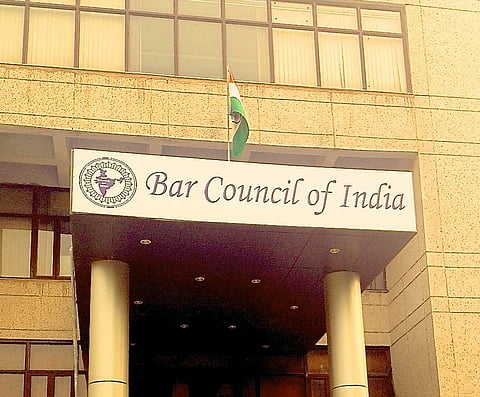
The Delhi High Court recently observed that a provision under the Bar Council of India (BCI) Rules that excludes open university graduates from taking admission in law courses does not stand to reason [Akhilesh v. Union of India & Ors]..In an order passed on July 17, the Bench of Chief Justice Devendra Kumar Upadhyaya and Justice Tejas Karia made this prima facie observation in a petition filed by a law graduate whose enrolment with Bar Council of Delhi (BCD) was rejected due to the said BCI Rules.“Prima facie, it appears that if on completion of a course in an open university system/distant learning system, a candidate obtains the qualification, however, he is held to be ineligible for pursuing any vocational career. Such prohibition, if any, does not stand to reason.” .The petition was filed by a student who completed a Bachelor’s Preparatory Program (BPP) from Indira Gandhi National Open University (IGNOU). Thereafter, he completed Bachelor of Social Work (BSW), a law degree (LL.B.) and went on to clear the All-India Bar Examination (AIBE).However, the BCD refused to enrol him as an advocate, stating that he does not have 10+2 qualification, meaning he did not fulfil the requisite qualification for enrolment under BCI Rules..The Court observed that open universities were created to allow certain disadvantaged students to enter the higher education stream. “It is common knowledge that system of continuing education or open universities or institutions of distant learning have been initiated with an object to permit those who for some disadvantage or reason could not pursue their studies timely. It is to give opportunity to such students or persons to join the mainstream of studies that the provisions for distant learning / open universities / continuing education have been introduced.".The provision under challenge is the explanation to Rule 5 under Chapter II, Part IV of the BCI Rules, which states:“Explanation: The applicants who have obtained 10 + 2 or graduation / post graduation through open Universities system directly without having any basic qualification for prosecuting such studies are not eligible for admission in the law courses.”.The Court observed that though the BCI has previously replied to the petition, it did not respond on the constitutionality of the rules under challenge. Thus, the Court has sought specific response of the BCI on the rule challenged in this petition.The BCI is required to file its counter affidavit within four weeks. The next date of hearing is October 9..Advocates Sunil Kumar, Vipin, Dimple Singh, Vijay and Dheeraj appeared for the student.Advocates Nishant Gautam, Vineet Negi, Kavya Shukla and Vibhav Nath appeared for Union of India.Advocate Preetpal Singh appeared for Bar Council of India.Senior Advocate T Singhdev along with Advocates Tanishq Srivastava and Abhijit Chakravarty appeared for the Bar Council of Delhi.Advocates Anshuman Sharma and Kartikey Kumar appeared for University Grants Commission (UGC)..[Read order]