

The Delhi High Court on Wednesday declined to entertain a public interest litigation (PIL) petition seeking a comprehensive review of parliament security.
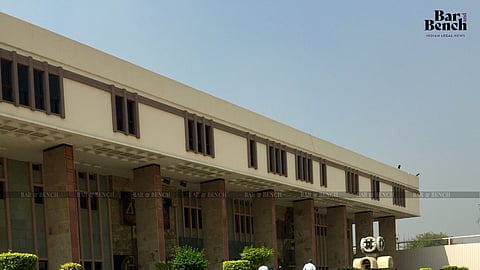
A Division Bench of Chief Justice (CJ) Devendra Kumar Upadhyaya and Justice Tejas Karia said there was no extraordinary circumstance warranting judicial intervention and that the Court would not issue directions on how parliament should manage its own security.
It also lamented the misuse of PIL petitions.
"What kind of a petition is this? You think parliament is incapable of taking care of its own security? Now we are going to issue directions as to how this is to be done? Whatever comes to your mind, you may carry a very good suggestion but that cannot become a matter of PIL. Everybody is into PIL just for publicity," the Court said.
The Court was hearing a petition filed by advocate Raj Singh. When the petitioner argued that the security of parliament is paramount in a democracy, the CJ retorted that every individual's security is paramount and that the Court did not need "a lecture" on parliamentary democracy.
The Bench also questioned why the petitioner's concern was confined to parliament alone, pointing out that stampedes at railway stations, security lapses at airports, and the safety of pedestrians did not similarly draw attention.
Singh's plea cited the 2001 terrorist attack on parliament and the 2023 Lok Sabha security breach, along with recent calls for large-scale mobilisation towards the institution during the Cockroach Janta Party (CJP) protests.
The petitioner argued that these episodes underlined the need for continuous institutional assessment and adaptation of parliamentary security arrangements.
He also flagged evolving threats ranging from cyber intrusions to AI-enabled misinformation and drone technology.
Singh told the Court that he had prepared a concept note titled "Proposed Outline of the Parliament of India (Security, Sanctity and Protection) Act, 2026," and sought a direction to the government to examine it and take a reasoned, time-bound decision on appropriate administrative, institutional or legislative measures.
The Chief Justice asked whether the petitioner was essentially seeking a court-mandated direction to the government to consider a note he himself had drafted.
"We will not entertain any such petition... How much will you stretch the Court?"
The Court then proceeded to dismiss the plea.
"No direction sought in the PIL can be granted. The safety and security of parliament is to be looked into by the government. So far as direction sought in relation to reviewing its administrative, institutional, operational, technological and cyber-security mechanisms, in light of evolving security challenges and emerging threats, is concerned, we again find ourselves at loss of words as to how such directions can be issued because it is for parliament to consider these issues and review the mechanism. As regards second prayer, it is against very difficult for the court to review the same. Some concept paper has been preapred by the petition on some proposed legislation. He is seeking a direction to the respondent to examine the concept note prepared by an individual. Such direction in our opinion also cannot be issued by the Court under Article 226. The petition is therefore dismissed," the Court ordered
[Read Live Coverage]