
Subscribe
Subscribe
- Latest Legal News
- News
- Law Firms
- Columns
- Interviews
- Law School
- Legal Jobs
- हिंदी
- ಕನ್ನಡ
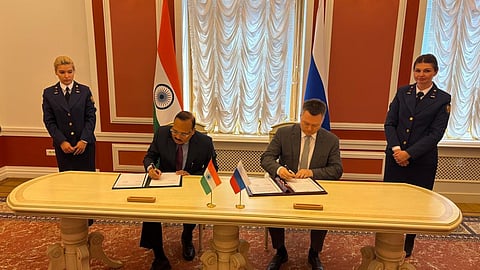
The Supreme Court of India and the Supreme Court of Russia on Tuesday signed a Memorandum of Understanding (MoU), following a meeting in Moscow between Chief Justice of India (CJI) Surya Kant and Chairman of the Supreme Court of the Russian Federation Igor Krasnov.
According to a press release, the MoU affirms the commitment of India and Russia to enhance cooperation through exchange visits, short-and long-term training programmes, and the organisation of joint seminars and conferences.
A key area of collaboration is the exchange of experiences and best practices relating to the use of technology in the administration of justice, with a view to improving judicial efficiency and service delivery.
To further this objective, it was agreed that a JointWorking Group would be constituted to develop strategies and mechanisms for sustained technological collaboration and deeper institutional engagement between the two Judiciaries.
Speaking at the meet, CJI Kant said that while Artificial Intelligence (AI) can assist courts in various functions, it cannot determine judicial outcomes or exercise judicial discretion.
He observed that while courts must embrace technological innovation, the administration of justice must remain a fundamentally human endeavour.
“Artificial Intelligence may assist Judges by organising information, facilitating translations, generating transcripts, and streamlining administrative processes. It cannot determine outcomes, assess witness credibility, evaluate evidence, or exercise judicial discretion,” he remarked.
This distinction, CJI Kant added, is reflected in the Supreme Court's recently notified Draft Regulations for the Use of Artificial Intelligence in the Judiciary, which seek to ensure the responsible deployment of AI while preserving judicial independence and human oversight.
CJI Kant observed that courts across various jurisdictions are facing a common challenge of preserving public confidence in the administration of justice while also adapting to a rapidly changing world.
"Institutions may evolve, technologies may change, and new challenges may emerge, but the fundamental purpose of Courts remains to uphold justice in a manner that commands public trust," he added.
CJI Kant also pointed to several technology initiatives introduced by the Supreme Court.
He referred to SUVAS (Supreme Court Vidhik Anuvaad Software), which facilitates translation of judicial documents across languages and enables judgments delivered in English to be translated into 16 regional languages.
He highlighted the recently launched AI-powered chatbot, Su Sahay, which helps litigants, lawyers and members of the public access information relating to court procedures, case status and filing requirements.
He further referred to the "One Case, One Data" initiative, which seeks to create a standardised digital record for each case across judicial platforms, reducing duplication and improving the reliability of judicial information.
“Equally transformative has been the integration of technology into Mediation, which the Judiciary has actively promoted as a preferred mode of alternative dispute resolution, particularly in commercial, family, and civil disputes, thereby easing the burden on conventional courts,” he added.
At the same time, he cautioned that AI has clear limitations and cannot perform functions that require human judgment.
CJI Kant also emphasised the importance of judicial education and capacity-building, stating that technology can enhance the capabilities of courts only when supported by continued investment in people.
“India has therefore devoted considerable attention to building a comprehensive framework for judicial education and professional development,” he noted.
While concluding his remarks, the Chief Justice said the future of justice would depend on balancing technological innovation with human values and called for continued cooperation between the Indian and Russian judiciaries.