
Subscribe
Subscribe
- Latest Legal News
- News
- Law Firms
- Columns
- Interviews
- Law School
- Legal Jobs
- हिंदी
- ಕನ್ನಡ
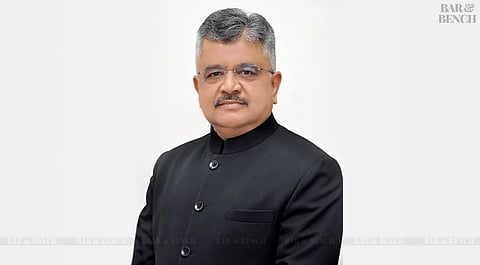
An independent judge does not necessarily mean one who constantly confronts the executive and legislature, Solicitor General Tushar Mehta said on Thursday.
Courts should not substitute their own policy preferences for policy decisions taken by elected governments, he emphasised.
"Independent judge does not mean that a judge who always fights or remains in confrontation with the executive or legislature. Executive is not a political party. Executive is a constitutional organ which represents each and every citizen and is answerable to each and every citizen," Mehta said.
He emphasised that India has an independent judiciary.
Mehta was speaking at a discussion on Shaping the Legal Architecture of Viksit Bharat 2047.
The discussion, moderated by Sanjeev Gemawat (Managing Director and Group General Counsel of Essar Group) was organised by the University of Chicago Center in Delhi, the Nani Palkhivala Foundation and the General Counsels' Association of India (GCAI).
It also featured Delhi High Court Justice Prathiba M Singh, Senior Advocate Arvind Datar and Atal Innovation Mission Director Deepak Bagla.
Mehta said elected governments have the mandate to formulate economic, financial and technological policies. Courts could examine their constitutionality but could not assume the executive's role and reframe policies.
"What I always call, and I'm criticised for calling it, 'NGO activism' is not permissible in judiciary. They cannot replace and reframe a policy unless it can be shown there is a violation of fundamental rights," he said.
Mehta also criticised certain past environmental judgments, claiming that they had set India’s economic development back by nearly two decades.
"Even if they bonafide believe in a particular policy, can they make it applicable to 140 crore Indians who have voted the other organ to do that?" he asked.
The Solicitor General clarified that his observations were personal and not made on behalf of the government.
He distinguished judicial intervention from judicial innovation.
He said that courts must intervene against unconstitutional executive or legislative action but could not formulate alternative policies.
"Innovation is not something which is given to judiciary. Innovation is given to executive and even the legislature. They can also experiment," he said.
Senior Advocate Arvind Datar called for transferring company law disputes from the National Company Law Tribunal (NCLT) back to the High Courts.
He said that insolvency proceedings were consuming much of the tribunal's time.
As a result, ordinary company law matters struggle to secure hearings because cases under the Insolvency and Bankruptcy Code take up most of NCLT's time.
"One is, immediately, shift the company law back to the High Court," he said.
Datar described tribunals as a neglected component of India's commercial justice system despite their jurisdiction over insolvency, taxation, telecommunications and electricity disputes.
He also criticised short-term tribunal appointments.
"The present system of having tribunal appointments for four years and five years will never, never help get an independent tribunal system," he said.
Datar maintained that tribunals must enjoy institutional independence comparable to regular courts. He also questioned the effectiveness of appointing retired judges and bureaucrats without adequate specialisation.
He expressed concern that litigation delays and expenses discouraged businesses from approaching courts, even to recover legitimate dues.
An entrepreneur might decide against pursuing a ₹20 lakh claim because the expense and time involved would make litigation commercially unviable, he opined.
He also said that regulatory procedures are particularly burdensome for smaller businesses and called for greater attention to micro, small and medium enterprises (MSMEs).
"Today, for example, in GST, they just cancel the registration. The man is completely helpless. If you cancel the registration, it's a civil death for him," he said.
Datar further argued that India's economic ambitions required reforms extending beyond the judicial system.
He cited the hospitality industry, claiming that opening a hotel in India required approximately 65 to 66 permissions, compared with substantially fewer approvals in other countries.
Effective implementation of existing laws was more important than repeatedly amending legislation, he stated.

Bagla said judicial independence remained a major strength in attracting foreign investment, although inconsistent State-level regulatory approvals continue to create uncertainty.