
Subscribe
Subscribe
- Latest Legal News
- News
- Law Firms
- Columns
- Interviews
- Law School
- Legal Jobs
- हिंदी
- ಕನ್ನಡ
India’s rapid expansion of renewable energy will lead to a larger number of disputes falling outside electricity regulators and being resolved through arbitration, Senior Advocate Gourab Banerji has said.
Banerji, President of the Arbitration Bar of India (ABI), said that while tariff disputes would necessarily remain within the regulatory framework, renewable-energy projects were generating several other categories of disputes capable of arbitration.
“Because of renewable energy being such a big player, I think a large number of the disputes will now fall outside the regulator.”
He cited EPC contractor disputes, supply disputes, operation and maintenance disputes, storage and performance disputes as well as shareholder disputes.
Banerji said he preferred arbitration or mediation backed by technical experts rather than requiring parties to approach regulators for every dispute.
“I am actually more comfortable with arbitration plus experts or mediation plus experts as opposed to going to the regulator for each and everything.”
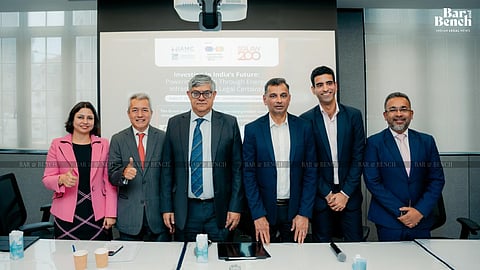
The discussion was part of “Investing in India’s Future: Powering Growth Through Energy, Infrastructure & Legal Certainty”, held during Singapore Convention Week 2026 at Maxwell Chambers.
The panel, titled “The Green Investment Playbook: De-risking Indian renewable energy investments and cross-border opportunities in clean energy, energy storage and transmission assets,” featured Senior Advocate Gourab Banerji; AJ Jawad, Registrar of IAMC; Divyam Agarwal, Partner at JSA Advocates & Solicitors; Minn Naing Oo of Arbitration Chambers; and Montek Mayal, Partner and Practice Head for Asia and the Middle East at Osborne Partners.
The discussion was moderated by Poonam Verma Sengupta, Partner at JSA Advocates & Solicitors, and focused on regulatory risk, arbitration, investment protection, payment risk and valuation issues in renewable-energy projects.
Banerji described the transition from conventional thermal power to renewable energy as a fundamental change in the nature of disputes.
“The evolving pattern is the shift to renewable energy means that it is not just a shift of, it's a paradigm shift. It's not a shift of degree.”
He said renewable projects raised newer questions involving grid connectivity, land acquisition, change in law, payment and technological performance. On grid connectivity, he said there remained a significant question over how the risk should be allocated.
Minn Naing Oo, an independent arbitrator with Arbitration Chambers and former Chief Executive Officer and Registrar of the Singapore International Arbitration Centre, identified payment risk as one of the biggest concerns in large energy projects.
He said even where a developer had successfully completed a project, failure to receive payment could trigger defaults under financing arrangements and potentially jeopardise the entire project.
Naing Oo also highlighted currency fluctuations and restrictions on cross-border movement of funds as important concerns for foreign investors.
“Payment risk is really, to me at least, one of the most significant risks that you will have to deal with.”
Divyam Agarwal, Partner at JSA Advocates & Solicitors, said foreign investors required what he described as the “three Cs”: certainty, clarity and consistency.
“If you are able to achieve all three, possibly it's a good investment.”
Agarwal said investors needed greater certainty over which disputes would go before regulators and which could be arbitrated. He also flagged inadequate contractual mechanisms and the possibility of policy changes following a change in government as concerns for investors.
He added that the choice of arbitral seat should be made with enforceability in mind.
“It is not about conducting, let's say an arbitration, it is about recovering that money. No point of having an award which you can't ultimately enforce.”
AJ Jawad, Registrar of IAMC, stressed the importance of institutional arbitration and specialist arbitrators in technically complex energy disputes.
He recalled an ICC arbitration arising from a wind farm project where the claim was around ₹260 crore and the claimant spent around ₹4 crore on the proceedings. However, the claimant ultimately recovered nothing after the opposing company was wound up around the time the award was delivered.
Jawad used the example to emphasise mediation and early dispute resolution.
“An ounce of mediation is better than a pound of arbitration and a tonne of litigation.”
He also said Indian arbitral institutions could be significantly cheaper than foreign institutions and could play a role in identifying arbitrators with the right technical expertise
Montek Mayal focused on how the energy transition was changing damages and valuation analysis.
Mayal said valuers could no longer mechanically assume that traditional power assets would continue operating at historical levels throughout long-term contracts.
Referring to the traditional assumption that a thermal power plant with a 30-year PPA would continue operating at broadly similar load factors for the foreseeable future, he said:
“That entire principle is going to be challenged in the new world.”
Mayal said valuation exercises would increasingly have to account for the effect of the energy transition on the economic life of an asset, along with future operating and regulatory costs such as carbon taxes and decommissioning expenses.
He also said damages assessments were becoming less deterministic and more probability-based, particularly in disputes involving technology-driven assets such as battery storage.
Instead of relying on a single discounted cash-flow scenario, experts were increasingly using scenario analysis and Monte Carlo simulations to show tribunals a range of possible outcomes.
Poonam Verma Sengupta, Partner at JSA Advocates & Solicitors, moderated the discussion and raised questions around the increasingly interconnected nature of renewable-energy contracts, including EPC agreements, power purchase agreements, financing arrangements and transmission contracts.
The panel discussed the difficulty of resolving disputes where multiple interconnected agreements contained different arbitration clauses and procedural mechanisms. One suggestion was to harmonise dispute resolution clauses across agreements at the drafting stage and use the same institution and compatible seats where possible.