

The Supreme Court on Monday clarified that the Delhi and other States governments are at liberty to withdraw first information reports against protestors involved in the recent student protests led by the Cockroach Janata Party (CJP) in Delhi's Jantar Mantar and various other States.
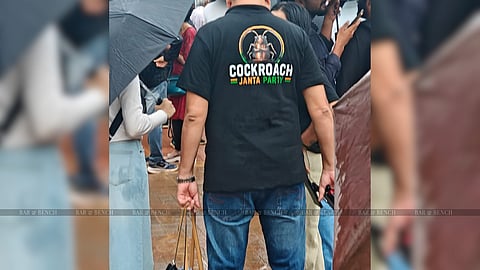
A Bench of Chief Justice of India (CJI) Surya Kant and Justices Joymalya Bagchi and V Mohana clarified its July 28 order which had said that police can continue prosecution of those protestors with criminal antecedents.
The words 'criminal antecedent' should be read to mean grave and heinous offences, the Court clarified today.
"It is clarified for July 28 order that NCT of Delhi and any other State shall be at liberty to close/withdraw FIRs against protesters. The word criminal antecedents is to be read as grave and heinous offences," the Court said today.
This was after the counsel for some of the protestors told the Court that the words criminal antecedents in the earlier order was being used to to keep cases pending even when such antecedents were for minor issues like driving offences or some earlier protests.
The Court during the previous hearing had said the allegations of excesses by the police prima facie made out a case of fair and independent probe. Thus, it had proposed to constitute a high-powered committee to ensure a fair and independent probe to these incident of violence.
However, the Court had granted the Union government and Delhi Police an opportunity to place their version on record. It said that other States, where the violence took place, may also place their version on record.
Accordingly, it had issued notice to the chief secretaries of Delhi , Maharashtra, Bihar, Kerala, Madhya Pradesh and Uttar Pradesh.
Today, the Court said that it was contemplating formation of a special investigation team of police officers to investigate the allegations of police excesses or to have a committee headed by a retired judge.
"There are two things in our mind. One is a SIT of police officers to investigate or to have a committee headed by a retired judge," the Bench remarked.
The petitioners also flagged use of pellet guns against protestors.
The Bench then said it will lay down a comprehensive protocol on when and how it can be used.
"We would like to lay down a complete protocol on how and where it can be used," the Bench remarked.
The Court eventually decided to wait for responses from various States before passing any order.
It posted the case for consideration on August 18.
Background
The Court was hearing a batch of petitions seeking pan-India guidelines to ensure peaceful protests are allowed. The pleas were filed in light of the recent use of force by police on protestors at Jantar Mantar in Delhi and in Bihar.
Some petitions also sought action against protesters accused of assaulting police personnel during the demonstrations
The protests had begun in June on a call by online collective Cockroach Janta Party (CJP) against repeated question paper leaks. They demanded the resignation of union education minister Dharmendra Pradhan, who has since resigned from the position.
The protests gained momentum after climate activist Sonam Wangchuk joined and started a hunger strike in solidarity. Wangchuk was later removed from the protest site and taken to a hospital by the Delhi police, citing his worsening health condition. He ended his 26-day hunger strike at Medanta Hospital late on July 23.
Delhi Police and Rapid Action Force (RAF) restored to baton charge, teargas shelling and even use of pellet guns to stop the protestors on "Sansad Chalo" march to the Parliament on July 20.
Pradhan eventually tendered his resignation as minister on July 25 and the protests were called off.
Similar protests were witnessed in Bihar as well where the police took similar action. A policeman was also witnessed using an AK-47 weapon against the protestors.
Police action against these protests have led to widespread discontent among those agitating and in support of such protests.
This led to a batch of petitions before the apex court.
When the matter was heard on July 28, the Court had ordered that no coercive action be taken against protestors.
The Court had also ordered immediate release of minors detained by police across different States.
However, the Court had clarified that this protection shall not extend to those with criminal antecedents.
However, the Court did not stay the investigation in any of the first information reports (FIRs) registered in connection with the protests
Arguments Today
When the matter was taken up for hearing today, Solicitor General Tushar Mehta, appearing for Delhi Police, told the Court that all FIRs against protestors can be withdrawn except against those who have criminal antecedents.
"Those who had criminal antecedents.. except them everything can be taken care of," the SG said.
"First FIR has to be segregated. One against students and then one against hardened criminals. Then you can examine," the CJI remarked.
Senior Advocate AM Singhvi, appearing for one of the petitioners, said that the earlier order passed by the court needs clarification since it can be misinterpreted to keep criminal cases pending against protestors.
"The last order needs a clarification. Criminal antecedent is the word used. There can be driving offence, some petty offence, political protests. The word needs clarification," he said.
Senior Advocate Gopal Sankaranarayanan also concurred.
"There is an ambiguity in the order.. It is like coercive action cannot be taken but they can be investigated," he said.
Senior Advocate N Hariharan called for quashing of the cases.
"Quashing is a better option," he said.
"Let them sit with the government and let us discuss and place before the govt," the SG offered.
"We are not asking you to drop charges against murderers solicitor," the Court said.
It then ordered that its previous order on the aspect of criminal antecedents will apply only to those with serious criminal antecedents.
The petitioners also flagged surveillance at the protest site and use of pellet guns.
"Pellet gun was used in 2010 in Kashmir. There is no standing order by Delhi police mandating use of pellet guns," said advocate Vrinda Grover.
The Court then said it will lay down a protocol governing use of pellet guns.
The case will be heard next on August 18.
[Read Live Coverage]