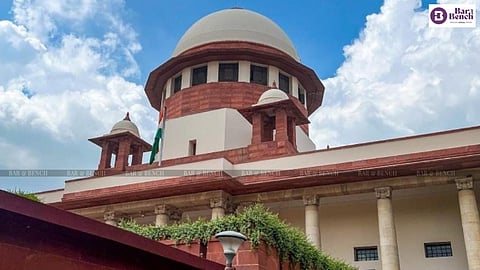

The Supreme Court on Monday sought responses from the Central government and the Atomic Energy Regulatory Board (AERB) on a public interest litigation (PIL) petition challenging provisions of the Sustainable Harnessing and Advancement of Nuclear Energy for Transforming India Act (SHANTI), 2025 concerning liability for nuclear accidents and the independence of the nuclear regulator.
A Bench comprising Chief Justice of India (CJI) Surya Kant, Justice Joymalya Bagchi and Justice V Mohana, was hearing a petition filed by retired civil servants and scientists challenging several provisions of the Act.
Advocate Prashant Bhushan, appearing for the petitioners, argued that the Act exempts nuclear plant suppliers from liability and caps the liability of operators at a level grossly disproportionate to the potential consequences of a nuclear accident.
However, the Bench said that such caps imposed by law would not bar courts from ordering higher compensation if it deems appropriate.
“Irrespective of provisions of the Act, nothing shall preclude a constitutional court to determine the amount of fair and just compensation.... Central government owes certain liability under the Act,” observed CJI Kant during the hearing.
When Bhushan pointed out that the government's liability was also capped, CJI Kant said,
“The parliament imposes a cap, that does not bar the court. Irrespective of provision of the Act, nothing shall preclude a constitutional court to determine the amount of fair and just compensation."
Bhushan, however, argued that the Court has to make it clear that the statutory caps would not restrict its power to determine the liability of the operator, supplier or the government. He said such a clarification was necessary to ensure that nuclear plant operators and suppliers did not have an incentive to compromise on safety because of the protection afforded by the statutory caps.
Bhushan further submitted that the Constitution Bench judgment in MC Mehta v. Union of India had clearly established that an enterprise engaged in a hazardous industry would have absolute and unlimited liability for an accident arising from its operations.
“This Court says that if you run a hazardous industry, then there cannot be a cap. Then there is the principle of strict and absolute liability which arises against you,” he submitted.
Bhushan argued that the SHANTI Act was therefore in violation of Supreme Court judgments, particularly because suppliers have been completely exempt from liability.
According to the plea, under the SHANTI Act, the overall liability for a nuclear incident is capped at the rupee equivalent of 300 million Special Drawing Rights, while operator liability ranges from ₹100 crore for smaller installations to ₹3,000 crore for the largest plants.
Bhushan said the Centre's residual liability was capped at ₹4,500 crore, whereas the cost of a major nuclear accident could run into several lakh crores.
Referring to Chernobyl and Fukushima, he said nuclear accidents could leave large areas uninhabitable for decades. He argued that exempting suppliers from liability could also incentivise them to compromise on safety.
Hence, the petition has raised challenge to Section 16 of the Act for removing the operator's earlier statutory right of recourse against suppliers.
Bhushan clarified that the petitioners were not opposing nuclear power or private participation in the sector.
He told the Court that India's solar power potential, according to the government's assessment, was 3,343 GW, while peak power demand was around 256 GW. He also compared the capital and generation costs of solar and nuclear power, arguing that solar offered a safer and cheaper alternative.
Additionally, the petitioners have also challenged the regulatory framework, arguing that there is a conflict of interest because the Atomic Energy Commission, which operates nuclear power plants, has a role in selecting members of the AERB.
Section 17(4) provides for appointment of the chairperson and members by the Centre on recommendations of a search-cum-selection committee constituted by the Atomic Energy Commission.
“This is the Commission which operates the nuclear power plants. So, therefore, there is a conflict here,” submitted Bhushan.
During the hearing, CJI Kant questioned whether replacing the arrangement with a committee of bureaucrats would ensure that suitably qualified experts were selected, observing,
“These are very highly sophisticated scientists.”
Bhushan responded that several outstanding nuclear scientists were not members of the Atomic Energy Commission and could form part of an independent selection process.
Advocate Neha Rathi appeared with Bhushan for the petitioners.
[Read Live Coverage]