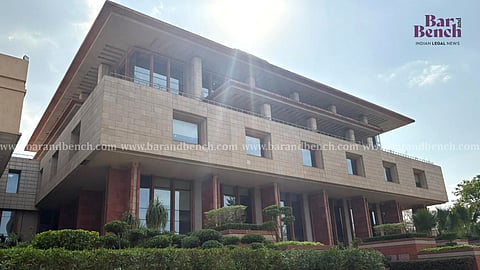
The Delhi High Court has refused to reject a suit filed by the Government of Canada seeking recovery of over CAD 33.3 million allegedly siphoned from the Government of Ontario into bank accounts in India [Government of Canada Vs Sanjay Madan].Justice Vikas Mahajan ruled that the Delhi High Court has the territorial jurisdiction to hear the suit since the funds allegedly misappropriated were transferred to bank accounts maintained in Delhi. The Court rejected the argument that Canada was the more appropriate forum to adjudicate the dispute..The suit filed by Canadian government arises from two fraud schemes involving former Ontario government employee Sanjay Madan. According to the Canadian Broadcasting Corporation, Madan had a senior IT role and helped develop a computer application related to a COVID-19 relief benefit before he was fired in 2020.Madan pleaded guilty before the Ontario Superior Court of Justice in April 2023 to criminal charges concerning fraud on the Ontario government and admitted receiving secret commissions or kickbacks between 2011 and 2020, the High Court was told..One of the schemes concerned Ontario’s Support for Families Program, introduced in 2020 to provide financial assistance for at-home learning during the COVID-19 pandemic. Canada alleged that more than 78,000 fraudulent applications were submitted, of which over 44,000 were processed, resulting in disbursements exceeding CAD 10.8 million.The second concerned contracts for IT consultants, under which Madan allegedly received commissions or kickbacks from vendors or subcontractors.In its suit before the High Court, Canada said that approximately CAD 40.2 million was eventually transferred from Canadian banks to accounts in India and that at least CAD 33.34 million remains unrecovered.Madan sought rejection or return of the suit, arguing among other things that the action was time-barred and that Delhi lacked territorial jurisdiction to decide the matter..The High Court rejected the jurisdictional challenge, noting that Canada had specifically pleaded that accounts containing the allegedly illicit funds were maintained with banks in Delhi.It also noted that Canada sought rendition of accounts from Indian banks and directions concerning repatriation of the funds. The Court also said that the plaint cannot be rejected at this stage on the ground of limitation..Further, the Court said that even if Canada were first asked to obtain a decree there, it would still have to institute proceedings in India to recover the money allegedly lying here since Canada is not a “reciprocating territory” under Section 44A of the Code of Civil Procedure (CPC).The decree obtained in Canada would not be executable in India, it noted.“No useful purpose will be served by asking the plaintiff to first obtain a decree from Canada, and then to file a suit in Delhi; rather it would be waste of time and effort," the Court said..The Court also rejected Madan’s reliance on the doctrine of forum non conveniens. It held that the doctrine cannot be invoked to decline a civil suit governed by the CPC merely because a foreign forum may be more convenient.The Court also refused to accept the argument that the Indian proceedings amounted to re-litigation since civil and criminal proceedings were already underway in Canada. It pointed to the Explanation to Section 10 CPC which expressly provides that the pendency of a suit before a foreign court does not prevent an Indian court from trying a suit founded on the same cause of action.Accordingly, Madan's application seeking return or rejection of the plaint was dismissed..The Government of Canada was represented by Senior Advocates Nakul Dewan and Shashank Verma along with Advocates Aaditya Vijay Kumar, Sooraj Sharma, Vipul Agrawal, Arjun Kant, Jatin Kochhar, Akshita Katoch, Upamanyu Ganguly, Gunjan Joshi, Himashi Singh and Pratishtha Chauhan..Madan was represented by Senior Advocate Ramesh Singh along with advocates Upinder Singh, Sharanya Bhatnagar, Sommya Rohatgi and Hage Nanya..[Read Judgment]