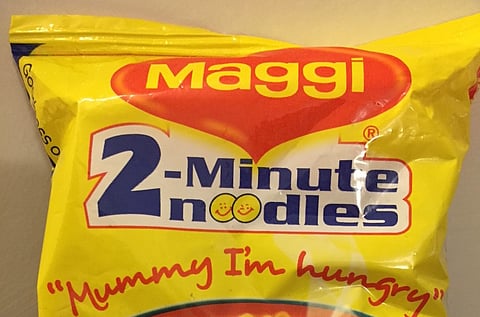

The Delhi High Court recently quashed criminal proceedings against Nestlé India Limited and its distributors in the 2015 Maggi noodles controversy, which began after food safety authorities alleged that samples of the popular instant noodles contained lead beyond the permissible limit [Dharmendra Hansraj Kotak & Ors v. State of Delhi & Anr].
In the August 6 judgment, Justice Madhu Jain held that the cases should not continue because subsequent court-supervised scientific testing found the lead content to be within the prescribed limit.
"This Court is of the considered view that permitting the present prosecutions to continue would serve no useful purpose. The continuation of the complaints would merely compel the petitioners to undergo a protracted criminal trial despite the very foundation of the prosecution having substantially eroded," observed the Court.
The cases arose from a nationwide sampling drive conducted by food safety authorities in May 2015 after concerns were raised about the safety of Maggi noodles. In Delhi, Food Safety Officers collected samples from retail stores and sent them for testing. The Food Analyst's reports concluded that the lead content in the tastemaker exceeded the prescribed limit of 2.5 parts per million (ppm).
Based on these reports, the Department of Food Safety had launched criminal prosecutions against retailers, suppliers, Nestlé India Limited and others responsible for their day-to-day business operations under the Food Safety and Standards Act, 2006 (FSS Act).
Challenging the proceedings, the petitioners argued that the cases were based solely on the 2015 Food Analyst's reports, whose reliability had been undermined by subsequent court-supervised testing.
They relied on the Bombay High Court's decision that had set aside the nationwide ban on Maggi noodles.
They also referred to the Supreme Court's directions for fresh testing by the Central Food Technological Research Institute (CFTRI), Mysore, a Referral Food Laboratory under the FSS Act, which had found the product complied with the prescribed lead limits.
The State, however, opposed the petitions, contending that the Delhi cases arose from independently collected samples and should proceed to trial. It also argued that the accused had not exercised their statutory right to seek testing by a Referral Food Laboratory after receiving the original Food Analyst's reports.
The Court, however, found that the Delhi cases arose from the same nationwide sampling exercise carried out in May 2015 and were based entirely on the original Food Analyst's reports.
"The complaints before this Court arise out of the very same nationwide sampling exercise undertaken during May, 2015. The allegations, the alleged analytical deficiencies and the scientific issues are substantially identical. The prosecution does not rely upon any independent evidence of adulteration apart from the Food Analyst's reports generated during the original sampling exercise," observed the Court.
It held that although criminal prosecutions ordinarily proceed independently, the later scientific findings could not be ignored because they directly affected the basis of the prosecution.
"Where the very scientific foundation upon which the prosecution rests has undergone subsequent examination through a process supervised by the constitutional courts, the High Court cannot remain oblivious to those developments while exercising jurisdiction under Section 482 Cr.P.C.," said the Court.
Additionally, the Court noted that the Himachal Pradesh High Court and the Uttarakhand High Court had recently quashed similar criminal proceedings arising from the same 2015 Maggi sampling exercise.
Holding that continuing the cases would amount to an abuse of the legal process, the Court quashed the criminal complaints and all related proceedings.
Advocates Rajesh Batra, Sonia Kukreja, Rohit Chandra and Sadhika Kochhar appeared for Nestlé India Limited and its distributors.
Additional Public Prosecutor Digam Singh Dagar represented the State.
[Read Judgment]