

The Madras High Court recently recognised the Thamirabarani river as a juristic person for the limited purpose of protecting its right against pollution [Sivanupandian v. District Collector].
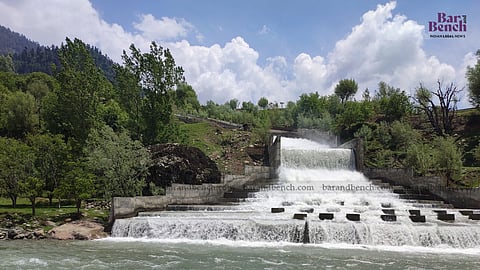
A Bench of Justices GR Swaminathan and B Pugalendhi noted that the Thamirabarani is worshipped as a deity by Hindus and, therefore, could be recognised as a person in law.
“River Thamirabarani is admittedly worshipped as a deity by the Hindus. Therefore, it partakes the character of a person. We, therefore, make it clear that we recognise the personhood of Thamirabarani not because it is a river but because she is a deity. No one has a right to pollute her. That will not only be a breach of the statutory provisions found in various environmental laws and a breach of the fundamental rights of fellow citizens under Article 21 of the Constitution of India but also the rights of the river herself. She is hereby recognised for her own intrinsic value," the Court said.
The Bench said the personhood conferred on the river was limited to its right not to be polluted and no other rights, duties or liabilities would arise from the declaration.
The Court passed the ruling while dismissing a petition by one Sivanupandian challenging his eviction from a 400-year-old mandapam situated on a bathing ghat along the river in Papanasam.
The case arose from an eviction notice issued to Sivanupandian, who was managing Anandhavilas, a pillared mandapam on a bathing ghat. He claimed exclusive possession and collected fees from persons using the ghat.
The Court found that the land was classified in revenue records as “river poramboke” and described in the ‘A’ Register as the Thamirabarani River. It held that a riverbank could not be separated from the river itself and had to remain free from encroachments.
The Bench added that the ancient stone structure had been altered beyond recognition through the construction of walls.
During the proceedings, the Court was informed about the extent of pollution caused by rituals performed along the river. An activist told the Bench that at least one tonne of used garments and clothes was being dumped into the river every day.
A booklet placed before the Court stated that between May 7 and May 28, cleaning efforts had recovered 86 to 90 tonnes of clothes, 2.2 tonnes of holy ash, 1,385 kilograms of plastic waste, 220 kilograms of glass bottles and 374 kilograms of sanitary napkins and diapers.
“No one has the right to pollute a water body even in the name of religion. This can be taken as an axiomatic proposition," the Court stated.
The Bench traced the religious and historical significance of the Thamirabarani to explain why it was considered a deity. It said the river finds mention in the Valmiki Ramayana, the Mahabharata and Kalidasa’s Raghuvamsam.
The Court said Hinduism, being a pantheistic religion, recognises innumerable deities. Referring to earlier judgments on the juristic status of Hindu idols, it observed that a deity need not necessarily be associated with a particular idol or shrine.
Consequently, the Court banned the dumping of clothes and other articles into Thamirabarani.
It directed the Tirunelveli district administration to enforce the ban, conduct sustained awareness campaigns and involve civil society members in keeping the river clean.
The local bodies were directed to pass resolutions providing for fines. The Bench warned that polluting the river could also be treated as contempt of court. It clarified that the directions would operate as a continuing mandamus.
However, the Court permitted the immersion of ashes, recognising the religious and emotional significance attached to the practice. It directed that ashes could be carried only in unfired earthen pots, which would dissolve in the water.
Pertinently, the Court upheld the eviction order against the petitioner and directed the Arulmighu Papanasa Swamy Temple to take over the mandapam immediately. The temple’s executive officer or trustees were asked to coordinate with the Archaeological Survey of India and restore the structure to its original form.
The petitioner was represented by advocate S Ramasamy.
Additional Advocate General B Saravanan assisted by Government Advocate M Kannan appeared for the district and temple authorities.
Advocate VR Shanmuganathan represented the Hindu Religious and Charitable Endowments Department.