

The News Broadcasting & Digital Standards Authority (NBDSA) recently flagged lack of neutrality in an Aaj Tak broadcast hosted by journalist Sudhir Chaudhary for airing debunked claims that the Taj Mahal was once a Hindu temple.
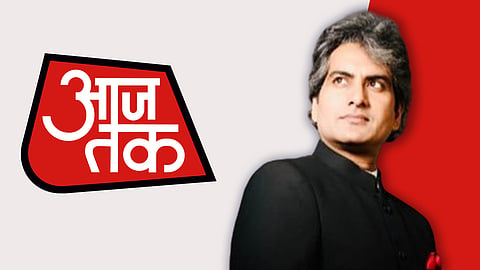
In an order dated May 28, NBDSA Chairperson Justice AK Sikri directed Aaj Tak to edit the programme to remove or suitably modify portions dealing with the Taj Mahal.
The authority held that the segment had failed to meet standards of impartiality under the NBDSA's Code of Conduct.
"There was selective reliance on official records across different segments of the programme. While the broadcaster had relied on the Archaeological Survey of India's report when covering claims about the Qutub Minar, it omitted similar official records when reporting on the Taj Mahal. As a result, the broadcast fell short of the standards of neutrality and impartiality mandated under the Code of Conduct," observed the NBDSA.
The decision came on a review application filed by advocate Indrajeet Ghorpade (complainant) seeking to revisit an earlier order passed by NBDSA in December 2025 which had found no violation.
The case arose from a November 29, 2024 episode of “Black and White,” which examined historical claims about religious structures such as Sambhal Jama Masjid, Ajmer Dargah and Taj Mahal.
Ghorpade had alleged that the programme promoted a one-sided narrative about the destruction of Hindu temples by Muslim rulers. He argued the broadcast amplified the widely discredited claim that the Taj Mahal was originally a Hindu temple despite the Archaeological Survey of India (ASI) having rejected such assertions.
The broadcaster, TV Today Network Ltd. (corporate owners of Aaj Tak), defended the programme as a documentary-style presentation that merely compiled and presented claims from books, reports and third-party sources. It argued that the anchor, Sudhir Chaudhary, had repeatedly clarified that the show did not advocate demolition of any religious structure or seek to incite communal tensions, but aimed to examine historical narratives placed in the public domain.
In its first order passed on the issue on December 23, 2025, the NBDSA accepted this explanation. It noted that the broadcast was framed as a historical account and that the anchor had relied on published material, including reports of the ASI, to support the narrative presented.
"Upon perusing the footage, NBDSA found that, during the broadcast, the anchor had given a narrative of the history of the destruction of Hindu temples over a period, which he supported with an ASI report and books written on the subject," held the earlier order.
On that basis, the authority concluded that there was no violation of its Code of Conduct and closed the complaint.
Ghorpade then sought a review of the same.
On review, the NBDSA drew a distinction between presenting historical claims and doing so in a manner that meets standards of neutrality and accuracy. It noted that while the broadcaster claimed to rely on official sources, such reliance was not consistent across the programme, particularly in the segment relating to the Taj Mahal.
On the broadcaster’s argument that neutrality does not require equal space to all sides, the NBDSA clarified that the issue in the present case was more fundamental. It found that there was a complete absence of any counter-view to the claim that the Taj Mahal was a Hindu temple, especially one based on official records.
"In respect of the submission of the broadcaster that under the Code of Conduct, 'Neutrality does not always come down to giving equal space to all sides", it would be pertinent to bring to the attention of the broadcaster that the question raised herein was not whether sufficient prominence was given to other views, but rather whether the broadcaster had presented any counter view, at all, particularly, one which is grounded in official records. In view of the same, NBDSA directs the broadcaster to edit the programme insofar as the Taj Mahal is concerned," said the NBDSA.
The authority thus limited its intervention to the Taj Mahal portion of the broadcast and concluded that the omission of established official findings despite reliance on similar sources elsewhere in the programme undermined the requirement of impartiality.
It also declined to revisit other allegations relating to communal tone, omission of legal context such as the Places of Worship (Special Provisions) Act, 1991, or reportage surrounding tensions in Sambhal.
The complaint was accordingly closed with observations, without any monetary penalty or further directions.
[Read Order]