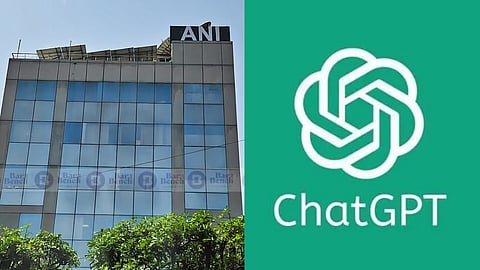
The Delhi High Court on Friday ruled that OpenAI's storage of news material published by Asian News International (ANI) to train ChatGPT does not amount to copyright infringement and hence, declined to grant any interim relief to ANI. .In an interim order, Justice Amit Bansal ruled that such use of content to train the Large Language Model (LLM) falls under the fair dealing provision of Section 52(1)(a) of the Copyright Act."Therefore, it does not amount to infringement under Section 51," the Court ruled.The Court said that outputs generated by ChatGPT using Retrieval-Augmented Generation (RAG) technique does not amount to copyright infringement since the answers generated by the Artificial Intelligence (AI)-tool were not substantially similar to the original content published by ANI."Further, ANI has failed to satisfy this Court that any memorisation or regurgitation of ANI's copyrighted literary works has happened to the responses generated by ChatGPT," the Court added.Thus, the Court declined to restrain ChatGPT from using the content published by ANI. It said irreparable injury would be caused not only to OpenAI but to public interest also if any interim injunction is granted in favour of ANI at this stage."ANI has failed to make out a prima facie case for grant of interim injunction. Balance of convenience is also against grant of interim injunction," the Bench said while dismissing ANI's interim application.The Court stated that ChatGPT has transformed information and is being used all around the world for beneficial purposes."Any interim injunction granted at this stage would, in my opinion, be detrimental to the growth of AI and more particularly, to the LLMs being developed in India. It would also have adverse impact on public interest, including millions of users of ChatGPT in India, many of whom would not be paid subscribers," the order stated.The Court observed that the data scraped to train LLMs is used privately and access is not given to public.On the issue whether the usage of ANI’s literary works by Open AI would result in economic competition and prejudice ANI, the Court stated that use of copyrighted works by Open AI is "fundamentally different" from the news articles of ANI and so, it cannot be said that ChatGPT responses are substitutes for ANI news articles..ANI was the first Indian media house to sue OpenAI for copyright violation. Several other publications later joined the agency in its case, including the Digital News Publishers Association (DNPA). The DNPA members include The Times Group, Hindustan Times, India Today Group, The Hindu and almost every major media house. In the suit filed in 2024, ANI alleged unauthorised use of its content by OpenAI to train and operate ChatGPT. In the interim relief application, ANI sought an injunction against OpenAI from using its content. ANI argued that merely because its news content is publicly available, OpenAI does not get a right to exploit it or create copies of it to store.However, OpenAI argued that there cannot be a monopoly on facts and that if any news platform does not want their website accessed by OpenAI, they can get themselves included in the blocklist..In November 2024, the Court framed the following issues for its consideration: Whether the storage by the defendants [OpenAI] of plaintiff’s [ANI] data (which is in the nature of news and is claimed to be protected under the Copyright Act, 1957) for training its software i.e., ChatGPT, would amount to infringement of plaintiff’s copyright. Whether the use by the defendants of plaintiff’s copyrighted data in order to generate responses for its users, would amount to infringement of the plaintiff’s copyright. Whether the defendants’ use of plaintiff’s copyrighted data qualifies as ‘fair use’ in terms of Section 52 of the Copyright Act, 1957.Whether the Courts in India have jurisdiction to entertain the present lawsuit considering that the servers of the defendants are located in the United States of America..Considering the importance of the issues involved in the case and that it was a first-of-its-kind suit in India, the Court had appointed advocate Adarsh Ramanujan and Dr Arul George Scaria (professor of Law at National Law School of India University) as amici curiae in the case. Subsequently, several intervention applications were filed in the case. Following hearing of detailed submissions on multiple dates, the interim order was reserved on March 27. The order was pronounced today..Advocates Sidhant Kumar, Akshit Mago, Manyaa Chandok, Anshika Saxena and Lahar Jain from Unum Law appeared for ANI. OpenAI was represented by Senior Advocate Amit Sibal as well as advocates Sanjeev Kapoor, Nirupam Lodha, Madhav Khosla, Moha Paranjpe, Gautam Wadhwa, Vanshika Thapliyal, Malika Nandkeolyar, Ankit Handa, Darpan Sachdeva, Rajat Bector and Saksham Dhingra.Senior Advocates Kapil Sibal and Arvind Datar with advocates Shashank Mishra, Akshi Rastogi, Parv Kaushik and Suvaroop Saha Roy appeared for intervenor Broadband India Forum.Senior Advocate Akhil Sibal with advocates Aditya Gupta, Asavari Jain, Shuvam Bhattacharya, Vani Kaushik, Riddhie Bajaj, Jahnavi Siddhu, Aishwarya Kane and Sauhard Alung appeared for intervenor IGAP Project LLP.Senior Advocate Haripriya Padmanabhan with advocates Shrutanjaya Bhardwaj, Akshat Agrawal, Tushar Srivastava, Shourya Das Gupta, Siddhi Nagwekar, Yashi Bajpai and Yash Tayal appeared for Flux AI Labs.Senior Advocates Rajshekhar Rao and Chander Lall and advocates Ameet Datta, Harsh Kaushik, Riddima Sharma, Akshay Nagarajan, Rishikaa, Gauri Khanna and Annanya Mehan appeared for Digital News Publishers Association.Advocates Ankit Sahni, Kritika Sahni, Chirag Ahluwalia, Mohit Maru, Tanisha Sharma appeared for the Federation of Indian Publishers..[Read Judgment]