Shiv Sena dispute: Supreme Court bats for clear criteria to determine majority in political party

Such standards could help prevent recurring disputes over party splits and defections, particularly in cases where the legislature party splits, the Court said.
Eknath Shinde and Uddhav Thackeray , Supreme Court
Published on
3 min read
Listen to this article

The Supreme Court on Tuesday observed that there is a need for clearly defined criteria to determine what constitutes a majority within a political party.
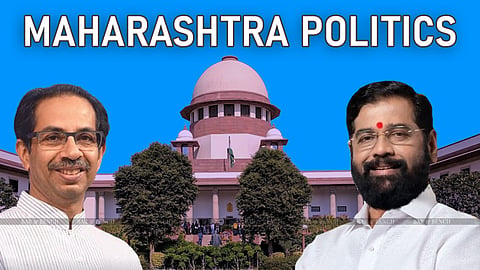
Such standards could help prevent recurring disputes over party splits and defections, particularly in cases where the legislature party splits (MLAs/ MPs within State assembly or parliament splitting or joining another party), the Court said.

The observations were made by a bench of Chief Justice of India Surya Kant and Justices Joymalya Bagchi and Justice V Mohana during the hearing of the plea filed by the Uddhav Thackeray-led faction challenging the Election Commission of India's (ECI) February 2023 decision to recognise the Eknath Shinde-led faction as the real 'Shiv Sena'.

The Shiv Sena political party split into two factions in 2022, one led by Thackeray and the other by Shinde.

Shinde then petitioned the ECI staking a claim to the 'Shiv Sena' name and the bow and arrow symbol. 

The ECI relied on the strength of the legislative wing of the party to arrive at its decision rather than on the test of its organisational wing.

The ECI explained that although it had attempted to apply the test of the organisational wing, it could not come to any satisfactory conclusion because the latest Constitution of the party was not on record.

The claims of numerical majority in the organisational wing of the party by both factions were not satisfactory, the ECI opined.

Hence, it proceeded to rely on the test of who had the majority in the legislative wing.

The Shinde faction was noted to have 40 Members in the Legislative Assembly (MLAs) as against the Thackeray faction's 15 MLAs.

Likewise, in the Lok Sabha as well, out of 18 Members of Parliament (MPs), 13 MPs supported the Shinde faction, while only 5 supported the Thackeray faction, the ECI found.

Hence, it ruled in favour of the Shinde faction and allowed it to retain Shiv Sena name and the bow and arrow symbol.

Justice Joymalya Bagchi, CJI Surya Kant and Justice V Mohana

The Thackeray faction then filed the present appeal before the apex court.

During the hearing of the matter on Wednesday, the CJI Kant asked how a majority within a political party ought to be determined.

While competing factions may rely on different indicators such as the strength of elected representatives, office-bearers or primary members, there should be some formula under the ECI's guidelines, the party Constitution or a statute to assess majority, the CJI said.

"If there is defined criteria, that will to a large extent prevent these kinds of occasions," the CJI observed.

Senior Advocate Kapil Sibal, appearing for the Uddhav Thackeray faction, said that the issue has already been settled by the Constitution Bench of the Supreme Court in the Subhash Desai case. He argued that the legislature party cannot be conflated with the political party and submitted that the Election Commission's jurisdiction under paragraph 15 of the Symbols Order is confined to identifying the recognised political party, not adjudicating upon the validity of a party Constitution.

Sibal contended that the determination as to which is the real party has to be made by examining the party Constitution and its organisational hierarchy, and not merely the numerical strength of legislators (MPs/ MLAs).

Seniour Advocate Kapil Sibal

Sibal also argued that the case reflects what he described as a "new phase" of defections in Indian politics. According to him, legislators elected on one party's symbol are now seeking to have the legislature party itself merge with another political formation without the political party (outside of the assembly or parliament) doing so.

Such a course, he contended, enables governments to change despite the electorate having voted for a different political formation, reducing the electoral mandate to "a farce" and carrying serious consequences for representative democracy.

Justice Joymalya Bagchi said that the control of the political party subsists over the legislature party and that any valid decision of the political party must prevail even over the will of a majority of the legislature party. The Bench also discussed the balance between preserving representative democracy and allowing elected representatives some space to take political decisions.

At one stage, while discussing the larger issues arising from the dispute, the CJI remarked that the situation presented "a big mess" and the debate was not merely about the autonomy of legislators but also about the exercise of political power.

The matter will again be heard on August 6, Thursday.

[Read Live Thread]

Bar and Bench - Indian Legal news
www.barandbench.com