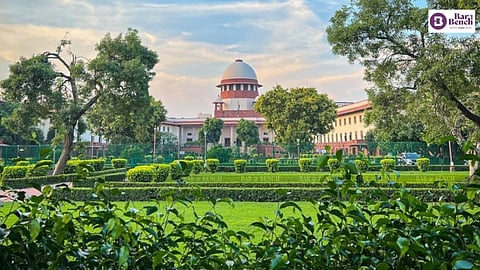

The Supreme Court on Tuesday dismissed an appeal filed by activist Ravi Nair challenging a Delhi High Court judgment that had quashed criminal defamation proceedings against journalist Nilanjana Bhowmick over a 2010 TIME article concerning scrutiny of NGO funding.
A bench of Justice JB Pardiwala and Justice Vinod Chandran dismissed the plea after questioning Nair on the delay in filing the defamation complaint.
Appearing for Nair, advocate R Gopal submitted that the Central Bureau of Investigation (CBI) had conducted a lengthy investigation against Nair from 2008 onwards in connection with issues concerning foreign exchange regulations.
“It was an issue concerning foreign exchange regulation. Thereafter, they filed a final report,” said Gopal.
The Court then asked Gopal to address the limitation issue.
“Come to paragraph 17 of the High Court judgment. Tell us what the error is. Was the article published in 2010? Now tell us, in which year did you file the complaint?” asked Justice Pardiwala.
Gopal replied that the complaint was filed in 2014.
In view of the same, the Court dismissed the plea.
The Delhi High Court had in November 2025 quashed the criminal defamation proceedings against Bhowmick, holding that her article, titled ‘Accountability of India’s Nonprofits under Scrutiny’, did not contain defamatory statements against Nair or his organisation, the South Asian Human Rights Documentation Centre.
Nair had alleged that the article implied that he and his NGO were involved in money laundering.
The High Court held that the article was factually correct. It noted that the manner in which a journalist presents facts cannot amount to defamation when the reported facts are true.
The High Court also held that Nair’s 2014 defamation complaint was barred by limitation, as the article had been published in 2010.
Additionally, the Court rejected Nair’s argument that the article’s continued availability online amounted to “continuous publication”. It held that the limitation period began from the date of its first publication.
Nair then approached the Supreme Court against the same.
[Read Live Coverage]