Supreme Court seeks responses from Meta, X on plea against police posting photos, videos of accused persons

The plea argued that police dissemination of accused persons’ photographs and videos could undermine the presumption of innocence and right to a fair trial.
Police
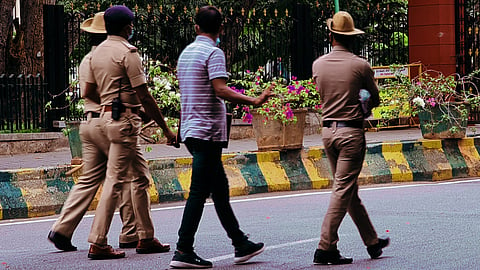
PoliceImage for representational purposes only
Published on
3 min read
Listen to this article

The Supreme Court on Tuesday sought replies from the Centre and social media intermediaries on a plea seeking safeguards against police uploading photographs and videos of accused persons on social media in a manner that could prejudice their right to a fair trial and violate their dignity [Hemendra Patel v. Union of India & Ors.].

A Bench comprising Chief Justice of India (CJI) Surya Kant and Justice Joymalya Bagchi and Justice V Mohana issued notice to Meta and X (formerly Twitter) and sought responses from them.

However, while issuing notice, the Court flagged the difficulty in regulating content once it enters the digital ecosystem.

“Issue notice. The only problem is how to control it because this is not a border that you can just close down,” observed CJI Kant.

Chief Justice of India Surya Kant and Justices Joymalya Bagchi and V Mohana

The present plea follows an earlier petition filed by the petitioner on the issue. The earlier petition was withdrawn in March 2026 with liberty to approach the Supreme Court with an enlarged scope.

At the time, the Court had indicated that guidelines being framed in separate proceedings concerning police media briefings could also cover police posts on social media.

The fresh petition has consequently brought Meta and X into the proceedings, besides seeking safeguards against the publication and dissemination of photographs and videos of accused persons.

Senior Advocate Gopal Sankaranarayanan, appearing for petitioner, told the Court that the social media platforms have been made parties because their existing policies do not specifically address the uploading of such material by police authorities.

Referring to Meta and X, he said,

“Neither of their policies cover this.”

Taking note of the submission, CJI Kant responded,

“Yes, that's needed.”

Further, Sankaranarayanan noted that individual High Courts had issued guidelines on the issue. However, he submitted that there was a need for a uniform and operational mechanism to deal with police-generated content circulated through social media.

Gopal Sankaranarayanan, Senior Advocate

Notably, similar concerns have also been raised before various High Courts.

The Punjab and Haryana High Court had in May 2025 directed the Chandigarh DGP to frame guidelines for uploading photographs and videos recorded by police officials during official duties on social media. The Court had said such guidelines were necessary to ensure that the publication of such material did not prejudice the investigating agency, victims or accused persons.

Similarly, in January 2026, the Rajasthan High Court had directed the immediate removal of photographs of arrested persons from social media and other online platforms after allegations of the photographing arrestees and circulating the images publicly were noted.

The High Court had held that such practices could violate the dignity and fundamental rights of arrested persons and undermine the presumption of innocence.

Following the Court's directions in May 2026, the Rajasthan Police issued an SOP prohibiting police from uploading or sharing photographs or videos of arrested persons on social media or with the press.

[Read Live Coverage]

Bar and Bench - Indian Legal news
www.barandbench.com