
Subscribe
Subscribe
- Latest Legal News
- News
- Law Firms
- Columns
- Interviews
- Law School
- Legal Jobs
- हिंदी
- ಕನ್ನಡ
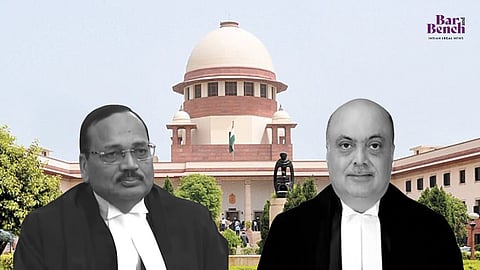
In yet another unusual administrative move, a second part-heard Supreme Court case that was expanded from an individual grievance into a sweeping nationwide probe - this time concerning unauthorised constructions and the commercial misuse of residential colonies - has been shifted away from a Bench led by Justice Ahsanuddin Amanullah.
Days before the case was slated to be heard on November 23, the part-heard matter has been reassigned to a bench led by Justice BV Nagarathna.
The development follows the reassignment of the private universities audit case from Justice Amanullah's Bench to a three-judge Bench led by Justice Vikram Nath.
Pertinently, under the Supreme Court's judges' roster, public interest litigation (PILs) are assigned exclusively to benches headed by the seven senior-most judges of the Court - Chief Justice of India (CJI) Surya Kant and Justices Vikram Nath, BV Nagarathna, MM Sundresh, PS Narasimha, JB Pardiwala and Dipankar Datta.
Justice Amanullah, who is currently ninth in seniority, does not hold PILs in his roster. Even the specific subject-matter category under which the case is classified - matters relating to municipal laws, housing and building permits, demolition, encroachment removal, sealing, and urban planning (Category 2301) - is not allocated to Justice Amanullah's Bench under the current roster.
By retaining individual petitions after dealing with the specific reliefs sought and expanding their scope nationwide, the Bench had effectively converted both cases into wide-ranging PILs outside its designated allocation.
Thus, the proceedings in Loganathan v. State of Tamil Nadu & Ors, which had been regularly heard as a part-heard matter by Justices Amanullah and R Mahadevan until September, will now be heard by a Bench headed by Justice Nagarathna.
The shift is particularly notable given how the Justices Amanullah-Mahadevan Bench had steadily broadened the scope of the proceedings over the last nine months. In its last order of September 22, the Bench had issued a contempt of court notice to the Chief Secretary of Uttarakhand for failing to appear and file responses in the case.
The case originally began as an individual challenge filed by a Chennai resident Loganathan against sealing and demolition notices issued by Tamil Nadu authorities over an unapproved ground-plus-one (G+1) building.
On February 16 this year, the Bench of Justices Amanullah and Mahadevan dismissed Loganathan's special leave petitions, finding no fault with the Madras High Court's refusal to interfere with municipal action. However, the Court refused to close the matter. Observing that a G+1 structure could not have come up without municipal connivance, it registered a miscellaneous application and sought a personal affidavit from the municipal commissioner explaining how the building was allowed to stand.
Over subsequent hearings, Justice Amanullah's Bench aggressively expanded the litigation into a nationwide monitoring exercise:
Pan-India municipal surveys and NCR impleadment: On March 25, the Bench made the municipal corporations of all State and Union Territory capitals as parties to the case and ordered surveys of residential areas being misused for commercial purposes. In May, the Court directed every State and UT to deposit ₹50,000 toward secretarial expenses.
IIT-Delhi audits and deadly building tragedies: In August, after the Court was told about a devastating fire at an illegal coaching centre operating in a residential zone in Lucknow's Aliganj that killed 15 students, the Court issued a contempt notice to the Lucknow Development Authority Vice-Chairman and impleaded all States and UTs through their Chief Secretaries. By September, after a five-storey PG hostel collapse in Delhi's Satya Niketan killed seven, the Bench also brought Sarojini Nagar and student PG accommodations under its direct scrutiny.
'Seal-first' drive against residential misuse: In its detailed order passed on September 22, the Bench ordered authorities across India to immediately seal premises being used for commercial purposes in areas earmarked exclusively as residential under master plans. The Court also ordered status quo in mixed-use areas and warned officials against selective, "pick-and-choose" enforcement.
In the same September 22 order, the Bench also dealt with a range of enforcement lapses and administrative developments across States:
Threats to senior counsel: The Bench took serious note of a submission by Senior Advocate Rajdeep Rastogi - who was assisting the Court on illegal coaching centres in Jaipur. The Court nearly summoned the Rajasthan Chief Secretary and Director General of Police (DGP) over police inaction on a September 12 FIR, stopping short only after State counsel conveyed prompt assurance from the DGP.
NDMC pull-up and Bhopal master plan: The Court pulled up the New Delhi Municipal Council (NDMC) for failing to cooperate or depute any responsible officer during inspections. It also questioned reports from Bhopal where sealed properties were being quietly unsealed within hours or days without any formal order. Further, the Madhya Pradesh government was allowed to publish a draft master plan for Bhopal, strictly to invite objections.
Contempt notice and sealed cover SIT report: The Bench issued a contempt notice to the Chief Secretary of Uttarakhand, directing his personal appearance on November 23.
