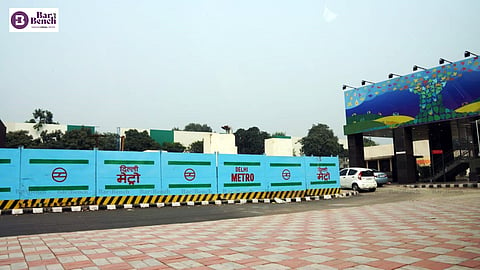
Supreme Court to examine plea challenging closure of Delhi metro stations during CJP protests

The Court issued notice to the Union government, the Delhi Police, Delhi Metro Rail Corporation (DMRC) and the Delhi government , seeking their replies.
Delhi Metro
Delhi Metro
Published on
3 min read
Listen to this article

The Supreme Court on Thursday sought responses from the Central government, the Delhi Police, the Delhi Metro Rail Corporation (DMRC) and the Delhi government on a plea raising constitutional questions over the closure of 17 Delhi Metro stations during the Cockroach Janata Party (CJP) student protests in July [Sparsh Kant Nayak v. Union of India and Ors].

A Bench of Chief Justice of India (CJI) Surya Kant and Justices Joymalya Bagchi and V Mohana was hearing the plea questioning whether the executive can direct the closure of metro stations, thereby restricting public access to a public utility, without a specific statutory provision or formal order.

Taking note of the submissions, Justice Bagchi observed that courts ordinarily defer to the executive on law-and-order issues, but can intervene where executive discretion is exercised disproportionately.

“The concept of SOP is actually a mirage. When it comes to a law and order question, courts have deferred to the executive authority. It is only in cases when it becomes disproportionate, as you indicated, that courts step in. So we will have to examine what is the way in which the discretion is being exercised,” he said.

Chief Justice of India Surya Kant and Justices Joymalya Bagchi and V Mohana

The DMRC had cited security reasons while announcing the closures through service updates on X. On July 20, it announced the closure of Janpath, Rajiv Chowk, Patel Chowk, Central Secretariat and Seva Teerth stations until further instructions.

On July 22, the DMRC announced the closure of several more stations, including Lok Kalyan Marg, Ramakrishna Ashram Marg, Barakhambha Road, Supreme Court, Mandi House, ITO, Delhi Gate, Indraprastha, Khan Market, Jor Bagh and Shivaji Stadium.

The issue had also come up before the Supreme Court during the protests in July, when concerns were raised about commuters being affected by the closure of metro stations. The stations were subsequently reopened after the protests were called off.

In today's hearing, the petitioner's counsel argued that there was no statutory basis or formal order for shutting down the metro stations. He submitted,

"It concerns the constitutional rights of the public at large and the constitutional standards governing the shutting down of a public utility. It also concerns the constitutional standard applicable to an order which restricts the constitutional rights of the public at large."

The counsel further argued that the closures failed the tests of proportionality and least invasiveness. He also questioned the legal authority under which the metro stations were closed.

“There is also no particular statute under which these orders were passed. In fact, no order itself was passed. There were only posts on X communicating the decision to the public."

The Court then asked whether the measure could nevertheless fall within the State's law-and-order powers. The counsel, however, maintained that the police could regulate a protest but could not direct a public utility to shut down its stations. He also argued that there was no standard operating procedure (SOP) governing such closures.

Taking note of all the submissions, the Court ultimately issued notice to the Union of India and the other concerned authorities.

[Read Live Coverage]

Bar and Bench - Indian Legal news
www.barandbench.com