
Subscribe
Subscribe
- Latest Legal News
- News
- Law Firms
- Columns
- Interviews
- Law School
- Legal Jobs
- हिंदी
- ಕನ್ನಡ
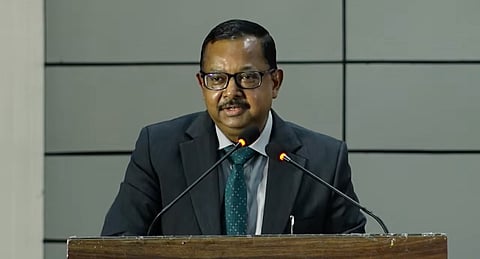
Supreme Court Justice Ujjal Bhuyan on Sunday called for a debate on the appointment of distinguished jurists as judges of the Supreme Court.
He highlighted that the constitutional provision enabling such appointments has remained unused for over 76 years
Justice Bhuyan was delivering the convocation address at the 13th Convocation of National Law University Delhi (NLU Delhi) for its postgraduate programmes.
Article 124(3) of the Constitution permits the appointment of a person who is, in the opinion of the President, a distinguished jurist, as a Supreme Court judge. However, Justice Bhuyan pointed out that no jurist has been appointed to the Supreme Court under this provision so far.
He suggested two possible reasons for this.
“The first is that earlier, when the collegium system was not there, in the view of the Central Government, and thereafter, when the collegium system came into being, in the view of the collegium, there is not enough depth in Indian academia to be seriously considered for elevation as a judge of the Supreme Court,” he said.
Justice Bhuyan then offered what he considered the more probable explanation.
“The second, which is more probable, is that both the Central Government and the collegium have not seriously explored this provision thus far.”
The judge traced the provision to the Constituent Assembly Debates and recalled that HV Kamath had proposed expanding the pool of eligible candidates beyond judges and advocates to include distinguished jurists. The proposal was ultimately accepted by the Constituent Assembly.
“The Constituent Assembly evidently felt it important to have legal academics and professors as judges of the Supreme Court of India,” Justice Bhuyan said.
He rejected the argument that academics should not be appointed as judges because they lack practical experience. He termed it a "shallow objection".
“A distinguished jurist can be a great value addition to the Bench. By his or her scholarship, he or she can make a visible contribution to the decision-making process at the top level,” he said.
Justice Bhuyan also referred to constitutional scholar DD Basu’s view that bringing academic jurists of the right calibre into the highest court would enrich it.
“It is regrettable that this provision has remained one of our Constitution’s unused mandates.”
Justice Bhuyan went on to cite the appointment of academics to constitutional courts in jurisdictions including the United States, United Kingdom, Canada and Kenya.
He concluded that the issue deserves renewed consideration.
“This is an issue I think the academia needs to debate and put it back into the public domain once again,” he said.
[Read Live Coverage]