Maternity leave is a Constitutional right, not State charity: Jammu and Kashmir High Court

Maternity leave rights cannot be defeated through executive fiat, the Court added.
Maternity Leave
Maternity Leave
Published on
3 min read
Listen to this article

The High Court of Jammu and Kashmir and Ladakh recently ruled that the maternity leave cannot be reduced to a matter of charity and that it is an unassailable constitutional right anchored in the dignity of women [Dr. Sonakshi Gupta & Ors. v. UT of J&K].
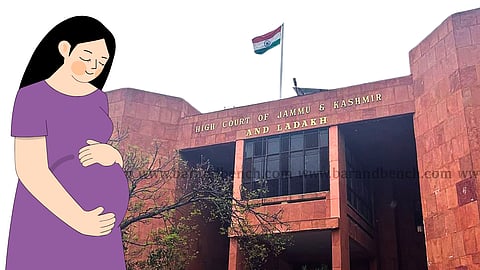
Justice Rajnesh Oswal made the observation while dealing with a petition filed by several doctors engaged in government medical colleges, challenging a communication that stopped payment of their salaries during maternity leave.

The Court held that once the government extends maternity leave under its rules, it cannot deny women doctors their salaries during the leave period through an executive communication.

The Court termed the government communication under challenge an instance of administrative overreach and underscored that rights to paid maternity leave cannot be defeated simply by executive fiat.

“Maternity leave cannot be reduced to a matter of state charity; it is an unassailable constitutional right anchored in the dignity of women. The respondents, having explicitly absorbed the existing Government Rules vide order dated 08.07.2024 to grant maternity leave to these Doctors, cannot now blow hot and cold by withholding their salaries. The right to full emoluments is an organic corollary of the right to leave itself, which cannot be defeated by an arbitrary executive fiat," the Court ruled.

Justice Rajnesh Oswal, High Court of Jammu & Kashmir and Ladakh

The petitioner-doctors before the Court included senior residents tutors engaged under the Jammu and Kashmir Medical and Dental Education (Appointment on Academic Arrangement Basis) Rules, 2020.

They challenged a communication dated October 14, 2025, issued by the Union Territory's Health and Medical Education Department on the advice of the Finance Department, which denied them pay and allowances during maternity leave on the ground that they were “out of assignment.”

The petitioners contended that a government order from 2024 expressly granted maternity leave in accordance with existing government rules and that they were never informed that availing such leave would result in loss of salary.

Their counsel argued that the 2024 government order incorporated existing government rules, including Rule 41(1) of the J&K Civil Services (Leave) Rules, 1979, which guarantees paid maternity leave.

He also relied upon the High Court's earlier judgment in Jammu and Kashmir Bank Ltd. v. Tanu Gupta, to contend that no woman employee can be subjected to financial disadvantage merely because she avails maternity leave.

The Jammu and Kashmir administration countered that the petitioners were not regular government employees to be entitled to paid maternity leave. It said that they were tenure-based appointees under the 2020 Academic Arrangement Rules.

The government counsel argued that an extension of residency granted to the petitioners after maternity leave was only an academic mechanism to complete the prescribed training period. This did not entitle the petitioners to salary for the maternity leave period, the government maintained.

The High Court rejected the government's stance. It held that the government order dated July 8, 2024 clearly extended maternity leave to the senior residents/ tutors as per the prevailing government rules and regulations. They were, therefore, entitled to the paid maternity leave provided for undore those rules and regulations, the Court concluded.

Relying on various caselaws, including the Supreme Court's decisions in Municipal Corpn. of Delhi v. Female Workers (Muster Roll), Deepika Singh v. PGIMER, Chandigarh, and Kavita Yadav v. State (NCT of Delhi), the High Court concluded that maternity benefits are constitutionally protected and cannot be diluted through executive instructions.

It, therefore, quashed the communication under challenge and directed the government to pay the petitioners full salary and allowances for their maternity leave period.

Advocate Abhinav Jamwal appeared for the petitioners.

Additional Advocate General Raman Sharma assisted by Advocate Saliqa Sheikh appeared for the Jammu and Kashmir government.

[Read Judgment]

Attachment
PDF
Dr._Sonakshi_Gupta_Vs_UT
Preview
Bar and Bench - Indian Legal news
www.barandbench.com