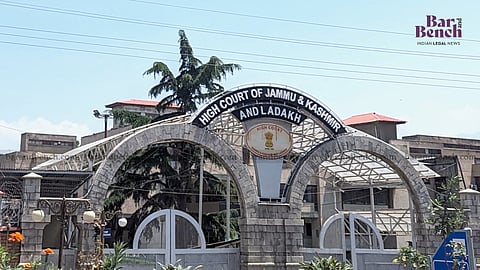
An academic being in possession of books alleged to be anti-national does not make him a criminal warranting his criminal detention, the High Court of Jammu & Kashmir and Ladakh held..Justice Moksha Khajuria Kazmi said that mere possession of books with “dispiriting titles” and authored by someone else is not sufficient to invoke preventive detention laws, particularly when the authorities fail to demonstrate any specific subversive or prejudicial activity attributable to the persons.The Court made the observation while quashing a preventive detention order issued under the Jammu & Kashmir Public Safety Act against academic scholar Shafat Maqbool Wani, who had been detained on the basis of allegations of involvement in anti-national activities and possession of alleged anti-national literature.These included books titled “Construction of an Islamic Order in Hindutva Reimagination” and “The Saffronization of Occupied Kashmir, Demystifying Hindutva Settlers, Colonial Designers.”"The alleged anti-national literature shown to have been seized from the detenue has also presumably weighed with the respondents to brand the detenue as an anti-national, however, the said literature has wrongly been attributed to the detenue having been authored by him. The learned counsel for the petitioner is quite justified in submitting that the petitioner, being an academic scholar, is expected to be in possession of variety of literary means, therefore, a mere possession of the books with dispiriting titles does not ipso facto make the petitioner/ detenue a criminal against whom the preventive detention was required to be invoked," the Court observed.Pertinently, the Court also said that the father of the dentenue being an ex-militant cannot be a reason to believe that the son might have been inculcated with the same separatist ideology, and such an assertion was "delusory". .The High Court was hearing a habeas corpus petition challenging detention order issued by the District Magistrate, Kupwara placing Wani under detention. .Wani's uncle challenged the detention primarily on the ground of non-application of mind. He contended that the detaining authority had acted mechanically and relied upon a case registered at Handwara police station for offences under the Arms Act and Unlawful Activities (Prevention) Act.It was pointed out before the Court that the detenue had already been granted bail in that case on September 13, 2025, after the court rejected the National Investigation Agency’s request for extension of remand beyond 155 days.However, the respondents defended the detention order and submitted that it was passed after proper application of mind and that the detenue was involved in activities detrimental to the security of the State.They further stated that the entire material relied upon by the detaining authority had been supplied to the detenue, its contents had been read over and explained to him, and he had been informed of his right to make a representation against the detention..After examining the detention record, the High Court found substance in the contention that there had been non-application of mind.The Court noted that although the respondents had referred to the grant of bail in both the grounds of detention and the counter affidavit, the detaining authority did not appear to have made any effort to independently derive satisfaction regarding the existence of prejudicial activity warranting preventive detention.While examining the grounds of detention, the Court noted that the authorities had stated that the detenue had been brought up in a family having a separatist ideology and that anti-India and separatist feelings had allegedly been inculcated in him since childhood because his father was an ex-militant, who had surrendered in 1990.The Court described this assertion as “delusory”, observing that preventive detention ordered on such an imaginary belief was an unmindful exercise of power..The High Court further emphasised that the respondents had not shown “any subversive activity” attributable to the detenue which had compelled them to take recourse to preventive detention.Hence, it quashed the preventative detention order and directed that Wani be released from preventive custody..Advocate Zahid Hussain Dar appeared for the petitioner.Government Advocate Faheem Nisar Shah appeared for the respondents.[Read Judgment]