
Subscribe
Subscribe
- Latest Legal News
- News
- Law Firms
- Columns
- Interviews
- Law School
- Legal Jobs
- हिंदी
- ಕನ್ನಡ
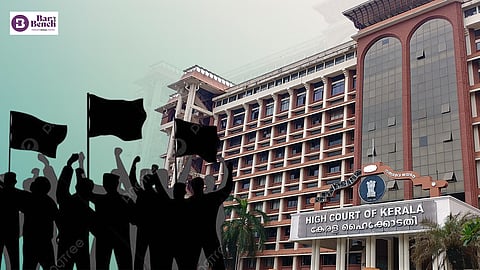
The Kerala High Court has reiterated that political activities like dharna, hunger strikes and other practices like Satyagraha have no place in a constitutional democracy, much less in academic institutions [Sree Sankaracharya University of Sanskrit v Archana PS & Ors.].
A Division Bench of Justices Anil K Narendran and Muralee Krishna S made the observation while setting aside a single judge's interim order that had permitted 16 suspended students of the Sree Sankara University of Sanskrit at Kalady to appear for university examinations scheduled to begin on November 4.
The students were suspended after they conducted a symbolic funeral of the Vice-Chancellor Ciza Thomas and later allegedly obstructed and assaulted her as she was leaving her office.
While considering their case, the Court cited a 2017 ruling from another Division Bench of the High Court on the right to protest within the context of an educational institution.
In that judgment, titled Dr Antony Thomas v. VM Muhammed Rafique & Ors., the Court had observed that students engaging in protests would be making themselves liable to be expelled.
"We would like to observe is that political activities like Dharna, hunger strikes and other practices like Satyagraha have no place in a constitutional democracy, much less in academic institutions. Anyone indulging in the said activities in an educational institution would make himself liable to be expelled and/or rusticated. Educational Institutions are meant for imparting education and not politics. By their political ambition, the political parties cannot hold to ransom the educational institution or the right of the civilized students to receive education," the 2017 judgment read.
The judgment also quoted Dr. BR Ambedkar's words while introducing the Constitution of India in the Constitutent Assembly on November 25, 1949.
"If we wish to maintain democracy not merely in form, but also in fact, what must we do? The first thing in my judgment we must do is to hold fast to constitutional methods of achieving our social and economic objectives. It means we must abandon the bloody methods of revolution. It means that we must abandon the method of civil disobedience, non - cooperation and satyagraha," Dr. Ambedkar had said.

The present case before the High Court stemmed from the symbolic funeral protest held by students at Sree Sankaracharya University of Sanskrit on August 13, 2026, when the university's syndicate was holding a meeting.
The incident led to the registration of two First Information Reports (FIRs) at the Kalady Police Station.
On September 1, the university suspended 16 students and initiated disciplinary proceedings against them.
According to the university, an enquiry committee that heard the students on September 29 and 30, recommended disciplinary action against them. However, the report could not be placed before the Syndicate for approval, until some procedural defects were corrected.
The students subsequently approached the High Court arguing that their continued suspension without a final decision in the disciplinary proceedings affected their studies and prevented them from attending classes.
They claimed that the protest was organised to raise concerns over inadequate facilities on campus and denied conducting any symbolic funeral of the Vice-Chancellor.
With university examinations scheduled to begin on November 4, the students sought permission to appear for them.
A single-judge of the Court on October 30 allowed them to provisionally appear for the exams.
The university challenged this order before the High Court's Division Bench. It pointed out that the deadline for examination registration had expired on October 23 and that the students had not submitted their applications within the prescribed time
It also stated that six of the suspended students were pursuing doctoral research programmes and were not covered by the examination notification, while the remaining students did not meet the mandatory attendance requirement of 80 per cent or complete the prescribed internal assessment necessary to appear for the examinations.
The Division Bench on Tuesday found force in the arguments made by the University and set aside the single-judge's order. However, it clarified that its observations were limited to the appeal before it and not a final comment on the dispute pending before the single judge.
Senior Advocate TA Shaji, along with advocates PG Pramod and Nadiya KM represented the students.
Advocate Silpa Sreekumar represented the University.
[Read Judgment]