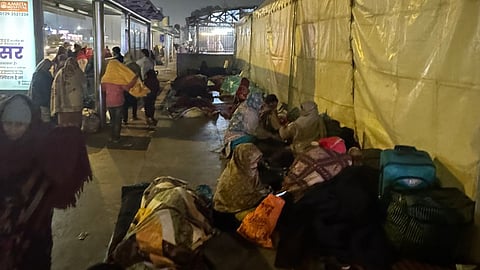
The Delhi High Court recently ruled that the people sleeping on pavements cannot be held liable for contributory negligence in road accident cases [Digamber Kumar Vs National Ins Co Ltd & Ors]..Justice Anish Dayal acknowledged that many homeless persons or workers, who have no place to sleep during the night, rest on pavements as they consider these places to be relatively safer.They do not expect vehicles to be driven on the pavements and mow them down, the Court said. It added that this calculated risk of sleeping on the pavement cannot be translated into contributory negligence.The Court was dealing with an appeal challenging a Motor Accident Claims Tribunal (MACT)'s decision to reduce 50 percent compensation as contributory negligence in a case of road accident involving people who were sleeping on a pavement. The accident had led to death of two men and caused injuries to two others when they were hit by a truck while sleeping on a pavement under the Madipur metro station.The Court said it was surprised with MACT's observation about contributory negligence of these victims. The tribunal rather ought to have asked itself whether the truck driver had any authority or right to drive his truck over the pavement, which is meant for pedestrians, the Bench said. "The answer to that question would have been obvious, and therefore, whatever activity is happening on the pavement, whether people are sleeping, or hawkers are present, or people are walking, cannot come within the purview of contributory negligence," it observed..It is a reality in this country that many persons are homeless, work through the night, or are part of labour deployed at various constructions sites and do not have a place to sleep. For such persons, these pavements also become a relatively safer place to rest.Delhi High Court.Therefore, the Court set aside the MACT's finding of contributory negligence of 50% in the case dating back to 2015.In a decision on the claim petitions of the injured victims and families of deceased, the MACT had in 2017 ruled that since pavements are not meant for sleeping, the victims were liable for contributory negligence in the accident. Four appeals were filed to challenge the decision. .In the ruling passed on July 8, the High Court said that a pedestrian who is using a pavement, walking, standing, or resting owing to compelling circumstances, cannot be expected to anticipate that a motor vehicle would be driven onto the footpath.The very purpose of the pavements or footpaths is for pedestrians or for any licensed user, and not for motor vehicles to drive, it added.Therefore, the entire responsibility lies upon the driver who drove the vehicle into a space reserved exclusively for pedestrians, the Court ruled.It emphasised that a diver ought to be more cautious while driving in an area meant for pedestrians and cannot use a pavement for driving even if it is not being used for the purpose it is intended for.“The law does not permit their use for any other purpose, whether by way of unauthorised encroachments, parking of vehicles, or driving motor vehicles upon them. The very purpose of a pavement is to provide pedestrians with safe space to walk and be free from the dangers of vehicular traffic," the Court said..Thus, the Court held the truck driver liable for the accident as he had driven the vehicle into a space reserved exclusively for pedestrians.Accordingly, it enhanced the quantum of compensation awarded to the victims and directed that the amount along with accrued interest be deposited with the MACT by the insurance company within 6 weeks..Advocates Anshuman Bal, S N Parashar and Ritik Singh appeared for the claimants.Advocate Manu Luv Shahalia appeared for insurance company.[Read Judgment]