
Subscribe
Subscribe
- Latest Legal News
- News
- Law Firms
- Columns
- Interviews
- Law School
- Legal Jobs
- हिंदी
- ಕನ್ನಡ
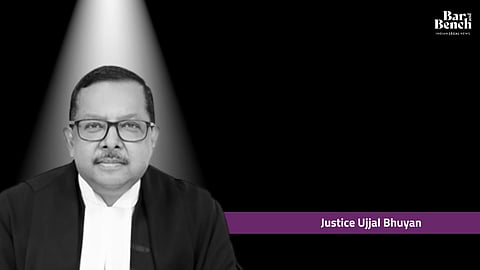
Spotlight is a series where we shine the, well, spotlight on members of the legal fraternity who have been making the news of late.
This past week, or perhaps even the past two weeks, the spotlight was on Supreme Court judge Justice Ujjal Bhuyan, who is emerging as one of the more outspoken voices on the Bench.
The most recent example of Justice Bhuyan's candour was at an event, where he observed that failure to disclose reasons in Collegium proposals concerning the appointment of judges does a great disservice to judges and goes against public interest.
There is no mandatory requirement for the Supreme Court Collegium to disclose reasons for its recommendations. However, during Justice DY Chandrachud's tenure as Chief Justice of India (CJI), the Collegium released detailed resolutions with a cursory mention of the particulars and reasons for each recommendation. That practice seems to have been done away with now under CJI Surya Kant.
Justice Bhuyan criticised this opacity, stating that it was creating space for undesirable candidates to enter the judiciary who then make unconstitutional remarks.
"I have noticed that the last three collegium resolutions contain no reasons whatsoever. Is this a step back from the principle of transparency?” he asked.
In this regard, Justice Bhuyan cited the example of a controversial speech given by a former Allahabad High Court judge in 2024 at a VHP event, when he made certain veiled references against Muslims.
"...by withholding reasons, we also create space for individuals to enter the judiciary who may later describe groups of people (with references to their treatment of) ‘ants’ and make other remarks that are wholly unconstitutional and contrary to the values of the Constitution," remarked Justice Bhuyan.
Among other comments, the Allahabad High Court judge in question had reportedly said,
"In our country, we are taught not to harm even the smallest animals, not to kill ants. But in your culture, from a young age, children are exposed to the slaughter of animals. How can you expect them to be tolerant and compassionate?"
Justice Bhuyan took exception to such remarks as he reiterated that judicial appointments must follow proper discussions and reasons.
"What harm is caused if there is informed public debate on such decisions?” Justice Bhuyan asked.
Several other issues, all of which have occupied headlines of late, were also discussed by the Supreme Court judge recently.
On July 25, while delivering the Justice GP Singh 4th Memorial Lecture, Justice Bhuyan remarked that public spaces for accommodating divergent views are shrinking in India to the point where students peacefully protesting for their rights are being arrested and denied bail.
"People who come to voice their anguish over environmental degradation, which is a reality, are chased away as if they are criminals. Students protesting in campuses are arrested and they do not get bail for 30-40 days. They are suspended for which they have to go to the court. It takes time," he noted.
Speaking on the role of courts in protecting constitutional freedoms, Justice Bhuyan said that citizens were increasingly facing criminal action for exercising their right to protest.
"It will not be an exaggeration to say that public space for expressing divergent opinion is shrinking in India. The right to express one's views and to demonstrate peacefully are fundamental freedoms of the citizens. Debate and dissent are the essence of democracy. Unfortunately, even normal activities are being criminalised," said Justice Bhuyan.
When the Supreme Court itself has been under fire for exhibiting what one may view as callousness towards protesting students facing police brutality, remarks from a sitting Supreme Court judge advocating for their rights was a welcome reprieve.
Justice Bhuyan also weighed in on the Ganga-Iftar boat case, in which 14 Muslim men were arrested in Varanasi in March this year for allegedly hurting religious sentiments after organising an iftar gathering on a boat in the middle of the holy river.
"There is no law prohibiting consumption of chicken over the Ganga river. They were arrested for that very reason and they had to remain in jail for 3 months," Justice Bhuyan said, criticising the arrests that kept the men in jail for 3 months before they were granted bail by the Allahabad High Court in May.
He also called for introspection by members of the judiciary.
"It amazes me when we go on ourselves patting our own backs by saying how powerful the Indian Supreme Court is, how great Indian Supreme Court is. It is not for us to make that comment. It is for the citizens to assess."
In the same lecture, Justice Bhuyan revisited the Supreme Court's 2024 ruling against punitive "bulldozer justice," saying that the judgment, though welcome, had come two years too late. He also referred to a recent Bombay High Court order refusing permission for a demonstration in solidarity with Palestine, calling the Court's observations "very amusing" and noting that petitioners had been questioned about their intentions despite India maintaining diplomatic relations with Palestine.
A brief look at Justice Bhuyan's work on the Bench and off it makes it amply clear that these statements are not one-offs intended to grab headlines.
Justice Bhuyan was born on August 2, 1964 at Guwahati. His father Suchendra Nath Bhuyan was a Senior Advocate and a former Advocate General of Assam. After completing his schooling in Guwahati and graduating in Arts from Kirori Mal College, Delhi, he obtained his LL.B. degree from Government Law College, Guwahati and LL.M. degree from Gauhati University.
In 1991, he enrolled with the Bar Council of Assam, Nagaland, Meghalaya, Manipur, Tripura, Mizoram and Arunachal Pradesh. He practiced primarily before the Gauhati High Court and other courts and tribunals in Assam and Arunachal Pradesh.
In 2010, he was designated as a Senior Advocate by the Gauhati High Court. A year later, he was appointed as Additional Advocate General, Assam.
On October 17, 2011, Justice Bhuyan was elevated to the Bench, first appointed as an additional judge and later in 2013 as a permanent judge of the Gauhati High Court.
In September 2019, the Supreme Court Collegium recommended Justice Bhuyan's transfer to the Bombay High Court.
The news was met with staunch opposition from the Bar in Gauhati. The Gauhati High Court Bar Association passed a resolution unanimously objecting to the transfer. The Association noted that Justice Bhuyan's seniority rank would fall once he shifts from the Gauhati High Court, where he was the third senior-most judge. The Bar members also emphasised that Justice Bhuyan had been discharging his judicial work in an exemplary manner and called on the Central government to return the Collegium proposal.
However, Justice Bhuyan's transfer was notified by the Centre soon thereafter, and he took oath as judge of the Bombay High Court on October 3.
After a 2-year stint at Mumbai, Justice Bhuyan was transferred to the Telangana High Court and was sworn in there on October 22, 2021. On June 28, 2022, he was appointed as the Chief Justice of the Telangana High Court.
Just over a year later, the Collegium recommended his elevation to Supreme Court and he was sworn in on July 14, 2023. Justice Bhuyan is currently halfway through his 6-year tenure which will end on August 1, 2029.

In June 2020, a Division Bench of the Bombay High Court headed by Justice Bhuyan granted relief to Republic TV's Editor in Chief Arnab Goswami, who had been embroiled in legal trouble for his comments on the gathering of migrant workers in Mumbai's Bandra on April 14 and the Palghar lynching incident. Goswami was accused of making incendiary and hateful statements that caused disharmony among communities.
The Bench said that there was no prima facie case against Goswami and suspended the FIRs against him. While doing so, the Bench said,
"India is now a mature democracy. Seventy years into our republic we cannot be seen to be skating on thin ice so much so that mere mention of a place of worship will lead to animosity or hatred amongst religious communities causing upheaval and conflagration on the streets. Subscribing to such a view would stifle all legitimate discussions and debates in the public domain."
At the Bombay High Court, Justice Bhuyan also headed another Division Bench which allowed a women who was the victim of domestic violence to terminate her 23-week-old pregnancy. This ruling came years before the Supreme Court passed its judgment in X v The Principal Secretary Health and Family Welfare Department, Delhi NCT Government & Anr, which is now the authoritative precedent for reproductive rights in India.
Much like the Supreme Court did two years later, Justice Bhuyan in his judgment at the Bombay High Court held that the mental health of the woman that needs to be taken into account while considering whether to allow termination of pregnancy older than 20 weeks.
In another important ruling at the Bombay High Court, a Bench headed by Justice Bhuyan held that a person disfigured due to violent assaults by throwing of any corrosive substance will be considered as an 'acid attack victim' under the Rights of Persons with Disabilities Act and would therefore be eligible for compensation.
As Chief Justice of the Telangana High Court, Justice Bhuyan authored a ruling in Vyjayanti Vasanta Mogli v. State of Telangana, which struck down the colonial-era Telangana Eunuchs Act, 1919. The law had permitted warrantless arrests and mandatory registration of transgender persons. Justice Bhuyan held that the Act was violative of fundamental rights under Articles 14 and 21 of the Constitution.
Since his elevation to the Supreme Court in 2023, Justice Bhuyan has mostly been on Benches lead by other senior judges, including CJI Surya Kant. It is only in the past month that he started leading a two-judge bench.
But even when he was the junior judge on the Bench, Justice Bhuyan did not hesitate to make his voice heard, sometimes through oral observations and sometimes through concurring or dissenting opinions in judgments.
One such case saw a Bench of himself and Justice BV Nagarathna expressing serious reservations about its own earlier judgment delivered by another Bench denying bail to activist Umar Khalid in the Delhi riots case.
The Bench opined that bail should be the rule and jail the exception even in Unlawful Activities (Prevention) Act (UAPA) cases, especially considering the Supreme Court's ruling in Union of India v. KA Najeeb, in which a three-judge Bench had ruled that the right to speedy trial and related rights under Article 21 would apply to UAPA accused as well.
"In that spirit, we make it clear that Najeeb is binding law and entitled to the protection of judicial discipline. It cannot be diluted, circumvented, or disregarded by trial courts, High Courts, or even by benches of lower strength of this Court," the Bench said.
The same Bench also delivered the verdict which quashed the Gujarat government’s premature release of 11 life convicts in the 2002 Bilkis Bano gang-rape case.
The Bench found that the Maharashtra government should have taken a call in the matter since the trial in the Bilkis Bano rape case took place in Maharashtra. The Bench also slammed the Gujarat government for "usurping" the power of the Maharashtra government in the matter.
This Bench also dealt with a petition which challenged the title of the film Ghooskhor Pandat on the ground that it equated “Pandat” (a caste within the Hindu society) with “Ghooskhor” (bribe-taker). Justice Bhuyan authored the judgment in the case in which he cited his previous judgment stated that 75 years into the life of the republic, India cannot afford to treat poetry, satire, films or other forms of art as automatic triggers for communal discord.
The judge also made it clear that no one can be permitted to target any particular community on the basis of religion, language, caste or region, especially public figures occupying high constitutional office.
"It is therefore constitutionally impermissible for anybody, be it the State or non-state actors, through any medium, such as, speeches, memes, cartoons, visual arts etc, to vilify and denigrate any community," the judgment said.
Justice Bhuyan has also spent time on a bench led by Justice Abhay S Oka. This Bench passed a verdict in 2024 holding that bail conditions enabling investigating agencies to constantly track the whereabouts of an accused are arbitrary and unlawful. The Bench ruled that it is not permissible for courts to order an accused to share his Google PIN location with the police authorities as a condition for the grant of bail stating,
"The investigating agency cannot be permitted to continuously peep into the private life of the accused enlarged on bail by imposing arbitrary conditions since that will violate the right of privacy of the accused, as guaranteed by Article 21."
The same Bench in another case delivered a landmark verdict on the protection of free speech in India as it quashed a Gujarat Police case against Congress Member of Parliament (MP) Imran Pratapgarhi over a poem uploaded by him on social media.
The Bench stressed that courts must be at the forefront to protect the fundamental rights of citizens facing repercussions for exercising their right to freedom of expression. It also said that even if a large number of persons dislike the views expressed by another, the right of that person to express the views must be respected and protected.
"The effect of spoke or written words cannot be judged on the basis of standards of people who always have a sense of insecurity or those who always perceive criticism as a threat to their power or position," the Bench said.
Another significant ruling delivered by this Bench held that those accused of offences under the Prevention of Money Laundering Act, 2002 (PMLA) are also entitled to copies of documents that the Enforcement Directorate (ED) does not rely on for investigation or prosecution. It held that this is part of an accused's right to a fair trial under Article 21 of the Constitution.
The same Bench also delivered a ruling asserting that courts must not order takedown of media reporting of court proceedings without valid reason at the cost of public debate and impartiality.
"Courts, as a public and open institution, must always remain open to public observations, debates and criticisms. In fact, courts should welcome debates and constructive criticism," Justice Bhuyan said, while pronouncing the verdict.
Some of Justice Bhuyan's most outspoken moments on the Bench can be found in his dissenting (or partially dissenting) opinions in some major judgments.
In September 2024, the Supreme Court granted bail to Delhi Chief Minister (CM) Arvind Kejriwal in the case registered by the Central Bureau of Investigation (CBI) in relation to the corruption allegations surrounding the now scrapped Delhi Excise Policy of 2021-22. Kejriwal had filed two separate pleas before the top court - one challenging the legality of his arrest by the CBI and a second plea seeking bail.
A Bench of then Justice Surya Kant and Justice Bhuyan unanimously held that the Aam Aadmi Party (AAP) leader should be released on bail. However, the judges differed on the legality of the CM's arrest.
Justice Kant held that the CBI's arrest of Kejriwal after he was granted bail in the ED case was valid and in compliance with relevant procedural laws.
On the other hand, Justice Bhuyan differed from Justice Kant with respect to the necessity and the timing of the AAP leader's arrest. Justice Bhuyan criticised the CBI, saying that Kejriwal's arrest by the agency after he secured bail in the ED case was only to frustrate his release from prison. The judge also said that the CBI must dispel the notion that it is the Central government's "caged parrot" which engages in politically motivated targeted harassment.
"CBI must be seen above board and every effort must be made so that arrest is not in a high-handed manner," Justice Bhuyan said.
In 2025, in a case concerning the legality of retrospective environmental clearances (EC), Justice Bhuyan dissented from the majority verdict of then CJI BR Gavai and Justice K Vinod Chandran which allowed a review petition, effectively permitting retrospective grant of ECs for projects.
Justice Bhuyan in his dissenting opinion said that the Court cannot be seen backtracking on the sound environmental jurisprudence that has evolved in this country, that too, on a review petition filed by persons who have shown scant regard for the rule of law.
“Before parting with the record, I would like to painfully observe that the deadly Delhi smog reminds us everyday about the hazards of environmental pollution," he added.
Beyond his written judgments, Justice Bhuyan’s public addresses over the years offer a window into his judicial philosophy.
In March this year, while speaking at a Supreme Court Bar Association conference, Justice Bhuyan delivered what is perhaps his sharpest institutional critique. He said that a “more loyal than the king syndrome” within parts of the judiciary has contributed to prolonged incarceration of accused persons.
“Many within the judiciary suffer from this more loyal than the king syndrome. As a result, people continue to languish in jails for months and months together,” Justice Bhuyan said.
During his address, Justice Bhuyan raised concerns about prolonged detention under laws such as the Prevention of Money Laundering Act (PMLA).
“The PMLA is a potent weapon. But like any weapon, if it is overused, it will lose its potency,” he said.
A month later, while speaking at a book release event, Justice Bhuyan advocated for payment of compensation to individuals who undergo prolonged detention under strict statutes like PMLA only to be ultimately acquitted.
“Constitutional courts cannot allow provisions like Section 45 to become instruments in the hands of the ED to continue incarceration for a long time when there is no possibility of the trial concluding within a reasonable time,” Justice Bhuyan said.
Speaking at a seminar organised by the Telangana Judges Association and the Telangana State Judicial Academy in February this year, Justice Bhuyan asserted that constitutional morality must prevail over popular morality.
Illustrating the gulf between constitutional guarantees and lived reality, he shared a personal anecdote of how his daughter's Muslim friend was denied accommodation in Delhi once a prospective landlady learned her surname.
He stressed that courts must actively bridge these social divides, adding,
"This is a mirror to us showing how distant we still are from the benchmark of constitutional morality even after seventy five years into our republic.”
Judicial independence from executive overreach is a subject that Justice Bhuyan has spoken about on several occasions.
In January this year, Justice Bhuyan asserted that transfer of judges is an internal matter of the judiciary and that the government should have no role in the process. Justice Bhuyan cautioned that any departure from this principle compromises judicial independence and defeats the purpose of insulating the judiciary from outside influence.
In March 2026, Justice Bhuyan spoke candidly on the internal diversity and representation in the judiciary, highlighting the fact that not a single woman judge was elevated to the Supreme Court during the entire tenure of former CJI DY Chandrachud.
Interestingly, Justice Bhuyan has also countered the rigid view of judicial restraint, remarking that it is wrong to say that judges should not interfere with law-making.
“According to me, the criticism that unelected judges of constitutional courts should not interfere in the law making by the elected representatives of the people has no legal or constitutional basis. This is because the Constitution has mandated the Supreme Court the power to examine whether law made by the parliament conforms to the constitutional requirement and if not, to strike down such law by exercising the power of judicial review."