

The Supreme Court on Friday asked the Central and State governments to put in place a mechanism for compensating victims of stray cattle accidents and for ensuring better implementation of laws governing stray cattle [Nisha v Municipal Council Sangrur & Ors].
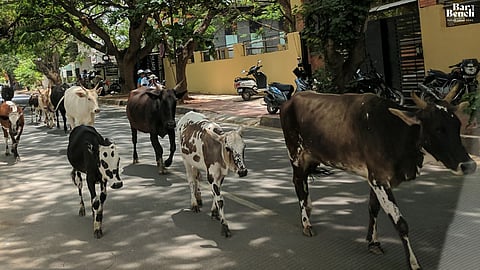
A Bench of Justices Sanjay Karol and NK Singh passed the direction while flagging the danger posed by stray cattle to both human and animal life on highways and roads.
“Stray cattle on highways are a constant invitation to death. After all, they are not meant to be natural speed breakers, placed willy-nilly on the National Highways, roads and streets,” it observed.
The Bench added that such incidents often prove fatal for motorists and pedestrians alike, and can occur even without a vehicle involved.
“It is not only these animals but also the humans that at times meet the most painful of ends while driving merrily along for no other reason but the fact that all of a sudden, an animal comes in front of the vehicle leading to a collision,” it noted.
Citing government data, the Court noted that animal attacks killed 1,130 people across India in 2018, 1,425 in 2019, and 1,305 in 2020.
It proceeded to ask the Centre and States to frame a mechanism to compensate victims of stray cattle accidents, mandate cattle tagging and ensure better implementation of laws governing stray animals.
The case arose from an appeal filed by one Nisha, whose husband Vijay Kumar was hit by a stray bull while walking on a road in Punjab's Sangrur in September 2007. He sustained a serious head injury.
Vijay sought compensation from the authorities during his lifetime, but the Deputy Commissioner of Sangrur declined his request solely on the ground that the department did not have funds available for such compensation - without ever disputing that the incident had occurred.
Vijay passed away some years later.
After his death, Nisha approached the Punjab and Haryana High Court. A single-judge in May 2019 awarded compensation of ₹29.32 lakh with 6% annual interest, applying the principles used to calculate compensation under the Motor Vehicles Act.
However, a Division Bench, in a November 2025 judgment, set aside the order, holding that the claim involved disputed questions of fact and should be pursued before a civil court instead.
Aggrieved by this, Nisha approached the Supreme Court.
The Supreme Court said that sending the family to a civil court nearly two decades after the incident would effectively leave them without a remedy. It awarded Nisha a lump sum compensation of ₹15 lakh, clarifying that the amount was granted in the peculiar facts of the case and would not operate as a precedent.
The Bench then expanded the scope of the case to examine the larger problem of stray cattle on Indian roads, noting that such incidents are no longer isolated and affect pedestrians and motorists across the country.
It traced the State’s constitutional obligation towards animal welfare to Article 48 of the Constitution, and the duty of citizens to show compassion towards animals under Article 51-A(g).
The Court also acknowledged that at least 24 States and Union Territories already have dedicated cattle welfare legislation in place.
The Court said the practice of owners abandoning cattle once the animals cease to be economically useful could not be ignored.
“The reality of animals being let go after they cease to serve a useful, economic purpose cannot be denied,” the Court said.
It held that such owners must be made accountable.
“The owners choosing to make such a decision should be held responsible and ensure safe transfer of such animals to the shelters run by the appropriate authority,” it added.
Therefore, the Bench directed all States that have enacted cattle-related laws to ensure their immediate implementation.
It also recommended framing a mechanism for compensation in accidents caused by stray cattle, mandating tagging of all cattle, appointing nodal officers to oversee tagging and shelters, and ensuring abandoned animals are transferred safely to authorised shelters with proper records.
The Court directed that a copy of its judgment be sent to the chief secretaries of all States, the administrators of all Union Territories and the member secretaries of the State Legal Services Authorities for appropriate action.
[Read Judgment]