
Subscribe
Subscribe
- Latest Legal News
- News
- Law Firms
- Columns
- Interviews
- Law School
- Legal Jobs
- हिंदी
- ಕನ್ನಡ
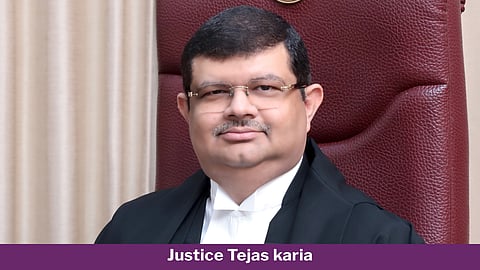
Technology, if poorly designed, can cause more harm than good in India's justice system, said Delhi High Court judge Justice Tejas Karia on Sunday.
Justice Karia was speaking at the inaugural edition of JusTech, a national conclave organised by the Dharmashastra National Law University. Jabalpur (DNLU).
His address focused on addressing the justice gap by harnessing technology.
He pointed out that the justice gap does not arise because of any lacunae in law, but due to various barriers such as cost, accessibility, complexity, undue delays, and a lack of trust in the system.
Justice Karia opined that Online Dispute Resolution (ODR) can be a handy tool to bridge the gap, without replacing human involvement.
"Mediation is the norm of the day. We all know that mediation is very valuable, but if it can be done in online mode, what all it can achieve: all the barriers which we just discussed can be easily eliminated with the help of an Online Dispute Resolution mechanism. ODR doesn't mean they are replacing judges with computers, or that they are removing the human aspect of it. ODR, or Online Dispute Resolution, is only providing a tool. And it can be a tool by which the documents can be exchanged, there can be video conferencing, you can have the platforms where you can have negotiations, and also sometimes an early determination or an expert determination can also be done through the ODR mechanism," he said.
He pointed out that ODR reduces the need for litigants to incur travel expenses or miss days of work and enables them to approach cases from the comfort and familiarity of their homes. AI tools could also reduce the burden on courts by automatically grouping similar cases.
However, he warned that for the benefits of technology to truly percolate the justice system, there must be strong safeguards in place.
"Technology can improve justice, but it can also undermine it if poorly designed, and an ODR system must never come as a result of a fast lane for an unfair outcome," he said.
The judge went on to suggest various safeguards to bear in mind while using technolgy in the administration of justice.
Key principles outlined by him in this regard include equal bargaining power among stakeholders, impartiality of the decision-maker, whether arbitrator, mediator, or algorithm, robust cybersecurity to protect personal data, informed consent rather than blind compliance, and continuous human oversight.
Justice Karia also emphasized that ODR must be hybrid by design so that India’s digital divide does not exclude marginalised citizens or persons with disabilities.
"On one side, there is a litigant who is seeking justice, and the other side is a justice delivery system. And ODR should be used as a bridge between the two. So traditional courts can be slow, it can delay the entire justice delivery system, but if we use ODR, I am sure we can really improve the justice delivery system and bridge this gap," he said.
Justice Karia further advised law students in the audience to not rely exclusively on AI tools for research, pointing out that such tools not only hallucinate fake case laws but also miss out on existing precedents.
"The persons who apply that mind will be successful. The lawyers who are able to read on their own, study on their own, and use technology only as a tool will be able to do justice, and we will be able to bridge this gap in justice. So our challenge is not simply to build digital courtrooms. It is to build a justice system in which a person's rights do not depend on financial capacity, geographical location, language, gender, disability, or digital literacy. Let us build Online Dispute Resolution not as a substitute for justice, but as a bridge to it," he underscored.