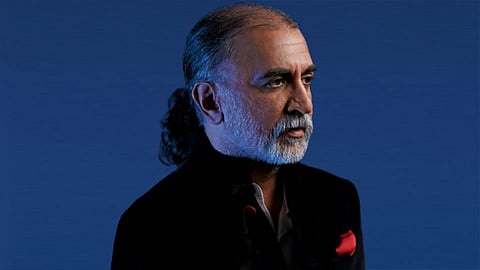

The Bombay High Court on Thursday held former editor-in-chief of Tehelka magazine, Tarun Tejpal, guilty of raping a journalist working at the magazine, and sentenced him to ten years of rigorous imprisonment.
The rape survivor said that she was assaulted twice in 2013 - once on November 7 and a second time on November 8 - inside a lift at a hotel in Goa during the conduct of the THiNK Festival hosted by Tehelka.
The High Court today criticised the trial court’s earlier decision to acquit Tejpal.
It noted that the trial court's decision centred primarily on the rape survivor’s moral character rather than a proper appreciation of evidence.
“The appreciation of evidence by the trial court is not only unreasonable but perverse,” said the High Court.
Highlights from the judgment rendered by a Bench of Justices Neela Gokhale and Amit Jamsandekar include the following.
1, Survivor remained steadfast despite unwarranted personal attacks
The High Court noted that during the trial, despite scores of invasive questions designed to shake her confidence, the rape survivor remained consistent and steadfast in her testimony with no contradictions in her account.
The Court also criticised the trial court for failing to intervene even when the survivor was harassed and humiliated in court.
“What struck us most was the Court's noticeable silence during (the rape survivor's) cross-examination by the defence. We find it surprising that the Court allowed the defence to use this time to harass and humiliate her,” the High Court said.
2. Justice not only meant for the “perfect victim”
The Court critiqued notions of justice being reserved only for “ideal” or “perfect” rape victims who are “moral” in character.
“It is well-settled law that even if a victim is accused of immoral character, it does not give the accused any right to rape her … Even in cases where there may be some material showing that a victim was habitually engaged in sexual intercourse, no inference can be drawn that a woman alleged to be of loose moral character can be raped by a person for that reason. Every woman has a right to refuse to submit herself to sexual intercourse with anyone,” the Court said.
The Court also rejected the defence’s argument that the rape survivor did not demonstrate any trauma after the alleged sexual assault, merely because she stayed back at the hotel where the incident occurred and continued doing her job at an event that Tehelka was hosting.
“Neither the Court nor the respondent (Tejpal) can decide how she should react or process her trauma,” it said.
The High Court criticised the trial court as well for discrediting the rape survivor’s allegations merely because she did not behave like the “ideal” victim.
“Expecting a survivor to be constantly miserable, meek or visibly broken, the Trial Court has ignored the reality of human coping mechanisms. However, these concepts of a perfect victim are a myth. Credibility must be evaluated on facts, not on whether a survivor fits a narrow cultural mould. The trial court appears to be influenced by extraneous, inadmissible material and testimony, including graphic details of the victim's past sexual history, which are prohibited by law, and used them to censure her character and discredit her evidence,” the High Court said.
3. Sexual crimes happen on the sly, judge has a duty to ensure that guilty man does not escape
The Court observed that sexual crimes often happen behind closed doors and on the sly, making it difficult to produce direct evidence of the crime. Victims of such crimes are also often hesitant to report the incident.
In such a scenario, the prosecution is not expected to always produce direct evidence of the crime, the Court said.
“A judge does not preside over a criminal trial merely to see that no innocent man is punished. A judge also presides to see that a guilty man does not escape. Both are public duties. The law does not enjoin a duty on the prosecution to lead evidence of such character that is almost impossible to lead, or at any rate extremely difficult to lead,” the Court added.
In this case, the Court noted that the sexual assault is said to have happened inside a closed hotel lift which did not have a CCTV camera. Therefore, there was no video footage of the incident, nor any eyewitnesses.
However, the Court observed that there was CCTV footage to place Tejpal at the scene of the crime. The CCTV footage of Tejpal and the survivor entering the lift from the ground floor and exiting the lift from the second floor lined up with the survivor’s version of events.
“In the present case, the victim’s statement is reliable and consistent. Her story is also corroborated by witnesses. The evidence in the form of CCTV footage is significant to the extent that it places the victim and the Respondent at the spot of the incident on the date and time testified by her,” the Court said.
Notably, Tejpal had claimed that after entering the lift, he had actually mistakenly exited on the first floor. He wished to deliver a message to actor Robert De Niro, a guest at the Tehelka event who was staying at the hotel on the second floor. On realising it was the wrong floor, Tejpal said that he re-entered the lift, which then went to the second floor.
He added that the State had failed to produce CCTV footage of Tejpal walking on the first floor, which could exculpate him. However, the Court rejected this alibi defence, observing that if Tejpal wished to put forward an alternate version of events, he had to produce proof for the same and not the State.
The Court observed that Tejpal’s claim of having gone to the first floor was also difficult to believe since, going by the CCTV footage, he did not go to De Niro’s room even after exiting on the second floor.
“In any case, even if the respondent’s story that they mistakenly exited the lift on the first floor and went again to the second floor to give some message to Mr De Niro is presumed to be true, there is no explanation as to why, upon exiting the lift on the second floor, they straightaway descended by the staircase without even attempting to go to Mr De Niro’s suite," it said.
4. Apology emails admit the incident took place
The Court also noted that after the sexual assault incidents, Tehelka sent two emails to the rape survivor, in which he apologised for the shameful lapse of judgment on his part.
The Court found that Tejpal acknowledged that the encounter took place in these emails, although he added that he had no idea that the same was non-consensual until his daughter conveyed the rape survivor’s objections.
He is stated to have asked for the survivor's forgiveness and offered to apologise to her mother and partner as well.
The Court pointed out that these emails contradicted Tejpal’s claim that he had never met the rape survivor before and had only considered her one of many staff members.
The Court also rejected Tejpal’s claims that he had sent the emails after being pressured to do so by others, including his sister, to settle the matter.
“If he truly sent the e-mail solely under pressure, why did he also send a formal apology to her, (survivor) with a copy to PW-45 (Managing Director Suparna Chaudhury), and then step down as Editor-in-Chief for six months? No person of reasonable prudence would apologise falsely for such an incident, especially someone like him. The e-mail was sent from the Respondent’s personal mobile device, ruling out tampering,” the Court added.
5. Extortion claim rejected
The Court further flatly rejected claims by Tejpal that the rape survivor’s allegations were part of a ploy to extract money from him by getting a lucrative severance package from Tehelka.
The Court found that some text messages were selectively read out of context by Tejpal’s counsel to make this claim. On a closer examination, the Court found that these messages simply included sympathetic conversations between a survivor of sexual assault and her friends and family.
“We see no knavery in (the rape survivor's) claim of a severance package. The text messages only demonstrate her friends’ care and concern for her. The messages indicate their attempt to encourage her to fight for her rightful claim. Admittedly, PW-1 lost her job and source of income due to (Tejpal’s) misconduct and sexual harassment. She had every right to demand a severance package and compensation. This cannot be construed as an intent to extort merely because she indicated her unwillingness (initially) to prosecute the Respondent. Mr Ponda’s (Tejpal’s counsel) description of the victim as an extortionist completely fails,” the Court ruled.
[Read Judgment]