Viral clips of court hearings and online outrage are changing how justice is seen: Justice AG Masih

"A case is argued over months but judged online in minutes. Evidence is tested by cross-examination, while opinion is manufactured by circulation," Justice Masih observed.
Justice AG Masih
Justice AG Masih
Published on
3 min read
Listen to this article

Social media trials, out of context viral courtroom clips and online outrage are creating new challenges for the judiciary, Supreme Court judge Justice AG Masih observed on Saturday.
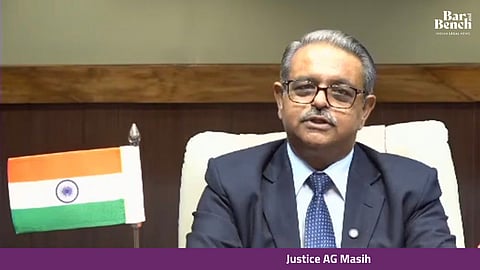
The Supreme Court judge cautioned that such content can distort court proceedings and weaken public faith in the justice system. While warning against such risks, he emphasised that safeguarding the dignity of courts is a collective responsibility.

"Justice cannot be weighed in retweets, and constitutional morality cannot be settled by algorithmic trends. Let me say this plainly. This discipline is not the judge’s burden alone. The onus lies upon all stakeholders, the advocates, the law students, the teachers, and upon every person who serves the law in any capacity," said Justice Masih.

Justice cannot be weighed in retweets, and constitutional morality cannot be settled by algorithmic trends
Justice AG Masih

Justice Masih was speaking at the fifth Justice HR Khanna Memorial National Symposium organised by the Confederation of Alumni for National Law Universities (CAN Foundation).

In his address, he stressed that while technology has transformed access to justice, it also came with some risks particularly when courtroom hearings are clipped out of context and circulated on social media.

The internet often delivers its verdict in legal disputes and criminal trials long before a court of law does, he noted.

"A case is argued over months but judged online in minutes. Evidence is tested by cross-examination, while opinion is manufactured by circulation. Very often, the public has reached its verdict before the first witness is sworn. Not from the record, but from a caption ... The court may acquit and the accused will still walk out into a world that convicted him months ago. Court’s judgment becomes, in effect, an appeal against a verdict that was never lawfully entered," he observed.

He further pointed out that social media algorithms often reward outrage rather than careful reasoning.

"It rewards speed over deliberation, emotion over reason, certainty over doubt. The louder, the angrier, the more absolute it is, the further it travels. But the judicial mind, to the contrary, is not built for the very qualities that travel as algorithms ... Lift a 19-second clip out of six-hour hearing, strip away the context, add a caption written by someone with no stake in the accuracy, and a passing question hardened into a settled verdict in the public mind. That's how the virtual world disseminates cooked information and distorted facts without realizing its ill effects on the litigant and his cause," noted Justice Masih.

Very often, the public has reached its verdict before the first witness is sworn. Not from the record, but from a caption,
Justice AG Masih

Another concern flagged was about the pressure of the public gaze felt by courts in this digital age.

"An atmosphere simply forms, a climate of expectation so dense cultivates that it presses upon the walls of the courtroom from every direction at once. This is the digital panopticon. But a million watchers with a million phone screens, and the judge feels their grace and gaze even in an empty room," he explained.

Justice Masih went on to observe that while judges cannot control how courtroom proceedings are edited and shared online, they can remain disciplined in how they conduct themselves from the Bench.

"One thing that a judge can do is to regulate the words that leave the bench. Every sentence spoken from that chair either upholds the constitutional ethos or betrays it," he said.

He clarified that he is not asking judges not to express themselves or clear their doubts, but to avoid the temptation to play to the gallery.

"What I'm asking for is transparency without tokenism and visibility without vanity. For the temptation, quiet and constant, is to play to the gallery, to trade the slow, grey labor of the reasoned judgment for a quick applause of a quotable line. That is the precise moment a judge ceases to be an oracle of the law and becomes merely one more voice in the noise," he explained.

Courts have long understood that such restraint is no weakness, Justice Bhuyan added.

A million watchers with phone screens; the judge feels their gaze even in an empty room... The temptation is to play to the gallery... (But if one gives in) a judge ceases to be an oracle of the law and becomes merely one more voice in the noise.
Justice AG Masih

[Read Live Coverage]

Bar and Bench - Indian Legal news
www.barandbench.com