
Subscribe
Subscribe
- Latest Legal News
- News
- Law Firms
- Columns
- Interviews
- Law School
- Legal Jobs
- हिंदी
- ಕನ್ನಡ
Every funding round changes a startup's valuation. Less visibly, it also changes the balance of power between founders and investors. Much of that evolution is reflected in the shareholders' agreement (SHA), the document that governs the relationship between founders, investors and the company. While often viewed as a legal formality, an SHA is in reality the operating constitution of a venture backed business. It determines who controls strategic decisions, how disputes are resolved, how investors exit and, ultimately, how value is shared among stakeholders. As startups progress from seed stage ventures to institutional growth companies, the nature of these agreements changes significantly. The transformation mirrors the changing realities of the business itself.
In the early stages, investors are backing little more than a founder's vision, a small team and an unproven business model. The risks are high, information is limited and governance systems are immature. Unsurprisingly, early-stage investors negotiate extensive protections. Reserved matters are broad, promoter vesting provisions are stringent, indemnities are founder-backed and investor consent is required for many critical decisions. The objective is straightforward: protect capital against execution risk.
The equation begins to change once a company reaches Series B and beyond. By this stage, the business typically has meaningful revenue, established governance processes, professional management and multiple institutional investors. The company is no longer defined solely by its founders. Accordingly, governance mechanisms evolve from investor control to institutional oversight.
One of the clearest examples of this shift is the treatment of investor consent rights. Early-stage investors often enjoy individual veto rights over a wide range of corporate actions. As the shareholder base expands, however, granting every investor a personal veto becomes impractical. Growth stage companies increasingly adopt "investor majority" mechanisms, where decisions are approved collectively by a defined percentage of investors. This creates a more representative governance framework while ensuring operational agility. Monetary thresholds, ordinary course business exceptions and deemed consent mechanisms further reduce transactional friction.
Founder obligations also begin to rebalance. Vesting arrangements, which are commonly imposed during the early years to ensure founder commitment, often lose commercial justification once a promoter has successfully guided a company through several financing rounds. Similarly, broad "cause" provisions that expose founders to severe economic penalties are increasingly replaced with more nuanced standards distinguishing genuine misconduct, such as fraud or wilful wrongdoing, from remediable contractual breaches. The underlying principle is proportionality: governance should encourage accountability without discouraging entrepreneurial leadership.
At the same time, investors are becoming more receptive to mechanisms that preserve founder incentives. Management stock option plans, enhanced pre-emptive rights and founder-friendly transfer arrangements have become more common as institutional investors increasingly recognise that long term value creation depends on keeping founders meaningfully invested in the business they built.
The economics of investment agreements also mature. Early-stage financing documents often contain simplistic exit provisions and highly negotiated liquidation preferences. As capital structures become more complex, investors typically seek standardised frameworks that can operate efficiently across multiple funding rounds. This has contributed to a growing preference for pari passu liquidation waterfalls and more sophisticated "valid exit" provisions that define the circumstances in which investors may realise their returns through a sale, secondary transaction or public offering.
IPO readiness becomes another defining feature of growth stage agreements. By the time a company enters its Series B or Series C phase, fundraising discussions increasingly contemplate a public listing as a credible exit path. Shareholders' agreements therefore begin to incorporate provisions relating to due diligence exercises, appointment of advisors, cooperation obligations and the treatment of investor rights following a public offering. The SHA effectively becomes a bridge between private capital and public markets.
Liquidity considerations also gain prominence. Restrictions that may have been appropriate for a closely held startup can impede legitimate shareholder transactions in a mature company. As a result, growth-stage negotiations often replace restrictive rights of first refusal with more flexible rights of first offer and eliminate aggressive "mop-up" rights that enable larger investors to consolidate ownership over time. The objective is to facilitate genuine price discovery while preserving appropriate safeguards for existing stakeholders.
Perhaps the clearest sign of institutionalisation is the treatment of risk and liability. Early-stage agreements commonly rely on founder-backed indemnities and broad events of default provisions. As companies mature, risk allocation shifts away from individuals and towards the corporate entity itself. The company assumes greater responsibility for its obligations, compliance functions become professionalised and default provisions are tailored to distinguish between company level failures and promoter misconduct. This reflects a fundamental change in mindset: investors are no longer funding individuals; they are investing in institutions.
The evolution of a shareholders' agreement is therefore much more than a legal exercise. It reflects a startup's journey from founder-driven venture to professionally governed enterprise. The most successful growth stage negotiations are not those that eliminate investor protections or founder accountability, but those that recalibrate them to match the scale, sophistication and ambitions of the business. As India's startup ecosystem matures and companies stay private for longer, understanding this evolution will become increasingly important. The best shareholders' agreements are not static documents. They grow with the company, balancing investor protection, founder motivation and institutional readiness at every stage of the journey.
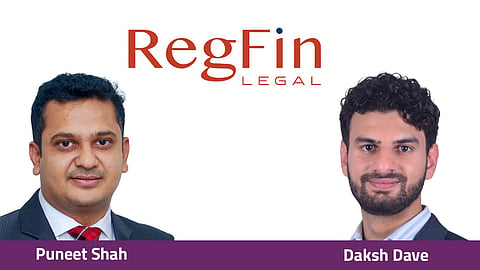
About the authors: Puneet Shah is a Senior Partner and Daksh Dave is a Senior Associate at IC RegFin Legal.
Disclaimer: The opinions expressed in this article are those of the author(s). The opinions presented do not necessarily reflect the views of Bar & Bench.
If you would like your Deals, Columns, Press Releases to be published on Bar & Bench, please fill in the form available here.